
BEZZERA ESPRESSO MACHINES: 5 TOP PICKS AND REVIEWS
I am always quick to recommend Bezzera espresso machines for their high quality and great value.

Bezzera machines should definitely be on your radar if you’re shopping for a prosumer espresso machine. Founder Luigi Bezzera was awarded one of the first espresso machine patents, and the brand has only continued to innovate in the decades since.
I have been consistently impressed with the combination of features, build quality, and price when testing Bezzera machines. In my opinion, all their models offer incredible value, so in this review round-up, I’ll simply help you track down the right machine to meet your needs.
The 5 Best Bezzera Espresso Machines in 2026
There’s a perfect Bezzera machine for you, whether you’re first dipping your toes into serious home espresso or are ready to invest in an end-game machine. These are my five favorites, chosen after extensive testing and research.
| Image | Product | Details | |
|---|---|---|---|

|
Bezzera Duo DE |
|
|

|
Bezzera Matrix MN |
|
|

|
Bezzera Strega |
|
|

|
Bezzera BZ10 |
|
|

|
Bezzera New Hobby |
|


1. Bezzera Duo DE
Boiler: Double Boiler
- Pump: Rotary
- Water capacity: 4 liters
- Dimensions (HxWxD): 16.5” x 12.2” x 18.5”
The Bezzera machine I would buy if I wanted the best of everything and money was no object is the Duo DE. It’s an advanced machine with a combination of features and functionality that make it hard to find fault. While definitely not cheap, it’s remarkably well-priced given what it offers.

It’s a dual boiler machine – hence the name Duo – so you can pull a shot and steam milk simultaneously. Both boilers are copper and equipped with independent PID temperature control.
The major selling point of the Duo DE, for me, is the Bezzera-designed electronically heated group head, with two heating elements controlled by a third PID. In testing, it delivered substantially better temperature stability versus a classic E61.
Every shot I measured was bang on the set temperature throughout the extraction time.
The DE is the automatic version of the Duo. Using the color touchscreen display, you can program up to four different shot volumes. A flowmeter in the group head ensures the precise volume each time. Or you can operate it like a semi-automatic using the manual button.
The Bezzera Matrix DE or MN models are nearly identical to the Duo DE or MN on the inside but have an eye-catching exterior that I can’t help but award for its unique style.
Both Matrix models feature LED-lit glass panels on the side that you can program to any color you desire using the stunning 3.5” touchscreen display. You can adjust the look of your espresso maker to suit your decor or even your mood! This is paired with rich rosewood detailing and a mirror-finish stainless steel case for an overall gorgeous design.
Of course, style alone isn’t enough to win me over; the espresso is no less impressive.
The Matrix MN is a dual boiler machine with PID temperature control and a classic E61 group head. The MN model relies on a traditional semi-automatic operation, with a lever on the side of the group head to start and stop the shot, but you can upgrade to the automatic DE if you have the budget.
3. Bezzera Strega
Boiler: Heat Exchanger
- Pump: Vibration
- Water capacity: 4 liters
- Dimensions (HxWxD): 29” x 13” x 17.7”
The Bezzera Strega is an espresso maker unlike any other. I love how it pairs modern and traditional elements to deliver something more than the sum of its parts.
The Strega is a manual lever machine that also has a vibration pump. So you have two ways to manipulate pressure while pulling the shot.
This extra level of control means you can really fine-tune extractions. I found it particularly useful when brewing lighter roasts or single origins.
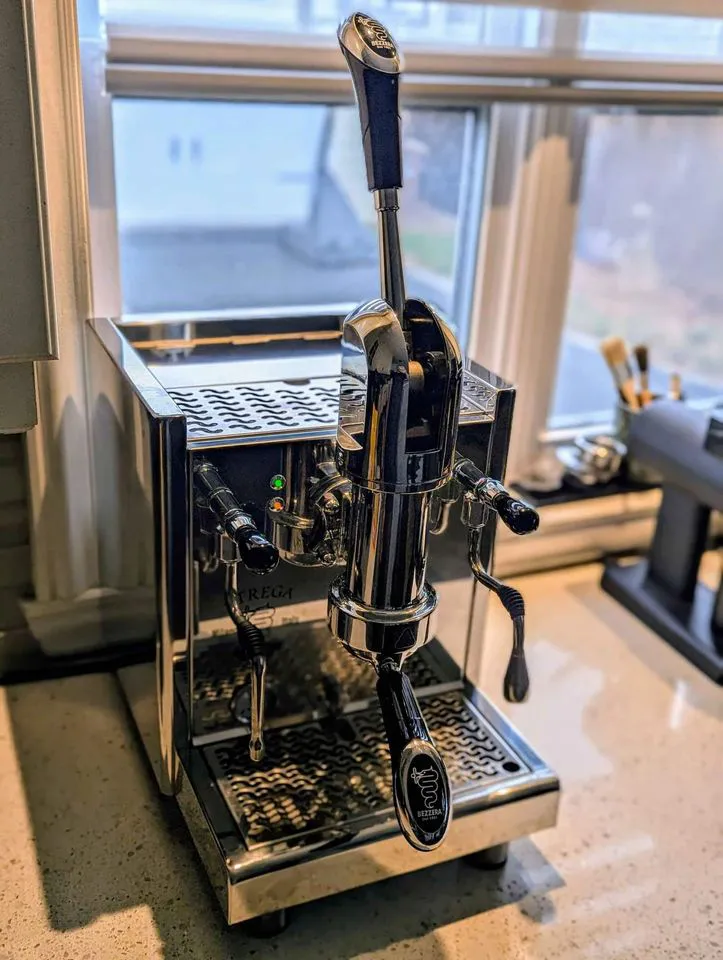
The Strega has a 2-liter heat exchange boiler, so you can pull a shot and steam milk at the same time — and access some really impressive steam power. It only takes about 10 seconds to froth enough for a cappuccino, and the joystick control is very responsive.
If you’re considering buying the Strega, do account for its size. It measures a whopping 29 inches high with the lever fully extended, so be sure you have space in your kitchen.
4. Bezzera BZ10
Boiler: Heat Exchanger
- Pump: Vibration
- Water capacity: 3 liters
- Dimensions (HxWxD): 15” x 10” x 17”
I regularly recommend the Bezzera BZ10 as one of the best-value heat exchanger machines on the market – not just from Bezzera. Though It’s not the fanciest model, few others deliver this level of performance and and quality at such a low price.
The standout feature is that it uses the same electronically heated brew group found on the higher-end models.
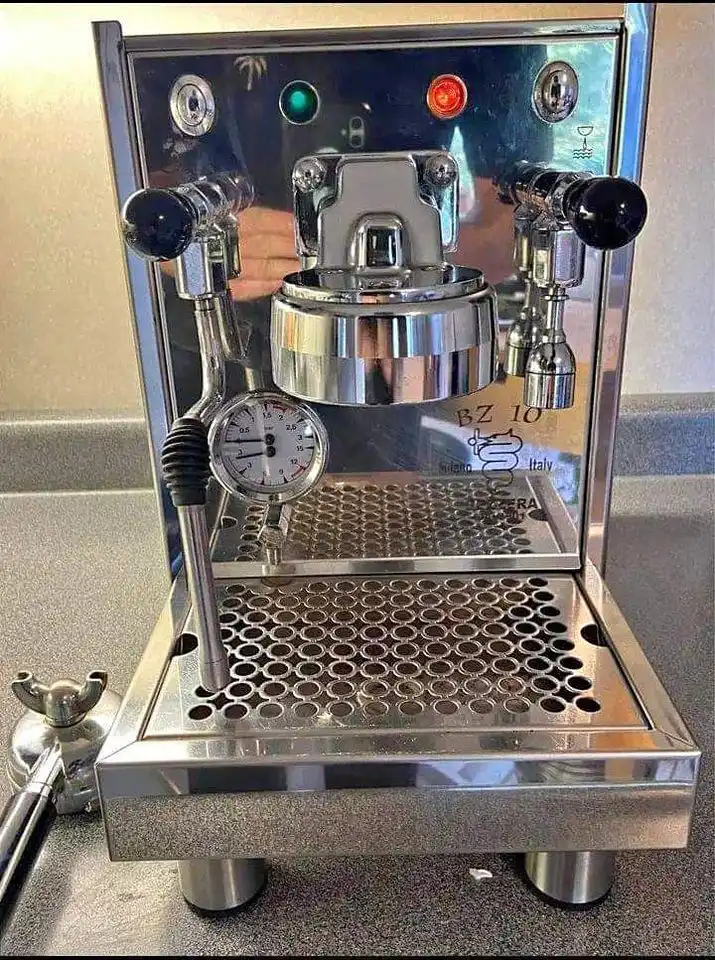
This gives the Bezzera BZ10 improved temperature stability compared to most heat exchangers and means it can be hot and ready to brew in as little as 10 minutes.
The nickel-plated copper boiler measures 1.5 liters. It provides ample steam pressure, which you can monitor via the pressure gauge. And the vibration pump is one of the quietest I’ve tested.
The Bezzera BZ10 espresso machine is also known for its durability, thanks to its 3-in-1 Mater pressure stat and heavy-duty stainless steel casing. At this price, you’re getting your money’s worth.
5. Bezzera New Hobby
Boiler: Single
- Pump: Vibration
- Water capacity: 3 liters
- Dimensions (HxWxD): 13.5” x 8” x 9.25”

The Bezzera New Hobby espresso machine is the smallest and least expensive model, but rest assured that it is still firmly a prosumer espresso machine. If you’re getting into espresso brewing, this is a fantastic entry point – and a good foundation on which to build your barista skills (1).
You can truly experiment, and it allows you to adjust and control so many parameters up close.
New Hobby is a single-boiler dual-use machine, meaning you can’t steam and brew simultaneously. But if you’re not a frequent latte drinker, this is only a minor inconvenience, and it comes with substantial cost savings.
Keeping it at prosumer quality are the stainless steel casing, chrome-plated brass group, a standard 58 mm portafilter, and a commercial-style steam wand. The 8.4-ounce brass boiler produces serious steam power, and conveniently, there’s a dedicated button for refilling the boiler after extended steaming.
All this is packed into a minimal footprint, making the New Hobby great for small kitchens or offices. And despite its small size, it still includes a larger-than-average 3-liter water tank, so you won’t need to refill constantly.
Choosing The Best Bezzera Coffee Machine
All the brand’s products are well-designed and built. So the best one for you comes down to your needs (2). Do you make a lot of milky drinks? Do you have a small kitchen? How hands-on do you want to be? Keep reading for everything you need to consider.
All About Boilers
When buying prosumer espresso makers, the type of boiler is probably the most critical decision. If you don’t make many milk-based drinks, a single boiler dual-use machine is your best bet: for example, the Bezzera Unica or New Hobby. You can’t brew and steam at the same time, but they are smaller and less expensive.
On the other hand, if you make many milky drinks, you’ll need a heat exchanger boiler or a double boiler. Double boilers generally have better temperature accuracy and control, especially with a PID, and they’re more intuitive to operate (3).
The barista should never have to wonder whether the water delivered to their coffee is too hot or cold.
However, espresso machines with heat-exchange boilers are usually smaller and less expensive and tend to have better steaming power for the price.
Why Pump Type Matters
There are two types of pumps used in these machines – rotary or vibration – and both easily generate the pressure needed for espresso. Vibration pumps are smaller, easier to repair, and less expensive. Rotary pumps are quieter and allow you to plumb your machine directly to a water line.
Style of Operation
Bezzera offers three styles of espresso maker: automatic, semi-automatic, and manual. Like the pumps, all are equally capable but have unique pros and cons.
- Manual machines use a lever to apply pressure when pulling the shot. This takes practice to master, but the resultant drink quality is unmatched.
- Semi-automatic machines use a pump for pressure, but the barista needs to time the shot and start and stop the pump.
- Automatic machines use a pump to apply pressure AND use a flowmeter to stop the shot automatically at a particular volume. They are the most hands-off style.
Size and Features
The final thing to consider is the space available for your espresso maker. Prosumer machines tend to be big, especially the double boilers, and often, the more features you want, the more space you need.
If you’re a heavy user (or considering a commercial application), look for a model with a larger boiler, water tank, and drip tray – all of which facilitate consecutive drinks without delay. This is especially true of heat exchangers because you use additional water doing cooling flushes.
One of the first features abandoned on more compact machines is separate wands for steam and hot water. So, evaluate the importance of this if you’re shopping for a smaller model.
The Verdict
As one of the few companies to keep all their manufacturing in-house, you can trust every Bezzera coffee machine to be remarkably well-made. The key is to find the right combination of functionality and price to meet your needs. If you can afford it, my favorite this year is the top-of-the-line Duo DE, which is packed with exclusive features.
FAQs
Bezzera machines are made by hand in Milan, Italy. Unlike most brands, they don’t outsource any of their manufacturing. This is why they’re known for impeccable quality control.
Yes, boiler material matters. Brass is inexpensive but has poor thermal properties. Copper has excellent thermal properties but is prone to limescale. Stainless steel can’t match the temperature consistency of a copper boiler, but it doesn’t develop scale and is less expensive.
No, Bezzera doesn’t make a super-automatic model. They’ve chosen to focus on more traditional semi-automatic and automatic designs. If you’re in the market for a bean-to-cup machine, look at brands like Gaggia, Jura, or DeLonghi.
References
- Grant, T. (2020, October 2). Which Type of Home Coffee Machine is Right for You? Retrieved from https://perfectdailygrind.com/2020/10/which-type-of-home-coffee-machine-is-right-for-you/
- Meister. (2018, August 9). Coffee History: Luigi Bezzera, Inventor of the Espresso Machine. Retrieved from https://www.seriouseats.com/coffee-history-luigi-bezzera-inventor-of-the-espresso-machine
- Prinsloo, M. (2018, November 9). How Do Espresso Machines Work? Retrieved from https://perfectdailygrind.com/2018/11/how-do-espresso-machines-work/
