
BEZZERA MATRIX DE AND MN REVIEW: CHIC DUAL BOILER ESPRESSO MACHINES
The Bezzera Matrix MN and DE models tend to fly under the radar. Here’s why I think they deserve more attention.
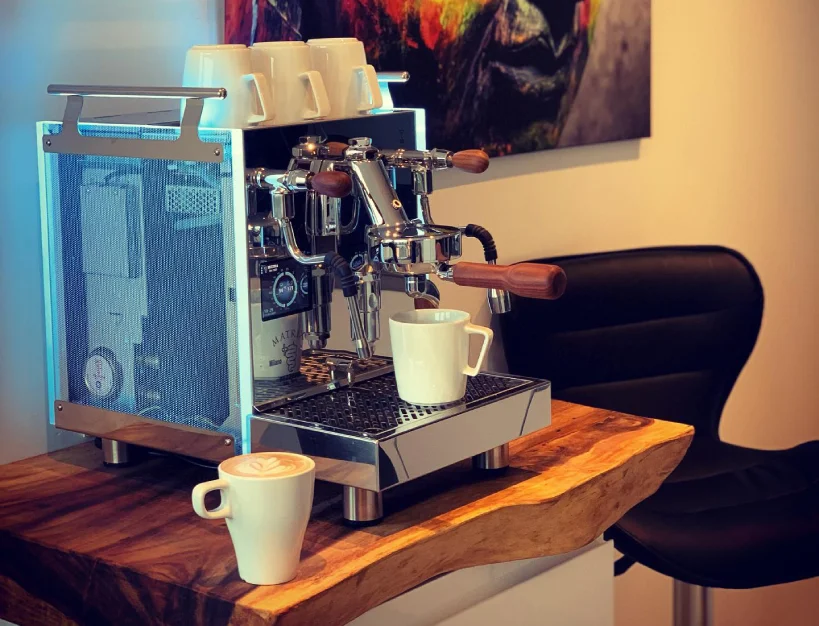
The Bezzera Matrix is a well-made, well-priced, and spectacularly feature-packed dual boiler espresso machine available in two versions – an automatic and a semi-automatic. I can’t understand why it’s not more popular, as I was consistently wowed while testing it.
In this review, I’ll discuss what makes the Matrix unique, including futuristic features like a touchscreen display and color-changing side panels. It’s about time espresso lovers took note of this impressive machine!
Things I liked:
- Independent PID temperature control for both boilers
- User-friendly touchscreen interface
- Futuristic light-up glass side panels
- Huge 4-liter water tank
Things I didn’t like:
- Milk frothing isn’t as powerful as competitors
- May be too large for some kitchens
A Full Review Of The Bezzera Matrix DE and MN Review
Bezzera makes two models of the Matrix. The base MN model is a semi-automatic machine, while the more advanced model is the auto volumetric Matrix DE. For this review, I tested the DE version (which is surprisingly only a few hundred dollars more expensive), but much of my experience applies to both.
| Retailer | Products | ||
|---|---|---|---|

|
Bezzera Matrix DE Dual Boiler |
|
|
|
|
Bezzera Matrix MN Dual Boiler |
|
In the following sections, I’ll cover both models in detail, including similarities and key differences, so you can decide which – if either – is right for you.
How I Rated It
-
Brewing Capacity
-
User Friendliness
-
Milk Frothing
-
Build Quality
-
Value For Money
Meet The Two Models Of Bezzera Matrix
I’ll start with the basic specs common to both Bezerra machines and what they mean.
The MN and DE are dual boilers with independent PID temperature control of each boiler and a rotary vane pump. Both have a 15-ounce copper coffee boiler, which can be set from 190 to 204 ℉, and a 35.5-ounce copper steam boiler, which can be cranked from 212 to 266 ℉.
Relying on a PID, rather than the more old-fashioned pressure stat, means better temperature control and consistency, and this was confirmed in my tests. The brew water temperature never fluctuated more than a degree Fahrenheit from the set point – an essential factor in making the perfect espresso (1).
The barista should never have to wonder whether the water delivered to their coffee is too hot or cold.
The rotary vane pump allows the Matrix to be plumbed in or run off the water reservoir, and plumbing directly gives you the option of line pressure pre-infusion, which is always my preference. In either machine, you can program the automatic pre-infusion for between 1 and 5 seconds.
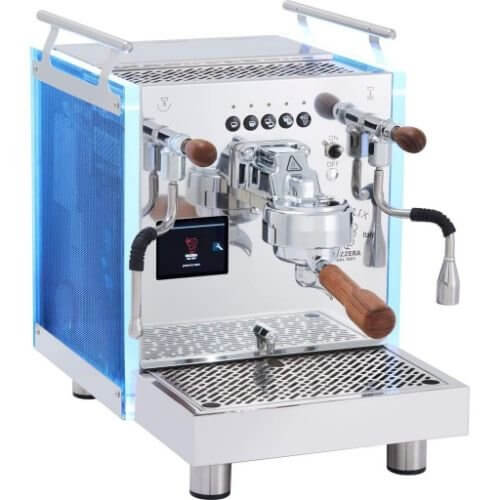
Speaking of programming, the Matrix models have one of the most advanced programming displays in their class. The stunning 3.5″ color touchscreen display looks like something you’d find on a super-automatic machine. I’ll talk more about the features it accesses below.
What’s The Difference Between The MN and DE?
The MN is the base model and uses the industry-standard E61 group head. Brew temperature is controlled by a thermosyphon that continually cycles hot water from the boiler. When pulling a shot, you start and stop brewing manually using a small lever on the side of the group.
The Bezzera Matrix DE dual boiler espresso machine has an electronically heated group head in place of the E61, though you’ll be happy to hear it’s still the standard 58 mm size. The DE has a triple PID setup, with a third heater controlling temperature at the group.
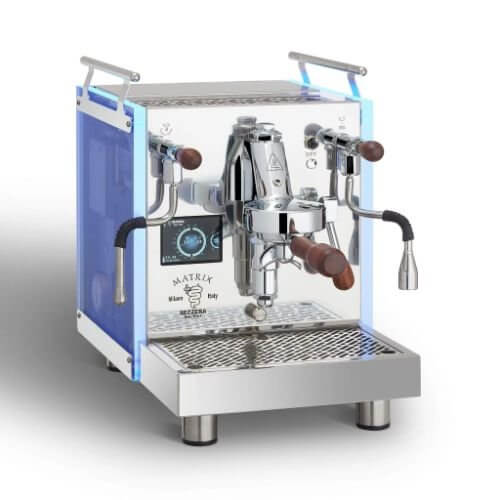
The electronic group is faster to heat up and has improved temperature stability.
Additionally, the Bezzera Matrix DE model uses programmable volumetric rather than manual brewing, making it an automatic rather than a semi-automatic espresso machine.
Four programmable buttons on the front of the machine, coupled with a flow meter inside, allow you to pre-set particular shot volumes. When it’s time to brew, you just push the button for a consistent output. Or there is a manual button if you prefer to be engaged fully in the process.
By the way, if you like the manual control and tactile feel of the E61 lever, you might love Bezzera’s innovative lever-operated machine, the Strega.
What It’s Like To Own And Use A Bezzera Matrix
The Matrix ranks high for user-friendliness thanks to the inclusion of the touchscreen display, a rarity among prosumer-grade espresso machines.
The display gives access to a ton of functionality that makes the operation of this machine a pleasure. It honestly might be faster to list what it can’t do, but I’ll try to give you a quick rundown.
You can set the boiler temperatures (and the group head temperature on the Bezzera Matrix DE), program pre-infusion, and turn the steam boiler on and off. You can set maintenance alerts or switch from running off the reservoir to plumbed in. You can adjust the colors of the side panels.
You can program the DE model to turn on at a particular time and even tell it which boiler has priority during heat up.
The display isn’t just to program the machine; it gives useful feedback as well. It acts as a shot timer during brewing and alerts you when the level in your water tank is getting low or other maintenance is required. It even has a neat mode where the display goes unresponsive for 10 seconds so you can clean it.
How Long Does It Take To Heat A Bezzera Matrix?
I found I could heat the Matrix DE in as little as 15 minutes, compared to 20 to 30 minutes for standard double boiler E61 machines (including the Matrix MN). With the DE, heat-up time is even less of a concern because you can program the auto-on to have it ready when you are.
Cleaning and Maintenance
Daily maintenance on this machine for a home user is almost nil, beyond the basics like cleaning the portafilter and purging the group and steam wand. Whether you opt to plumb in or not, the Matrix has a massive 4-liter water tank (the largest I’ve encountered), so it’s unlikely to need daily refills.
I recommend backflushing with water every week or two for a moderate user. The Bezzera Matrix DE offers an automatic backflushing program, whereas the MN does not. However, the display of the MN walks you through manual backflushing step by step, so it’s pretty foolproof.
More advanced maintenance, like repairs or descaling, should be done by an experienced technician. Note that it may be easier to find parts and expertise for the standard group of the MN than the unique Bezzera-designed electronic group of the DE.
Small Steam Boiler, Big Performance
The milk frothing on the Matrix isn’t necessarily a stand-out feature, but it’s more than adequate for a home user looking to churn out lattes and cappuccinos for friends and family. I never ran out of steam making back-to-back drinks, and it was impressively high-quality dry steam. Latte art enthusiasts will have no complaints.
What is the steam pressure on a Bezzera Matrix?
The 1-liter boiler isn’t the biggest in the business, but you can increase the steam pressure by upping the boiler temperature with the PID controls. Personally, I like the steam pressure around 1.2 bars to fit my workflow. But if you’re looking for more oomph, I got it as high as 1.7 bars in testing by maxing out the boiler temperature at 266 ℉.
There are separate wands for steam and hot water, both controlled with intuitive and easy-to-use joysticks. I prefer joysticks to knobs. They’re better for turning the steam on and off quickly and for generating quick bursts of steam, and Bezzera’s joysticks can be locked in the up position for hands-free steaming.
Iconic Bezzera Build Quality: Keeping It In-House
The quality of these machines is excellent, which is a hallmark of the best Bezzera espresso machines in general. From the outset, Bezzera has made all components in-house, starting from the raw materials, rather than outsourcing any engineering aspect. This gives the brand unmatched quality control.
The Matrix is big, like most dual boiler machines. It measures 12.2″ wide by 18.5″ deep by 16.5″ tall and weighs 85 pounds. Make sure you’ve established where it will live in your home before you buy, and be sure you’re a fan of the aesthetics because it’s guaranteed to become a focal point.
Where Is Bezzera Made?
Based in Milan, Italy, Bezzera is one of the oldest espresso machine manufacturers (2). Luigi Bezzera received one of the first patents for an espresso maker over 100 years ago, and the company is still family-run four generations later. The result of this extensive experience is reliably high-quality machines.
A Unique Modern Aesthetic
The light-up glass side panels will definitely be the first thing you notice about the Matrix. They’re a creative idea from Bezzera’s team, and they’ve garnered this model plenty of fans.
I love that the transparent glass lets you see the machine’s internals, but the built-in LED lights are arguably even more remarkable. Using the touchscreen, you can choose the light color from red, green, or blue — or any combination thereof. Feeling purple this morning? No problem!
I’m a big fan of the choice of rosewood for the joystick knobs, lever handle (on the MN), and portafilter handles – at no extra cost. The warm wood provides a nice counterpoint to the modern design features.
Don’t despair if you’re not into the modern look. The Bezzera Duo DE and Duo MN are nearly identical double boiler machines with a more classic stainless steel design.
What About The Price?
I’ve said it before, and I’ll probably say it again next time Bezzera comes out with a new model. The brand offers exceptional pricing. Every Bezzera machine I’ve reviewed is priced lower than I expect.
Usually, a low price for a machine as feature-packed as the Matrix indicates lower quality; after all, something had to be sacrificed. But that is absolutely not the case with Bezzera machines. If anything, they’re some of the highest-quality models on the market.
The Matrix DE costs around $3000, and you’ll save roughly $150 by opting for the MN. Obviously, that’s not cheap, but it’s on par with other dual boilers like the Profitec Pro 700 or ECM Synchronika – neither of which offer automatic volumetric controls or a touchscreen interface.
Don’t Buy The Matrix If…
- You’re looking for a more compact machine: Dual boilers are notoriously large, though there are some compact options like the Rancilio Silvia Pro, Profitec Pro 300, or Lelit Elizabeth. Alternatively, check out my Bezzera BZ10 review for a heat exchanger machine with a small footprint.
- You don’t make many milky drinks: If you rarely crave a latte or cappuccino, save your money by buying a single boiler espresso maker instead. The Bezzera Unica is an excellent choice if you want PID temperature control. Or, take a look at the entry-level New Hobby. It comes in at about a quarter the price of the Matrix. Here’s our Bezzera New Hobby review.
- You want more steam power: If you’re looking for that commercial-quality “blast milk onto the ceiling” level of steam power, check out the ECM Synchronika. It can hit upwards of 2 bars thanks to a larger 2-liter steam boiler and PID that goes up to 272 ℉. Or ignore budget concerns altogether and consider the La Marzocco Linea Mini, which has a 3-liter boiler for steam.
The Verdict
Bezzera’s Matrix is a fantastic dual boiler espresso machine for home baristas looking to blend Italian espresso tradition with advanced technology, with an easy-to-operate touchscreen display and optional volumetric dosing. The stunning colorful glass sides will catch the eyes of your guests, but it’s the quality of the drinks you serve that will leave them truly impressed.
References
- Prinsloo, M. (2018, November 9). How Do Espresso Machines Work? Retrieved from https://perfectdailygrind.com/2018/11/how-do-espresso-machines-work/
- Stamp, J. (2012, June 19). The Long History of the Espresso Machine. Retrieved from https://www.smithsonianmag.com/arts-culture/the-long-history-of-the-espresso-machine-126012814/
