
Flair 58 Review: The New Standard In Lever Espresso Machines?
The Flair 58 might be the brand’s fanciest machine yet, but is it right for your home espresso journey?
The Flair 58 was first released in 2021, and at the time, it represented the pinnacle of the Flair brand. It was the result of addressing every common user complaint about the original Flair Espresso Maker.
Fast forward four years, and the Flair line-up has changed considerably, so it feels like high time for a fresh review of the Flair 58, including the new Flair 58 Plus 2 – the latest, greatest, and most expensive addition.
In this review, I’ll discuss the three models of Flair 58 currently available, with a focus on my experience with the Flair Plus 2 and whether it’s worth the upgrade.
Things I liked:
- No need to pre-heat the brew group
- 58 mm commercial-style filter basket
- Better control with the new lever
- Beautiful design with wooden accents
Things I didn’t like:
- Plus model offers poorer value
- Comes standard with low-flow basket
The Full Review of the Flair 58
Flair Espresso was launched in 2016 through a crowdfunding campaign (1). Inventor Sergio Landau had the simple idea of making the best possible espresso with the least extraneous parts – no boilers, no pumps, no electronics – and he pulled it off. The original Flair espresso maker quickly gained popularity for the quality of espresso it could produce at a very reasonable price.
The Flair 58 line continues in that vein. While slightly more complex and expensive than the base model, it still delivers exceptional espresso for the price, while adding a more enjoyable experience for coffee lovers.
How I Rated It
-
Design
-
Brewing Capacity
-
Build Quality
-
Cleaning and Maintenance
-
Value for Money
The Different Models Of Flair 58
Let’s start with a quick overview of the Flair 58 line, so we’re all on the same page. Right now, there are three options:
- Flair 58 – The standard Flair 58 espresso machine looks similar to the 2021 model but was upgraded in 2023. The biggest change is that the electronics are removable if you want to take your espresso maker off-grid. It also reroutes the wiring for a cleaner aesthetic and adds an improved valve plunger.
- Flair 58x – The Flair 58x is the same minus the heater, and it costs about $85 less. The latest iteration includes the same internal wiring, so it can be upgraded with a heating element later. I won’t be reviewing this model here.
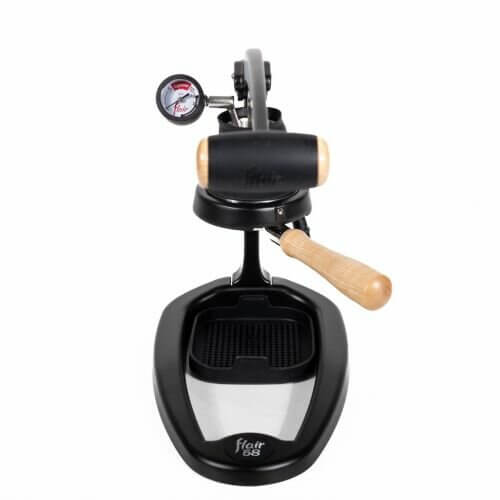
- Flair 58 Plus 2 – The new flagship Flair 58 Plus 2 runs about $100 more. The major update is that the heating system controller has been integrated into the base for a more seamless experience. The power supply and wiring have also been streamlined, and it adds a shot mirror.
With those basics out of the way, let’s get to the fun part!
Beautiful Design And Aesthetics
The Flair 58 is beautiful, with sleek curved lines, a matte-black frame, and wood accents. The Plus swaps blonde wood for a slightly darker walnut, but both are equally stunning in my opinion.
The Flair 58 has a longer lever with a rubberized T-shaped handle, making it easier to exert the required pressure to pull a shot.
When I reviewed the Flair 58 originally here at Homegrounds, I complained about the unsightly electronics. Evidently, I wasn’t alone because they have been cleaned up considerably – especially on the Plus 2 model.
Size And Shape
The Flair 58 is relatively compact, measuring 13.5” deep by 7.5” wide by 11.5” tall – smaller than the average semi-automatic machine. However, it gets significantly taller (up to 24.25”) with the fully upright lever. So make sure you have an appropriate place to use it.
Puck Screen
All models include a puck screen, a trendy gadget now included with many of the best espresso machines. This mesh circle sits atop the espresso puck in the portafilter to distribute water over the ground coffee, preventing channeling and promoting a more even extraction.
Features That Improve Your Flair 58 Experience
- Electric Preheat System: Integrated temperature preheat controller with three settings for different roast levels.
- Lever: Elongated lever with T-grip for easier extractions at higher pressures.
- Pressure Gauge: Integrated pressure gauge for real-time brewing feedback.
- Plunger: Enhanced valve plunger with a single slot for improved workflow.
- Portafilter Handle: Wooden for ergonomics
The brewing capacity is the most impressive part of the Flair 58, as it was with the Classic and Flair Pro 2, and subsequent Flair models. It is one of the least expensive ways to achieve genuinely top-notch espresso, though there is a learning curve involved with any manual espresso brewing method.
Electric Preheating System
The Flair 58 and Plus use the same electronic heating system – the differences are essentially aesthetic – which eliminates the need to preheat the brew head. This is a huge upgrade from a workflow standpoint and improves temperature stability during extraction (2).
It has three brewing temperatures (80, 85, and 90 degrees Celsius), which are supposed to correspond to different coffee bean roast levels.
However, I typically just preheat to the highest level, even with specialty coffee, and most Flair users I’ve spoken to do the same. Flair may want to consider removing the options and lowering costs.
It takes less than 5 minutes to preheat, much faster than a traditional espresso maker with a boiler. However, the heating element isn’t designed to act as a boiler. You still need to use a kettle to heat your brew water.
Improved Workflow
Using the Flair 58 feels similar to any semi-automatic espresso machine – a big change from the somewhat finicky Flair Classic. The only exception is that you heat water in a kettle, which is honestly faster than having a boiler. You preheat the machine. You grind, dose, and tamp your puck. You pull a shot. You knock the dry puck into a knock box, rinse the portafilter, and repeat.
The 58 mm Portafilter
Along with the heating element, the 58 mm portafilter is what distinguishes the Flair 58 – and gives it its name. This is a change Flair espresso fans have been clamoring for from the beginning, as most commercial and prosumer machines have 58 mm diameter portafilters.
It is now far easier to find accessories, like VST filter baskets, tampers, levelers, and so on. It also accommodates a larger coffee dose, up to 20 grams, and I think it delivers shots with greater clarity.
Pressure Profiling
Pressure profiling, in which you adjust the pressure on the puck during espresso extraction, is all the rage among coffee enthusiasts (3). By playing with the pressure during the shot, you have a new variable to optimize extraction for the perfect espresso (4). This is one reason we’re seeing manual lever espresso machines growing in popularity these days. They offer an affordable way to access this trend (5).
The Flair 58 makes pressure profiling easier than its predecessors. It includes a pressure gauge to monitor the pressure in real time, and the longer lever and better grip make it easier to exert fine control over the extraction pressure.
Cleaning and Maintenance Requirements
Cleaning and maintaining the Flair 58 is a breeze compared with a typical semi-automatic machine. Its simple design means there is little to go wrong and equally little to clean up. There is no pump to break down or boiler to descale.
I love that most parts of the Flair are sold separately, so if you break or lose something, it’s easy to replace a piece without buying a whole new machine – for example, a puck screen or heating system.
Cleaning after use is effortless. There will be a bit of water left in the brew chamber after extraction, so have an extra cup on hand to catch that. Then it’s just a matter of knocking out the dry coffee puck and rinsing the brew group and portafilter.
Simplicity, Built To Last
The build quality of the Flair 58 manual espresso machine is exceptional, and it is backed by a 5-year warranty.
The robust frame and lever are made from die-cast aluminum, and the main brewing components are stainless steel. Rubber is used for the handle grip and insulation around the exterior of the brew head and the drip tray. Your hot brew water never comes in contact with plastic.
I was impressed to find it’s very stable, even when pushing hard on the lever.
The accessories are equally high quality, including a stainless steel tamper and a naked portafilter with a wooden handle (6).
The Flair 58 comes standard with a “low-flow” basket, which I think is a little disappointing. It has chamfered edges and fewer exit holes, making it easier to dial in and allowing for a coarser grind – essentially a pressurized portafilter. This makes sense with something like the basic Flair Neo, but the 58 was designed for an audience of skilled baristas.
If you have a capable grinder, I definitely recommend the upgrade to the high-flow option. The Plus 2 comes with both portafilter baskets.
Is The Price Still Right?
Even though the Flair 58 is the brand’s most expensive series, the value is still excellent among top manual espresso makers. A semi-automatic espresso machine capable of the same cafe-quality shot of espresso (plus flow profiling) easily runs five times the cost.
That said, I’m less sold on the extra cost of the Flair 58 Plus. To me, the updates feel largely aesthetic rather than functional.
In my opinion, the two models pull the same espresso shots and offer roughly the same user experience. The Plus just feels a little more refined. It’s up to you if that warrants another $100 – or another $180 if you want the hard travel case.
If you already have the 2023 Flair 58, I probably wouldn’t recommend the upgrade. On the other hand, it is a larger step up from the 2021 original.
Flair 58 Specifications in A Nutshell
| Details | |
| Type | Fully-manual, professional-grade lever press |
| Assembled Dimensions | 13.5″ L x 7.5″ W x 11″ H |
| Weight | 12 lbs (5.44 kg) |
| Frame | Die-cast aluminum |
| Brew Path | Plastic-free with stainless steel components |
| Dose | 16-20 grams |
| Input Water Capacity | 90 ml |
| Yield | Up to 55 ml |
| Portafilter | 58mm, industry-standard |
| Pressure | Up to 12 bars |
| Preheat System | Integrated preheat controller with three settings |
| Lever | Elongated lever with T-grip |
Pressure Gauge | Integrated for real-time feedback |
| Plunger | Enhanced valve plunger with a single slot |
| Portafilter Handle | Ergonomic wooden handle |
Don’t Buy the Flair 58 If…
- You want to make milk-based drinks: You can pair the Flair 58 with a milk frother, but I’d suggest just buying a lever espresso maker with a steam wand. For example, check out the famous La Pavoni Europiccola or its higher-capacity sibling, the La Pavoni Professional espresso machine.
- You want something that doesn’t need electricity: I like that the new Flair 58 allows you to remove the heating element for portability. But if you’re perfectly happy preheating with a kettle, you can save money with something like the Flair Pro 3, Flair 58x, or Cafelat Robot.
- You don’t want a lever machine: If the hands-on nature of lever espresso doesn’t appeal, there are plenty of regular espresso machines to consider instead. Around the same price is the Breville Bambino Plus, or pay a bit more for the prosumer grade Rancilio Silvia. However, if you want flow profiling AND semi-automatic operation, expect to pay more for something like the Lelit Bianca.
The Verdict
The Flair 58 sets out to be the perfect manual espresso maker, addressing all complaints about previous Flair products and adding a gorgeous design. In my mind, it achieves this goal. The espresso quality is exceptional, and the workflow for the home barista is substantially improved.
Whether the Plus 2 is a worthwhile update is more debatable. But in either case, you’re guaranteed fantastic espresso, incredible build quality, and a sculpted art piece for your coffee bar.

References
- Bryman, H. (2016, November 22). The Flair Machine Spreads Pizazz to the Portable Espresso Market. Retrieved from https://dailycoffeenews.com/2016/11/22/the-flair-machine-spreads-pizazz-to-the-portable-espresso-market/
- Coffee Research. (n.d.). Temperature Stabilizing for Espresso. Retrieved from http://www.coffeeresearch.org/espresso/tempstabilize.htm
- Prestidge, J. (2015, August 18). Pressure Profiling: The Key to Perfect Extraction. Retrieved from https://perfectdailygrind.com/2015/08/pressure-profiling-the-key-to-perfect-extraction/
- Seven Miles. (2021, November 23). What is the ideal pressure for espresso? Retrieved from https://www.sevenmiles.com.au/blogs/editorial/espresso-pressure/
- Rosas, A.P. (2022, April 20). Exploring the evolution of manual espresso machines. Retrieved from https://perfectdailygrind.com/2022/04/the-evolution-of-manual-espresso/
- Five Senses Coffee. (2009, April 7). Getting Down and Dirty with a Naked Portafilter. Retrieved from https://fivesenses.com.au/blogs/news/getting-dirty-naked-portafilter/
