
BEZZERA MAGICA PID ESPRESSO MACHINE REVIEW: ALL ABOUT BALANCE
If you’re shopping for a heat exchanger espresso machine with a PID, the Bezzera Magica should be on your shortlist.

The Bezzera Magica espresso machine finds a happy medium in nearly every respect. It has the right features for the right price, and it beautifully balances modern technology with traditional engineering and design. It’s even the perfect size, riding the line between compact and over-large.
This espresso machine is built to please, but will it meet your needs? I’ll walk you through my experience with the Magica to help you decide.
Things I liked:
- E61 group and PID for temperature control
- Impressive Bezzera quality, engineering, and design
- Large boiler provides plenty of steam pressure
- Massive 4-liter water reservoir
Things I didn’t like:
- Takes some skill to operate
- Older model PID doesn’t include shot timer
- Mirror finish shows the dirt
The Full Bezzera Magica Review
Bezzera has a long history of espresso machine manufacturing (1). Founder Luigi Bezzera held the first patent for an espresso machine, making the brand a gold standard in the industry. Bezzera has been family-run from the beginning, with current general manager Luca Bezzera now the fourth generation. He credits hard work and enthusiasm for their ongoing success.
You need to put a lot of passion into your job and to dedicate a lot of yourself to your job.
Bezzera espresso machines stay relevant by innovating while maintaining traditional manufacturing techniques and design. The result is models like the Magica, which pair the best of the past and present.
How We Rated It
-
Brewing Capability
-
User Friendliness
-
Milk Frothing
-
Build Quality
-
Value For Money
What Is The Bezzera Magica?
The Bezzera Magica is a semi-automatic espresso machine with a vibratory pump and heat exchanger boiler. This design reserves a portion of the boiler for lower-temperature brew water so that you can brew and steam milk simultaneously.
At the heart of the Magica is a 2-liter copper boiler. Copper is a top choice in high-end espresso machines thanks to its high thermal conductivity, fast heating and cooling, and accurate brew temperatures.
This is particularly apparent in this machine’s fast heat-up time. I found it was ready to brew in as little as 15 – 20 minutes.
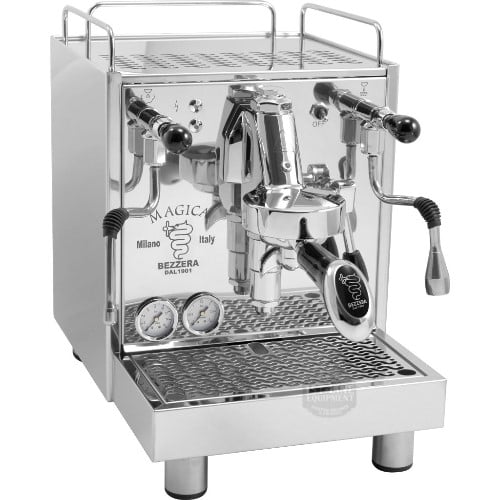
On the front of the machine, you’ll find the iconic E61 group head, with a standard 58 mm diameter. The E61 group head uses a thermosyphon system for cycling hot water from the boiler to the brew group and heavy chrome-plated brass portafilter. The thermal mass of these components ensures everything is hot and temperature-stable in preparation for extracting espresso (2).
PID Temperature Control: Worth It?
The Magica falls in the small market of heat exchanger machines with PIDs. PIDs are a relatively new addition to HX machines, following pioneering examples like the Rocket Giotto Evolutione.
A PID doesn’t have the same impact in a heat exchange as it does in a dual boiler because you can’t set the brew temperature directly. However, I definitely noticed an improvement in temperature stability versus HX machines with pressure stats. And setting the PID is a more intuitive process than performing cooling flushes if you’re new to prosumer espresso.
How To Use The Bezzera Magica
The Bezzera Magica espresso machine has a learning curve, like any semi-automatic espresso machine, but the PID certainly simplifies the process of temperature control. A simple display at the top right of the machine is accompanied by +/- buttons.
The interface is very straightforward, with a simple on/off toggle switch and two LED lights, one for power ON and one for heater ON.

Once the machine has preheated for at least 15 minutes, you’ll need to prepare the portafilter. This is where the art of espresso comes in – dialing in the grind size, dose, distribution, and tamp to optimize extraction. And you’ll need to do it again every time you change coffees. In my experience, it’s kind of like making pancakes. The first one is rarely the best.
Slot the portafilter into the group once your coffee puck is prepared, slide an espresso cup under the spouts, and lift the lever on the side of the group to start the shot. It should take around 25 seconds to complete the extraction. Lower the lever to stop the shot.
I was a little disappointed to find this machine doesn’t include a shot timer, something increasingly common in PID machines. The Bezzera BZ13, for example, has an updated PID with this functionality, but the Magica is still rocking an older model.
The dual pressure gauges make monitoring brew pressure and steam boiler pressure easy. Analyzing the pressure of a shot in progress is helpful for dialing in and reproducing a perfect espresso.
Cleaning And Maintenance
Most prosumer machines are created equal when it comes to cleaning and maintenance. You need to put some elbow grease into keeping it in tip-top shape, but it will last for decades with the appropriate care.
At the most basic level, keep the water reservoir topped up and empty the drip tray regularly. The Magica has one of the largest water tanks I’ve encountered, at a whopping 4 liters, so this likely won’t be a daily task. It’s easy to access under the built-in cup warmer. The cup rails act as handles, so you can remove the tray without disturbing any cups. My only quibble is that it would be nice to see a handle on the water tank itself.
Always use filtered water to avoid scale build-up, especially with copper boilers, which are more prone to corrosion than stainless steel.
The Magica comes with a stainless steel backflush disc, and you should use it. I’d recommend backflushing with water weekly and with a cleaning solution every few months – depending on use. You will also need to lubricate the gaskets on the E61 annually.
Steaming Milk With The Magica
Milk frothing is excellent on this machine. The 2-liter heat exchanging boiler provides plenty of steam power, especially if you crank the PID up to its max. I could steam 6 ounces of milk to a perfect silky microfoam for latte art in under 30 seconds.
The stainless steel steam and hot water wands are operated with spring-loaded joysticks. Personally, I’m a fan of joysticks rather than knobs. I prefer their quick responsiveness, which makes it easy to turn the steam quickly on and off or produce short bursts, though I know others enjoy the more delicate pressure control of a knob.
Bezzera Build Quality Always Impresses
The Magica’s build quality is as exceptional as you would expect from a century-old Italian espresso machine manufacturer. From the stainless steel exterior panels and drip tray to the copper boiler and E61 group head, this machine is made from quality materials that are built to last.
The engineering is top-notch, from the perfectly welded seems to the smart interior layout. It’s obvious this is the product of skilled craftsmen and decades of refinement.
The Magica is medium-sized, measuring 16.7” deep by 16.34” tall by 11.7” wide, which is impressively compact given the ample boiler and massive water tank. If you’re pressed for space, consider the smaller Bezzera BZ10, an HX machine with a 1.5-liter boiler and electronically heated brew group.

The Bezzera Magica has a classic design, in contrast with Bezzera’s modern-style models like the Matrix. The aesthetic is minimalist, with gleaming mirror-finish steel panels, polished black accents, and white pressure gauges. It comes with a single and double-spouted portafilter, both adorned with the iconic snake logo.
Is The Magica Good Value For Money?
Priced around $2000, the Magica is excellent value for an HX machine with an E61 group and a PID. It’s on par with the similar Profitec Pro 500 and substantially cheaper than other machines in this class like the Rocket Timer Type V and the ECM Technika V Profi. However, if you’re not sold on the benefit of a PID for a heat exchanger boiler, you can find less expensive models with similar specs minus the precise temperature control.
Bezzera Magica Vs Profitec Pro 500
I am frequently asked to compare these two machines, and for good reason. They have similar specs and a similar price, so what’s the difference? Honestly, not much.
Both have a 2-liter boiler, E61 group head, dual pressure gauges, and PID temperature control, and they’re roughly the same size. In my experience, both are equally capable of great espresso and cafe-quality specialty drinks.
The Profitec 500 has a stainless steel rather than copper boiler and a marginally more powerful heating element. It also has a newly updated PID (as of 2022) that offers shot timer functionality. It has a smaller 3-liter water tank and uses knobs rather than joysticks for the steam and hot water wands. Naturally, the aesthetics are slightly different between the two.
Don’t Buy the Bezzera Magica If…
- You don’t make milky drinks: If you rarely enjoy a latte, there’s no reason to spend the money on a heat exchanger machine. Instead, opt for a single boiler, dual-use option like the high-end Bezzera Unica or entry-level Bezzera New Hobby, and spend the cost savings on a quality grinder.
- You want a dual boiler: If you’re seriously into specialty coffee, you’re probably going to want the temperature control of a dual boiler with a PID. In that case, consider upgrading to the gorgeous and advanced Bezzera Matrix. If you’d prefer to stick to roughly the same price point, check out the Lelit Elizabeth V3 or even the unique Breville Dual Boiler, which trades build quality for advanced functionality.
- You don’t care about the PID: If you’re not convinced a PID is a worthwhile addition to an HX boiler, there are many fantastic options with pressure stats. Take a look at the ECM Mechanika V, Rocket Appartamento TCA, or the aforementioned Bezzera BZ10.
The Verdict
The Bezzera Magica E61 espresso machine is easy to love, delivering impressive functionality at a reasonable price. I was charmed by how seamlessly it balanced modern technology with Italian tradition, which has become something of a hallmark for the Bezzera brand. The result is a timeless espresso machine you’ll be proud to enjoy for years to come.

References
- Stamp, J. (2012, June 19). The Long History of the Espresso Machine. Retrieved from https://www.smithsonianmag.com/arts-culture/the-long-history-of-the-espresso-machine-126012814/
- Morris, J. (2020, December 23). The Faema E61 Espresso Machine. Retrieved from https://www.historians.org/research-and-publications/perspectives-on-history/january-2021/the-faema-e61-espresso-machine
