
ROK ESPRESSO MAKER REVIEW: INCREDIBLE ESPRESSO ON A BUDGET
Is a manual lever espresso machine right for you? Find out in my review of the remarkably affordable ROK EspressoGC!
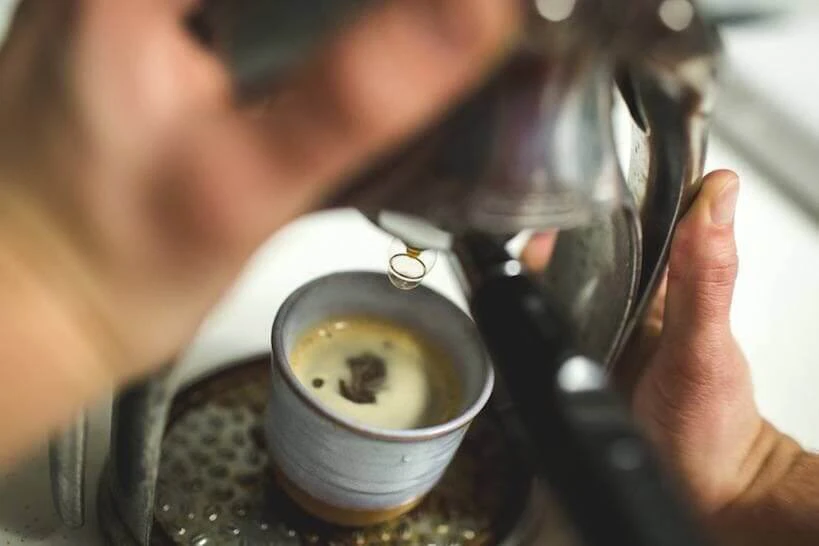
If you thought enjoying a proper espresso at home meant dropping thousands of dollars on a fancy espresso machine, think again. A manual lever espresso machine like the ROK Espresso GC is an affordable alternative with no limit to the quality of espresso it can produce.
I’ve been experimenting with the ROK espresso maker for the past few months to discover the pros and cons of this clever device. With a bit of a learning curve, it might not be the espresso brewer for everyone. But if you’re keen to learn how to pull a shot by hand – and to enjoy the incredible espresso that results – it will be right up your alley. Read on for my complete review.
What I Liked:
- Brews excellent espresso
- Incredibly durable build with 10-year warranty
- Doesn’t require electricity; portable
- Simple to use, clean, and maintain
What I Didn’t Like:
- No pressure gauge
- Takes practice to master
- Only fits a small coffee scale
The Full ROK Manual Espresso Machine Review
Several iterations of the ROK Espresso Machine have existed over the years, and I’ve noticed reviewers using their names interchangeably, so first, some clarity.
The original Presso Coffee Maker was launched in 2004, and thanks to its incredible longevity, you’ll still find some in operation! The company rebranded as ROK in 2013 and released the upgraded ROK EspressoGC in 2018. That remains the most recent edition and is the model I’ll be reviewing today.
How I Rated It
-
Brewing Capability
-
Espresso Flavor
-
Ease Of Use
-
Build Quality
-
Value For Money
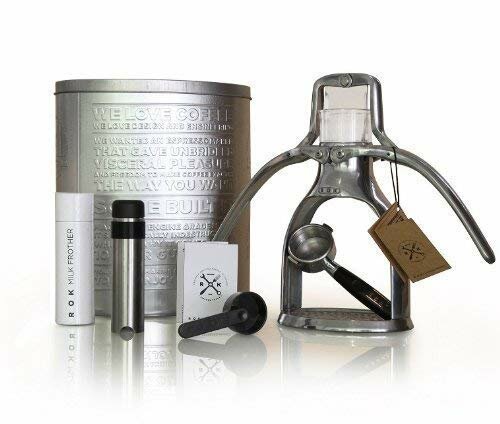
What Is ROK Espresso?
The award-winning ROK Espresso GC is a manual lever espresso machine. Think of it as a home espresso machine stripped down to the bare minimum of parts required to make tasty espresso. Unlike a standard automatic espresso machine, there is no water reservoir, heater, or pump. You don’t even need electricity.
The ROK consists of a metal frame, a portafilter for ground coffee, a chamber for hot water, and two lever arms. Hot water comes from a separate kettle, and extraction pressure is generated when you press down on the arms.
The ROK has been around for 20 years, but lever machines are having something of a moment right now, and for good reason (1).
Your bicep is a far more sophisticated controller than any motor (or spring) could ever be.
Modern espresso lovers are realizing that the intimate control afforded by the manual lever provides a fresh avenue for optimizing shots – controlling extraction pressure. And I can’t deny that there is something undeniably satisfying about pulling a shot of espresso by hand.
Pressure Gauge: Yay or Nay?
The only part that I would argue is missing from this stripped-down machine is a pressure gauge. While not absolutely mandatory, it makes it much easier to pull delicious shots – and to do so repeatedly.
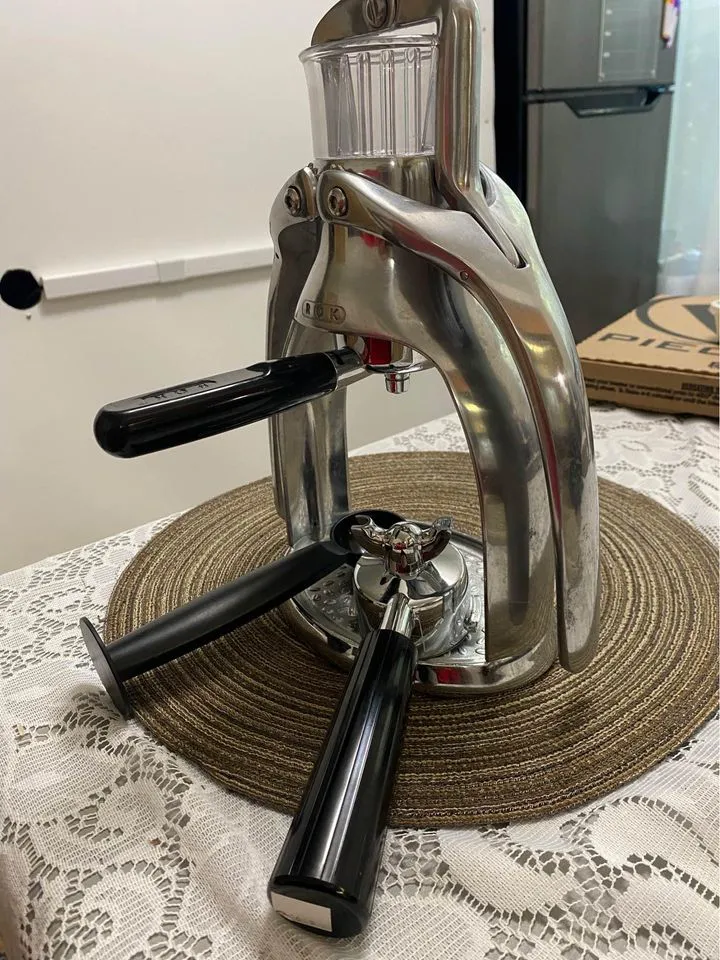
Additionally, one of the best things about a manual espresso maker is that you can experiment with adjusting the pressure during extraction (aka pressure profiling) (2). This is a much more rewarding process if you can see the changing pressure in real-time with a gauge.
ROK now sells an EspressoGC Commercial version capped with a pressure gauge, but it is more expensive and much less widely available. I’ve also seen a few places selling a pressure gauge conversion kit, but it’s more than half the price of the base model, making it a tough sell.
How To Use The ROK Manual Espresso Maker
As with most manual espresso machines, using the ROK can be as simple or as complicated as you want. I’ll give you my basic recipe here, but once you have that nailed down, feel free to experiment.
- Heat water to 200 F in a kettle.
- Grind 16 grams of coffee to a fine espresso grind.
- Fill the portafilter with the finely ground coffee, being sure to distribute it evenly, and tamp firmly.
- Insert the portafilter into the EspressoGC and place a pre-heated espresso cup under the spout.
- With the arms lowered, fill the chamber at the top of the ROK with hot water.
- Raise the arms to pre-infuse the coffee puck and hold for 4 seconds.
- Now press down on the lever arms consistently for about 20 seconds to pull the shot.
With this manual brewer, practice makes perfect. You may need to tweak the grind size and timing to achieve the best espresso with your favorite coffee beans.
A Note On Thermal Mass
A key aspect of an even extraction is a stable brewing temperature, which generally involves preheating all aspects of the espresso machine (3). Electric machines do this automatically while they warm up. With entirely manual machines, you typically use your kettle to rinse the brew chamber and portafilter with boiling water.
This is particularly important if the group has a large thermal mass because if it’s cold, it will suck the heat right out of your brew water. The original Flair is notorious for this.
The ROK group is less beefy, and the new-and-improved glass composite brew chamber offers better thermal stability, so I found preheating wasn’t crucial. It’s always good practice, but it’s a step you can safely skip in the name of efficiency – with one caveat. If you’re trying to extract a lighter roast, I definitely recommend getting everything as hot as possible first to avoid under-extracted coffee.
Cleaning
The ROK’s simple design means that cleaning is straightforward. After every brew, I knock out the used coffee grounds, rinse the portafilter, and wipe the shower screen. On a weekly basis, I wash the portafilter with soap and water and pull a few blank shots with hot water to rinse the group head.
Once every few months, you should disassemble the whole device and use water and vinegar to descale its components manually.
Does The ROK Make Good Espresso?
I have been very impressed with the shots I’ve pulled with the ROK, including with light, medium, and dark roast blends and single-origin coffee beans.
The fully manual control means the shot quality is limited only by the amount of time you’re willing to put in dialing everything to perfection.
I found that I could pull a good shot right off the bat, but with a few more iterations, I was approaching cafe quality. My best shots were rich, sweet, and complex, and capped by a dense layer of crema.
One thing to note is that the relatively small filter basket limits you to about 16 grams of ground coffee. This is pretty standard with classic Italian espresso, but it’s hard to achieve the larger double shots of espresso some modern cafes offer, which use as much as 22 grams (4).
The true limiting factor with a manual coffee maker like this is more likely your grinder, so make sure you pair the ROK with the best quality burr coffee grinder you can afford. A manual grinder is a good way to save money while still getting a high-end burr set.
An Almost Unbreakable Brewer
The ROK espresso maker comes with a 10 year warranty on all metal parts, which is the longest of any I’ve encountered. But it’s not all that surprising because there is really nothing that can break here – another perk of manual machines in general. I know several people still using their original ROK Presso from 2004!
Sustainability is a key aspect of the brand’s ethos. They strive to be the opposite of the waste-producing Keurigs and Nespressos of the world and don’t want their products filling landfills (5). In fact, when they released the new EspressoGC, they also released a GC conversion kit so you could upgrade your older machine without having to buy a new one.
Accessories
Along with the brewer and portafilter, you get a dosing funnel, a combination coffee scoop and tamper, and a plastic spout splitter to divide a double espresso into two single shots. The idea of a spout splitter that snaps on and off is a clever and versatile solution, but I have no idea why they opted for plastic. It’s such a tiny part; it can’t possibly be that expensive to make it metal.
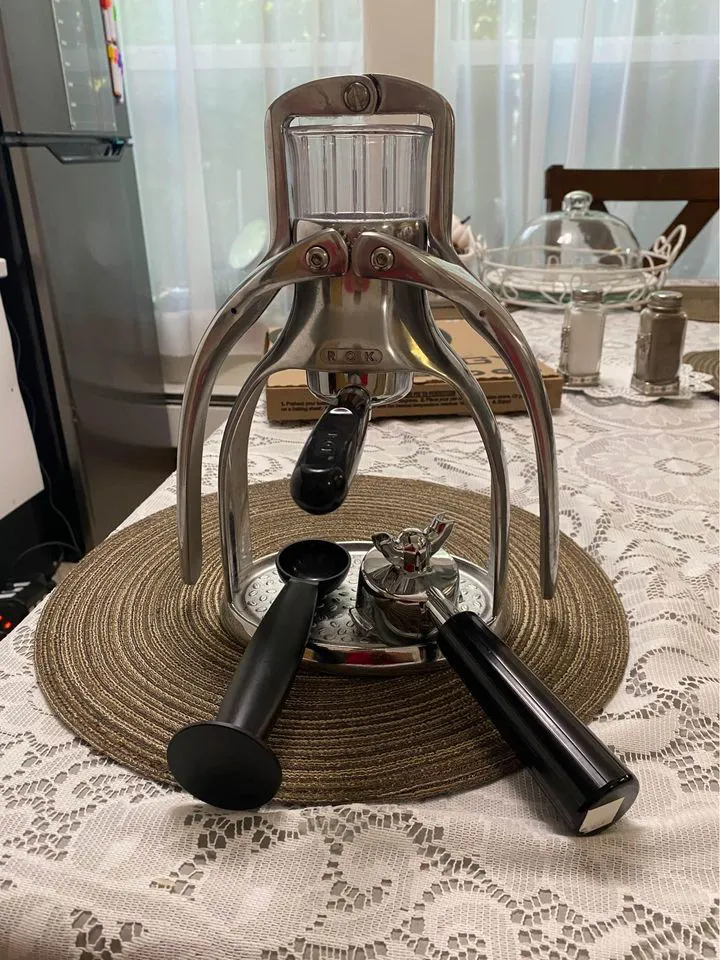
I’d probably recommend replacing the included plastic tamper with a metal one if you have the budget. I don’t like plastic tampers in general, but the way this one is just the base of the coffee scoop makes it particularly hard to achieve a level tamp. Just keep in mind the portafilter’s small 50-mm diameter when shopping for a tamper.
Where are ROK espresso machines made?
ROK espresso machines are designed and engineered in London but, as with most things these days, manufactured in China.
Design And Style Aspects
I think the ROK is a pretty sleek-looking machine, though not quite on par with the sculptural beauty of the Flair or the funky aesthetic of the Cafelat Robot. The ROK is more unassuming; not unattractive but not a style standout. It’s available in two finishes, either classic chrome or a matte black with chrome levers.
It’s very compact, measuring just 8.75″ x 5.125″ x 11.5”. It weighs just over 6 pounds, making it portable enough for a road trip or car camping. However, it’s probably not something you’d toss in your backpack for a hiking adventure—though it does come in a very nice travel tin.
One issue I have with the design of most of these manual lever machines, including the Flair and Robot as well as the ROK, is that the space between the legs at the base isn’t large enough to fit my coffee scale. Brewing by weight is valuable as you get more serious about espresso. Of course, the tiny Acaia Lunar fits, but it costs more than the ROK itself, so that isn’t a budget-friendly option for most of us.
Should You Buy The ROK EspressoGC?
The ROK is impressively affordable for something that will likely last decades. At just over $200, you’re looking at $20 per year even if it only lasts as long as it’s warranty. That’s a pretty unbeatable value, provided you don’t mind using arm power instead of electric power.
It substantially undercuts the price of competitors Flair Pro 2 and Cafelat Robot, though these both include pressure gauges. It’s a bit more expensive than the Flair Classic, which has a few more plastic parts and, in my opinion, a more finicky workflow.
I would happily recommend the ROK to the budding espresso enthusiast on a budget.
You’ll learn a lot about manual espresso brewing while you dial it in, and you’ll be rewarded with shots to rival the local coffee shop.
Plus, as you develop your skills, it’s easy to upgrade with accessories like a pressure gauge or naked portafilter without buying a whole new machine.
Don’t Buy The ROK Espresso Maker If…
- You don’t want to pull espresso shots manually: If the idea of making a cup of espresso by hand doesn’t appeal, consider an automatic or semi-automatic espresso machine. Some of the cheapest are nearly as affordable as the ROK, though they probably won’t last as long. The Breville Bambino or Cafe Roma are two reliable entry-level options.
- You also want to steam milk: ROK makes a standalone manual milk frother to accompany its machine, but if you want proper steamed milk, you need an espresso machine with a steam wand. If you have the budget, consider the iconic La Pavoni Europiccola, an Italian-made lever machine with a small boiler and steam wand for milky espresso drinks.
- You want a more portable espresso: The great thing about manual espresso machines is that you can take them anywhere, as long as you have a way to heat water. But if you want to make coffee way off the grid, you might want something less hefty than the ROK. My favorite way to make real espresso in the backcountry is the Wacaco Picopresso, or if you’re willing to settle for a strong brewed coffee, the Aeropress will never let you down.
The Verdict
The ROK EspressoGC is one of my favorite manual espresso machines, offering an unbeatable combination of espresso flavor, build quality, and low price. It’s a practical, portable, and sustainable solution to brewing perfect espresso coffee at home or on the road.
With the espresso quality limited only by your skills, the ROK offers a chance to unleash your inner barista. You’ll enjoy increasingly delicious shots as you progress, and thanks to a durable metal build and 10-year warranty, you’ll be enjoying them for at least a decade!
References
- Buckman, J. (n.d.). What Decent Espresso has learned from lever machines. Retrieved from https://thelevermag.com/blogs/articles/decent-espresso
- Prestidge, J. (2015, August 18). Pressure Profiling: The Key to Perfect Extraction. Retrieved from https://perfectdailygrind.com/2015/08/pressure-profiling-the-key-to-perfect-extraction/
- Nuova Simonelli. (2020, May 28). EXPERT: Why temperature matters when brewing espresso. Retrieved from https://magazine.coffee/blog/9/5906/expert-why-temperature-matters-when-brewing-espresso
- Blue Bottle Coffee. (n.d.). Espresso. Retrieved from https://bluebottlecoffee.com/ca/eng/brew-guides/espresso
- Miller, P. (2019, March 28). The problem with coffee pods and the eco-friendly alternatives to use instead. Retrieved from https://inhabitat.com/the-problem-with-coffee-pods-and-the-eco-friendly-alternatives-to-use-instead/
