
ROCKET ESPRESSO GIOTTO EVOLUZIONE V2 REVIEW: WHAT A STUNNER!
The Rocket Giotto Evoluzione is as beautiful as it is high-performance, making it a fine choice for any serious espresso lover.
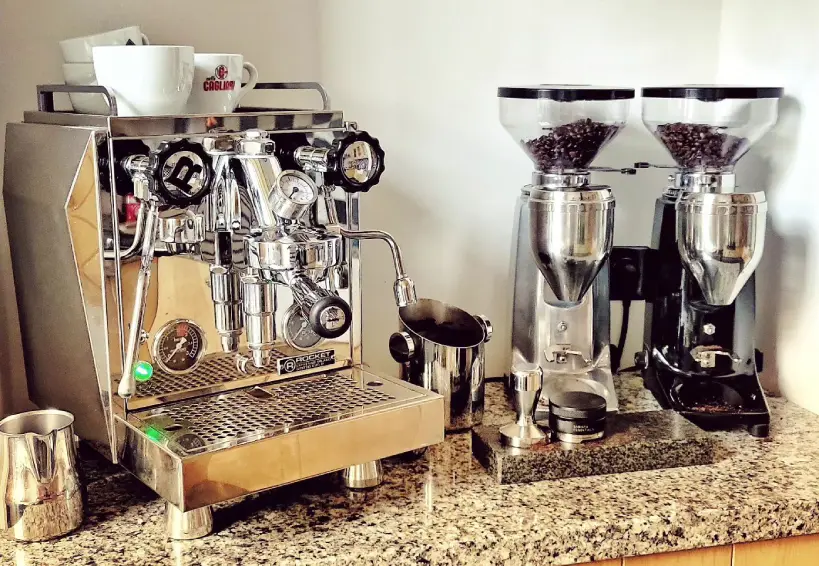
You’re ready to upgrade your espresso bar with a top-of-the-line, Italian-made machine, and Rocket caught your eye. I get it. The brand has a well-founded reputation for remarkable style, but do their espresso machines have substance too?
That’s what I wanted to find out while testing the Rocket Giotto Evoluzione R. I put together this review after weeks of putting it through its paces, and if you’re considering this machine, you’ll definitely want to keep reading.
What I Liked:
- Commercial-grade quiet rotary pump
- Heat exchange boiler with PID
- Impeccable build quality and design
- Updated E61 for dual-stage pre-infusion
What I Didn’t Like:
- Priced at a premium
- Small cup clearance
- Awkward to adjust the PID
A Full Review Of The Rocket Giotto Evoluzione V2
The Giotto Evoluzione falls in the middle of Rocket’s line, so I suspect it will hold wide appeal as a home espresso machine. It is neither the cheapest nor the most expensive; neither the biggest nor the smallest. It hits a nice middle ground in terms of performance and price without skimping on Rocket’s iconic style or build quality.
How We Rated It
-
Brewing Capacity
-
User-Friendliness
-
Milk Frothing
-
Build Quality
-
Value For Money
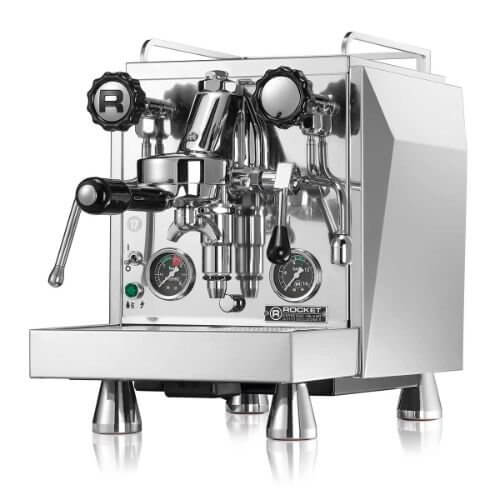
The Four Versions Of The Rocket Evoluzione
The Evoluzione comes in four variations. Giotto and Mozzafiato refer simply to the shape of the sides. The Giotto models have eye-catching angled sides, while the Mozzafiato has more classic straight sides. There are also R and V versions of each, indicating either a rotary (R) or vibratory (V) pump type.
For this review, I’ve been testing the Giotto R-type. The V2 machine is a nice step up from previous versions. The boiler is now insulated, and the internal layout has been re-tooled for better noise dampening.
Check out my Rocket Espresso Mozzafiato review for a closer look at the V-type.
Note that a new model of this machine, the Giotto Cronometro R – known in North America as the Giotto Timer R – adds a shot timer to the front panel for a small upcharge.
The Basics: Boiler, Pump, And Brewing Performance
The Rocket Giotto Evoluzione R is not your average heat-exchanger espresso machine, thanks to its rotary pump and PID temperature controller.
Rocket was one of the first companies to use a PID with a heat exchange boiler – in this case, a 1.8 liter insulated boiler made of pure copper.
There has been some debate about a PID’s effectiveness in this machine style; it certainly has more of an impact in a double or single-boiler espresso machine. But at this point, I’m convinced that it improves temperature stability versus the traditional pressure stat and lets you get away with fewer cooling flushes. Plus, solid-state PIDs last longer than mechanical pressure stats.
The rotary pump is another nice upgrade, as HX machines more often rely on vibratory pumps. Combined with Rocket’s retooled interior, this machine is notably quiet compared with others I’ve tested in its class.
The rotary pump also enables direct plumbing to a water line, which removes the hassle of water management and allows for soft line-pressure pre-infusion.
Innovating The E61
The Giotto Evoluzione V2 espresso machine sports the tried-and-true E61 group, found on many prosumer espresso machines. However, Rocket is one of few companies to introduce an update. They innovated an automatic dual pre-infusion system that fully saturates the puck for better extraction and great espresso (1).
They’ve also upgraded the mushroom valve from chrome-plated brass to ceramic. This solves the issue of chrome plating flaking off that has plagued some E61 groups, improving longevity.
Using The Rocket Evoluzione
I won’t walk you through using this machine step by step. I assume if you’re considering something of this caliber, you know how to pack a portafilter and use an E61 lever. But I’ll give you my overall thoughts on the user experience.
Using the Evoluzione R is on par with most heat exchanger espresso machines, with the exception of setting the PID temperature. I wouldn’t say they’ve gone out of their way to make things easy – for example, there’s no digital display. The brand seems to prioritize build quality and aesthetics over ease of use, so it’s up to you to rank your priorities before you buy. That said, it does include a helpful user’s manual and video guide.
I like the easily accessible OPV for adjusting pump pressure, an increasingly popular feature of the best espresso machines. Likewise, the water control switch, which lets you switch seamlessly from the water tank to a plumbed-in line, is quickly accessed.
The auto-filling boiler comes in handy when making a lot of back-to-back drinks. Plus, integrated sensors alert you if the water level is too low in the boiler or the water reservoir, and it will shut down automatically before you can do any damage.
I don’t love the relatively low 3-inch cup clearance beneath the spouted portafilter, especially given that this is not a compact machine. If you’re making a larger drink, you may need to pull the shot into a small espresso pitcher first or consider investing in a bottomless portafilter.
Cleaning And Maintenance
Cleaning and maintenance are paramount to avoid problems down the line, but HX machines are generally easier to manage than bigger dual boilers. And the E61 group head is widespread, making it easy to find skilled technicians and spare parts should anything go wrong.
The interior is well-engineered to avoid the common pitfalls of cheaper machines, like damage due to moisture or vibrations. As long as you’re proactive rather than reactive with your maintenance, it will last decades.
Always use filtered water, and consider adding a water softener if you live in an area with hard water (2). Backflush with water regularly and with a cleaning solution occasionally. Keep gaskets lubricated and wipe any coffee residue with a microfiber cloth. It’s not rocket science (no pun intended).
Steam Power To Spare For Latte Fans
This machine has impressive steam pressure and recovers rapidly thanks to its large 1.8-L boiler. In testing, it took me less than 20 seconds to steam 6 oz of milk to 140 ℉ using the included 2-hole steam tip, and the recovery time was only about 15 seconds.
This is an excellent rate; it’s slow enough not to intimidate the novice barista but fast enough to churn out rapid lattes.
The heat-exchange boiler allows you to brew and steam at the same time, so there’s basically no downtime between drinks. I could even see this machine keeping up in a low-volume commercial setting.
Steam pressure is controlled by a knob, which I personally prefer to a joystick. The joystick is great for short bursts of steam, but the knob allows more delicate control. And it’s definitely better for anyone new to managing this level of steam power.
The stainless steel steam and hot water wands have a good range of motion and double-wall no-burn construction. The current model uses a Teflon rather than a silicone insert, which maintains drier steam.
Rocket’s Reputation For Build Quality Is Well Deserved
Build quality and design is one category where Rocket always hits it out of the park, as you’ve probably noted in all my Rocket Espresso reviews.
All Rocket machines come with an instantly recognizable aesthetic, a conscious decision by owner Andrew Meo to make Rocket stand out in the storied Italian espresso machine industry (3).
“The machines had to become more appealing in terms of design. As a company, we had to build a strong contemporary brand with a global feel.”
The exterior is high-grade polished stainless steel, with either the angled sides of the Giotto or the straight sides of the Mozzafiato. The steam knob features the iconic R logo, the feet are modeled after rocket boosters, and the pressure gauges have a sleek new black background.
Rocket’s design team prefers a cleaner and more classic look, so they hide the PID display behind the drip tray and keep the controller separate. While beautiful, if you adjust the PID a lot, you might get tired of pulling the tray in and out. That said, the drip tray is well-designed, too, with smooth rails and a satisfying magnetic catch.
It’s a fairly large machine, measuring 13.2” wide by 16.5” deep by 15.75” tall, but it’s still compact relative to a dual boiler with equivalent performance. A good portion of that space is taken by the ample water reservoir, which holds 2.9 liters of fresh water.
The adjustable feet are an upgrade to the latest model. You can squeeze it under the counter or lift it to accommodate the tubing when plumbing in.
This machine comes with a nice collection of high-end accessories, including single and double-spouted commercial-grade portafilters, a stainless steel backflush disk, and a branded metal tamper.
Should You Buy The Rocket Evoluzione?
The Rocket Espresso Evoluzione Giotto runs close to $3000, which is definitely above average for a heat-exchange espresso machine. In my opinion, you are paying a bit extra for the brand name and aesthetics, but the bigger cause for the high cost is the relative rarity of HX machines with a PID controller and rotary pump. The Evoluzione not only delivers more than the average, but it doesn’t have a lot of competition in this market.
An obvious comparison would be the ECM Technika Profi V, which is about $500 less expensive. I’d say it’s very comparable in terms of features, build quality, and espresso flavor, with style being the biggest differentiating factor.
Where to Buy
This model comes with a nearly two-grand price tag, so it’s crucial to choose a retailer with a dedication to excellent customer service and a parts-and-labor warranty. The following retailers have been chosen for their reliability.
| Retailers | |||
|---|---|---|---|

|
Chris’ Coffee |
|
CHECK PRICE |

|
1stincoffee |
|
CHECK PRICE |

|
Seattle Coffee Gear |
|
CHECK PRICE |

|
Majesty coffee |
|
CHECK PRICE |
Don’t Buy The Rocket Evoluzione If…
- You prefer a double-boiler machine: If you’re regularly making a series of cappuccinos, it’s probably worth upgrading to a dual boiler to handle the load better. To keep the Rocket aesthetic, check out the R58. Or consider a cheaper option from another brand, like the Izzo Alex Duetto IV Plus or the Lelit Bianca espresso machine, which adds the bonus of flow control.
- You’re short on space: If counter space is at a premium in your kitchen, take a look at some of Rocket’s more compact models. The very popular Rocket Appartamento was explicitly designed for apartment living, or there’s Rocket’s Porta Via espresso machine, the first portable prosumer machine intended for travel.
- Aesthetics don’t matter: If I’m honest, Rocket espresso machines come at a premium. You pay extra for that iconic Rocket design. If that doesn’t interest you, you can save money with an equally excellent HX machine from another brand. Take a look at the Profitec Pro 500 or the ECM Technika Profi V, both of which also include a PID.
The Verdict
The Rocket Espresso Giotto Evoluzione R espresso machine is an excellent heat exchanger machine, with a PID and rotary pump putting it ahead of many others in its class. If you love the Rocket Espresso aesthetic and don’t mind paying a little extra for the look, you’ll be thrilled with this addition to your coffee bar. Your only concern will be resisting the desire to pull quality espresso shots all day, every day.
References
- Lee, J. (2017, April 28). Espresso-Making Skills: What’s Pre-Infusion? Retrieved from https://perfectdailygrind.com/2017/04/espresso-making-skills-whats-pre-infusion/
- Kornman, C. (2018, August 15). A Practical Water Guide for Coffee Professionals (Part 1). Retrieved from https://dailycoffeenews.com/2018/08/15/a-practical-water-guide-for-coffee-professionals-part-i/
- Velits, M. (2017, July 18). Andrew Meo founder of Rocket Espresso interview. Retrieved from https://isadore.com/blog/article/andrew-meo-founder-of-rocket-espresso-interview/
