
KALDI COFFEE ROASTER REVIEW: WHAT TO KNOW BEFORE YOU BUY
In this Kaldi coffee roaster review, I’ll cover my experience roasting at home with this popular drum roaster.
Roasting your own coffee beans at home can be incredibly fun and rewarding. You get complete control over the blend, roast level, and flavor profile – like a delicious science experiment. Unless you buy the wrong roaster for your needs. Then suddenly, it’s an expensive and frustrating disaster.
Let me spare you that fate by testing the Kaldi Coffee Roaster on your behalf, so you can decide if it’s worth your hard-earned dollars.
Things I liked:
- Allows a lot of user control and modifications
- Delivers a reliably fast and even roast
- Large capacity of 300g
- Durable stainless steel build
Things I didn’t like:
- Steep learning curve
- No smoke suppression
- Gas burner not included
The Full Kaldi Coffee Roaster Review
Korea-based Kaldi is one of the earliest producers of home coffee roasters, and their expertise is clear in the design and manufacturing of their wares. There are several models of Kaldi roasters, but I’ll be discussing the most popular of the bunch, the Kaldi Wide Size Coffee Roaster. I think it offers the most appealing balance of features and price.
How We Rated It
-
Features
-
Roast Quality
-
Ease of Use
-
Capacity
-
Value for Money
Initial Set-Up Is Challenging
It’s a good thing that first impressions aren’t everything because I was not immediately charmed by my new roaster. When I received the package, it was in quite a few pieces, and the instructions for assembly weren’t especially detailed.
Even having worked with coffee roasters in the past, it wasn’t obvious to me how everything fit together. And when it comes to equipment designed to get very hot, you want to get it right!
Fortunately, we live in the era of YouTube, so it was easy to find help online. If you experience similar unboxing confusion, rest assured that things go much smoother once you get it up and running.
Drum vs Hot Air Roasters
The Kaldi coffee roaster is a drum roaster. A heated rotating drum tumbles the coffee beans to ensure an even roast. The alternative is an air roaster (also known as a fluid bed roaster), which relies on a stream of hot air coming through a perforated mesh plate beneath the beans (1).
“If you opt for a filter or espresso roast using a drum roaster, then the sweetness and the body will be more pronounced compared to using a roaster with an indirect heat source.”
Many experts prefer drum roasters for darker roasts and espresso blends; my experience backs that up. Drum-roasted coffee tends to be richer, more complex, sweeter, and with a fuller body—all characteristics I love in an espresso shot. The design of a drum roaster also makes it much easier to scale to larger capacities.
Features And User Experience
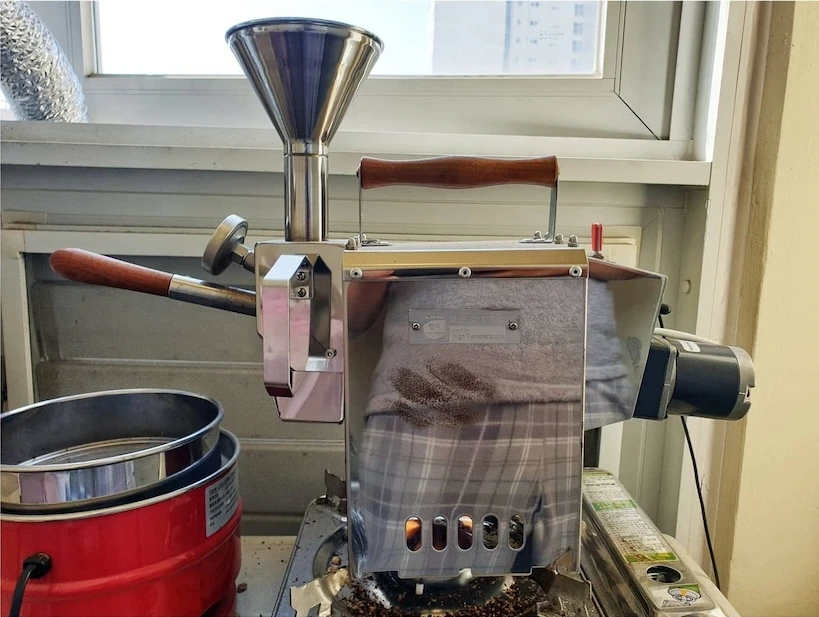
The Kaldi Coffee Roaster is a powerful workhorse without bells and whistles. You won’t find timers, rows of buttons, or a digital screen, but once you set the roaster on a gas burner, you have total control of temperature and roasting time.
Unfortunately, you can’t control drum speed, at least not right out of the box. I measured mine at about 47 rpm, which is relatively slow, though I had no issues with uneven roasting.
Many users have upgraded the Kaldi with a variable power adapter to give it adjustable drum speed, an easy and affordable modification. I’d suggest mastering the roast time and temperature, then deciding if you want to add speed to the mix.
Accessories
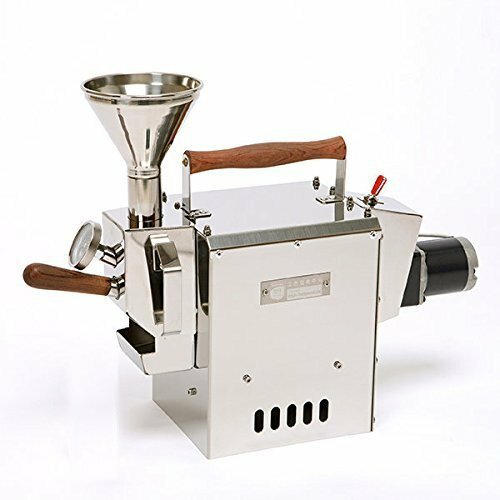
Kaldi includes a few useful accessories. It has a wide funnel-shaped hopper that makes it easy to pour in the green beans and a thermometer to monitor the internal temperature of the drum.
The analog thermometer is useful feedback, especially once you have some experience, but the sample probe rod is the best way to check the progress of your roast.
The probe lets you remove a few beans to check their color during roasting without interrupting the cycle (2).
This machine requires a gas burner, which is not included. You can find inexpensive gas rings online or use a camp stove or gas barbeque if you have one.
Use The Kaldi Roaster Outside
The Kaldi Wide doesn’t have smoke suppression. The brand maintains you can use it on a gas stove indoors if your kitchen is well-ventilated, but having tried it for myself, I’d definitely dispute this claim.
Even with the windows open and the fan on, the roasting process often set off my smoke alarm. And if I avoided the alarm, my house would still smell of coffee smoke for days. Spare yourself the (sometimes literal) headache and opt outside.
Learning To Use The Kaldi Coffee Roaster
There is a learning curve with the Kaldi, which is true of all coffee roasting machines but of commercial-style drum roasters in particular. There are many variables to dial in, and each coffee type benefits from a different roast profile. I found the biggest challenge was getting used to how adjusting the gas burner affected the temperature in the drum.
The best way to learn how to roast coffee beans is to start with some cheaper green beans and practice. Adjust one variable at a time, and check the probe and thermometer constantly. It took me about five batches before I roasted something I really wanted to drink.
Ease Of Cleaning
The Kaldi is a surprisingly tidy roaster, although it doesn’t matter as much when roasting outside. The chaff tray does an excellent job of collecting those pesky thin layers of dried skin that seem to get everywhere and cling to everything (3). Many cheaper roasters I’ve tested seem to have chaff collectors that are mostly for show.
You only need to loosen a few bolts on the back of the machine to disassemble it for a deep cleaning. The occasional deep clean is crucial to prolonging its life, but the average hobby roaster only needs to do this about once a year.
Exceptional Roast Quality
The quality of the roast is the reason you should buy the Kaldi. It’s not as convenient or friendly as the little home machines that are just glorified popcorn hot air poppers, but this impressive roaster delivers when it comes to an even and reliable roast.
Kaldi uses an innovative Air Roasting Technology to guarantee an even heat distribution inside the drum, resulting in consistent roasts. I suspect this is why I didn’t have the quality issues I anticipated from the slow drum rotation.
The perforated drum is 2mm thick, incredibly efficient, and has a copper sleeve to prevent the flame from scorching the beans. A mesh screen at the base, known as the flame arrest, adjusts the shape of the gas flame to ensure a smooth flow of conductive and convective heat to the entirety of the drum surface, no matter the type of burner you use.
Once I was over the initial learning curve, I had a lot of fun adjusting the variables and experimenting with different roast profiles and levels, from dark espresso to Nordic-style light roasts. This versatile roaster is well suited to true coffee geeks who enjoy the process as much as the result (4).
How much coffee can you roast at a time?
This Kaldi model is able to roast up to 300g of green coffee beans, which is more than most home roasters. This batch size equates to about 30 or 40 cups of coffee – a convenient amount for the average household. You won’t end up with stale coffee nor do you have to roast constantly to meet demand.
How long does it take to roast coffee with the Kaldi?
My roasting times with the Kaldi ranged from about 8 to 15 minutes, depending on the precise roast profile and burner temperature. I typically heard the first crack around 7 or 8 minutes and dumped the beans around 10 to 12 minutes for filter coffee. However, it always pays to experiment. I roasted a lovely batch of Sumatran beans for espresso using a lower heat and a longer roast time.
Build Quality and Design
The Kaldi coffee roaster is of commercial quality, suitable for avid home roasters and small-scale coffee businesses. Even while unboxing my Kaldi roaster, I was confident it was built to last, and speaking with many long-term Kaldi users only confirmed that assumption.
By avoiding the digital extras of more expensive roasters, very little can go wrong with the Kaldi, and every part is easily available and replaceable.
In fact, something I appreciate about the Kaldi is how the simple modular design makes it not only durable but upgradable. I already mentioned adding a variable power supply, but thermocouple and airflow modifications are also popular. It’s easy to find tutorials online, along with a welcoming and knowledgeable community of home roasters.
The external casing, drum, hopper funnel, and chaff holder are all thick stainless steel, and oil-less stainless steel bearings ensure a smooth drum rotation that never falters. I thought the heat resistant wooden carrying handle on top looked a little hokey at first, but it’s actually incredibly useful for moving the roaster around.
The Kaldi Wide has a very industrial look. It resembles a miniature professional roaster rather than a standard kitchen appliance, so you probably won’t leave it out on your counter between uses.
Size And Shape
Despite its commercial-grade build, the Kaldi is much less heavy and awkward than you might expect. Based on online photos, I was anticipating something much bulkier. It measures 18.11 x 6.69 x 14.57 inches and weighs 13 pounds—barely more than my prosumer coffee grinder. It’s easy for one person to manage. It’s a bit too big to store in a standard kitchen cupboard, but it fits well in the garage, laundry room, broom closet, etc.
Is It Worth The Price?
The Kaldi roaster costs around $600, though I’ve noticed this varies regularly. Plan on between $500 and $800, and remember to budget for the gas burner required. It comes with a 1-year limited warranty, which essentially covers you in case you get a lemon from the factory.
In my opinion, the price is very reasonable given the quality and capacity. If you’re an avid coffee roaster, either for home for a small business, its simplicity and solid design will stand up to regular use over a long period of time. Remember that buying green beans is much cheaper than buying roasted coffee, so if you use it consistently, it is well worth the investment.
On the other hand, if you only want to experiment with home roasting occasionally, I’d say the Kaldi is overkill. You’ll get better value from something more affordable and less robust.
Don’t Buy The Kaldi Home Roaster If…
- You’re new to roasting and on a budget: If you’re buying your first coffee roaster, you might not want to jump straight to an expensive commercial model. Consider starting with something more basic and user-friendly, like the Fresh Roast SR540. It’s a popular countertop electric coffee roaster that costs about a quarter as much as the Kaldi.
- You want to roast coffee beans anywhere: For a compact and portable roaster, check out the unique Nuvo Eco Ceramic Handy coffee bean roaster. The simple but clever design facilitates a quality roast even over a campfire. Remember that portable equates to a small size; the capacity is about 70 g.
- You want a larger capacity roaster: Does your household drink a ton of coffee? Do you want to start a business? Do you enjoy roasting coffee as gifts for friends and family? You might benefit from a larger roaster like the Behmor 1600 Plus, which can hold up to a pound of beans, or the 600g-capacity Kaldi Fortis.
The Verdict
The Kaldi Wide Coffee Roaster is a high-end drum roaster that delivers professional-quality coffee beans. While its high price point and steep learning curve might be intimidating for first-time roasters, experienced users will be treated to truly exceptional roasts. After all, it is essentially a scaled-down commercial machine.
I heartily recommend the Kaldi roaster to anyone serious about home coffee bean roasting or setting up a small roastery. With its durable build and large capacity, you’ll enjoy freshly roasted great coffee for years.
References
- Elliot, S. (2024, February 8). Drum vs fluid bed: How different coffee roasters affect flavour. Retrieved from https://perfectdailygrind.com/2024/02/drum-fluid-bed-how-roasters-affect-coffee-flavour/
- Perfect Daily Grind. (2020, May 26). Coffee Roasting Probes And Tips on Using Them. Retrieved from https://perfectdailygrind.com/2020/05/coffee-roasting-probes-and-tips-on-using-them/
- Waka Coffee. (n.d.). What is Coffee Chaff? Retrieved from https://www.wakacoffee.com/blogs/coffeepedia/what-is-coffee-chaff
- Coffee roast guide. (n.d). Retrieved from https://www.ncausa.org/about-coffee/coffee-roasts-guide
