
STANDARD COFFEE CUP SIZES: Oz and Ml Guide
Here’s a detailed overview of standard and specialized cup sizes for coffee.

Photo: Jovana Durovic
Does something feel off about your morning coffee? Believe it or not, your choice of coffee cup or mug might be to blame!
Different coffee drinks benefit from certain cup sizes. The Italian Espresso Institute has even defined clear requirements for the perfect espresso and cappuccino cup sizes. Other standards aren’t quite that stringent, but it doesn’t mean they aren’t worth knowing.
This is information that can elevate your coffee experience to the next level.
What Is The Standard Coffee Cup Size?
Let’s start with the basics – the ubiquitous white ceramic coffee mug found in kitchen cupboards and diners everywhere.
These types of coffee cups are usually broadly classified as small or large.
- Small mugs hold 8 to 10 ounces of coffee, or 236 to 296 ml.
- Larger coffee cups range from 11 to 15 ounces, or 325 to 444 ml.
What do coffee maker cup sizes mean?
Here’s where things get a little confusing. Most manufacturers of coffee makers and automatic drip coffee machines define a standard cup as just 5 oz. So when you buy a coffee maker with a 10-cup capacity, for example, it means that the carafe holds 50 ounces of brewed coffee.
Specialized Cups For Espresso-Based Drinks
Espresso-based drinks typically have specific coffee preparation recipes, with pre-defined ratios of milk and espresso. That makes the drink size much less variable compared with simply pouring brewed coffee, especially in traditional Italian cafes. As a result, their cup size rules are equally fixed.
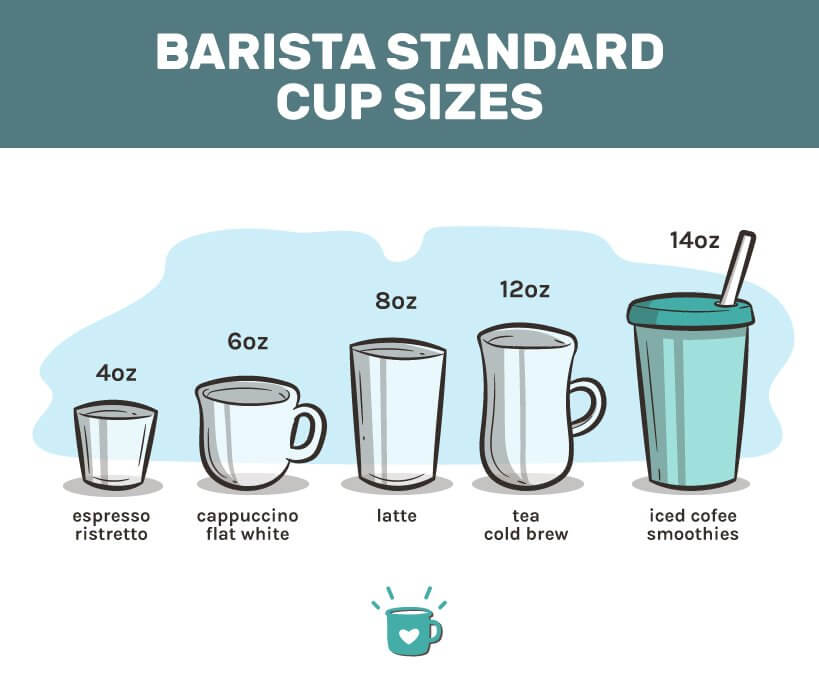
This section of my size guide will help you find the perfect cup for your favorite coffee shop classic, from smallest to largest.
Demitasse Cups
Demitasse cups, also known as espresso cups, usually hold 1.5 to 3.5 ounces, with 2oz to 2.5 ounces being the standard. They are used to serve a single or double shot of espresso or a macchiato, which is just an espresso shot with a dollop of foam.
These cups are designed to accentuate the espresso flavor. They feature a wide rim and a narrow base, which brings the aromas closer to your nose and palate.
Espresso has such a long and celebrated history in Italy that Italians have codified the specific size, color, and material for cups used for Italian espresso (1).
“Ideal cup for Italian espresso is a white china cup, free of any inside decoration, elliptical in shape, with a capacity of 50 – 100 ml.”
Turkish coffee has an intense flavor like espresso so it is served in similarly small mugs, typically between 3 and 4 ounces. The cortado, which adds an ounce of frothed milk to an espresso, is served in a cup slightly larger than a demitasse, usually measuring between 3.5 and 4.5 ounces.
Cappuccino Cups
Authentic cappuccinos and flat whites are served in cups that range from 5 to 6 ounces – about twice the size of an espresso cup. And like the espresso cup, a cappuccino cup often has a narrow base and wide rim.
Some modern coffee shops serve cappuccinos in much larger sizes, to the displeasure of more traditional baristas.
Cappuccino cups are usually accompanied by saucers to catch any spills. This is because the traditional cappuccino is capped by a pillow of foam on top of the beverage, which often surpasses the lip of the cup.
Latte Cups
The latte is the largest espresso-based drink, and it’s getting larger all the time. Originally, latte mugs measured between 8 and 12 ounces. Modern renditions, especially in North American coffee shops, are often far larger – as much as 20 ounces.
The café au lait is distinct from a latte because it pairs brewed coffee with steamed or warmed milk, rather than espresso. But the two drinks are usually around the same size and share the same cups.
Latte cups come in two common styles. There are bowl-shaped ceramic mugs with wide rims, which are perfect for pouring latte art. Alternatively, tall and narrow cups made from glass are appealing because they better showcase the drink’s characteristic layers.
Some latte cups are designed with uniquely curved interiors to facilitate latte art. They help the barista pour the steamed milk with precision in order to craft delicate designs.
| Type of Cup | Drinks It’s Used For | Size (US) | Size (metric) |
|---|---|---|---|
| Classic Mug | Brewed coffee | Small (8 – 10 oz), Large (11 – 15 oz) | Small (237 – 296 mL), Large (325 – 444 mL) |
| Demitasse | Ristretto, espresso, machiatto | 1.5 – 3.5 oz | 44 – 104 mL |
| Turkish Coffee Cup | Turkish coffee | 3 – 4 oz | 89 – 119 mL |
| Cortado Cups | Cortado | 3.5 – 4.5 oz | 104 – 133 mL |
| Cappuccino Cup | Cappuccino, flat white | 5 – 6 oz | 148 – 177 mL |
| Latte Cup | Latte, cafe au lait | 8 – 12+ oz | 237 – 355+ mL |
Travel Mugs
These days, travel mugs come in every conceivable sizes. I’ve even seen a teeny-tiny travel demitasse!
Many brands have sprung up in recent years offering travel cups designed to replace to-go cups in an effort to curb waste. These are sized to match average coffee shop takeaway sizes, usually 8oz to 16oz.
Larger insulated travel mugs hold up to 20 ounces and act more like thermoses. They hold enough coffee to keep you fueled for a whole day, while the insulation helps keep you hot beverages hot.
Cup Sizes At Starbucks
The cup sizes at Starbucks follow the same standards as most North American coffee shops, but they use their own naming convention. This dates back to the chain’s earliest days, when it was a more Italian-inspired cafe (2).
The three common sizes are:
- Tall (12 ounces),
- Grande (16 ounces), and
- Venti (20 ounces).
Note that Venti cold drinks measure 24 ounces to compensate for the volume of ice. They can be thought of as small, medium, and large – though 12 ounces is already a lot of coffee, in my opinion.
There are two smaller sizes, the Demi (3 ounces) and the Short (8 ounces), the latter of which is standard for kid’s drinks.
There is one larger size, the Trenta (32 ounces), offered for certain cold drinks. Order at your own risk because that is potential for a serious caffeine boost!
Starbucks Cup Sizes Chart
| Size | Starbucks Name | Volume (US) | Volume (Metric) |
|---|---|---|---|
| Demitasse | Demi | 3 oz | 89 mL |
| Extra Small | Short | 8 oz | 237 mL |
| Small | Tall | 12 oz | 355 mL |
| Medium | Grande | 16 oz | 473 mL |
| Large | Venti | 20 oz/24 oz | 591 mL/710 mL |
| Extra Large | Trenta | 32 oz | 946 mL |
FInal Thoughts
I hope I’ve convinced you that the right size of cup greatly impacts the enjoyment of your favorite coffee drink. You shouldn’t sip an espresso shot from a travel tumbler any more than you should slot a demitasse into your car’s cup holder.
If you’re a true coffee lover, invest in a few traditional coffee mugs of various sizes. I promise it’s money well spent!
FAQs
The most popular coffee cup size in the U.S. is medium, which has a coffee mug size from 12 to 16 ounces. In 2020, over 50% of coffee drinkers surveyed had ordered a medium coffee in the last day (3). However, in Europe, espresso drinks are more popular than brewed coffee, so 4 to 5 ounces is a more common coffee cup size.
There are 8 fluid ounces in a cup, if you’re talking about the standard size cup measurement used in recipes, which is equivalent to 237 mL. Keep in mind that a cup of coffee is not bound to the same definition of “cup.” Confusing, I know.
The difference between a mug and a coffee cup is that a mug is usually taller and straighter, whereas a coffee cup is shorter, tapered at the base, and wider at the rim. That said, the terms are often used interchangeably by manufacturers and coffee shops, so be sure to confirm if you have a preference.
References
- The Certified Italian Espresso and Cappuccino (2016, December). Istituto Nazionale Espresso Italiano. Retrieved from http://www.espressoitaliano.org/files/File/istituzionale_inei_hq_en.pdf
- Owen, E. (2023, January 4). The Real Reason Why Starbucks Uses Tall, Grande, and Venti. Retrieved from https://www.travelandleisure.com/food-drink/starbucks-cup-sizes
- Ridder, M. (2022, January 13). Coffee drinking U.S. consumers by cup size 2020. Retrieved from https://www.statista.com/statistics/323437/coffee-drinking-us-consumers-by-cup-size/
