
BREVILLE CAFE ROMA REVIEW: CAN THIS ESPRESSO MACHINE KEEP UP?
The beginner-friendly Breville Cafe Roma is a perfect machine for the novice barista looking to bring the espresso experience home for the first time.
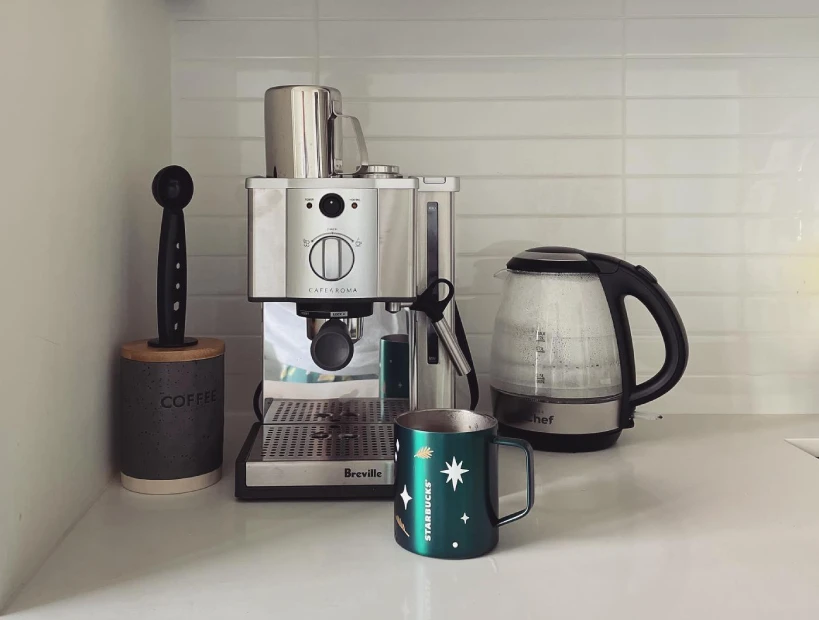
Are you in the market for your first home espresso machine? Maybe you’ve realized you’re spending too much money at the local coffee shop or you’re wondering if you can make a tastier drink at home. Or maybe you’re just excited to break into the compelling world of pulling your own espresso shots.
No matter your reason, I think the Breville ESP8XL Cafe Roma Espresso Maker is an excellent option for the budding home barista. It’s affordable, easy to use, and teaches you the critical skills required to further your espresso education.
Keep reading for my honest and in-depth Breville Cafe Roma espresso machine review to find out if it’s the right entry-level espresso maker for you.
What I Liked:
- Entry-level espresso machine is easy to use
- Durable and attractive stainless steel exterior
- Includes all necessary accessories
- Froth-enhancing steam wand for reliable frothed milk
What I Didn’t Like:
- Outdated thermoblock heater
- No control over steam pressure
- Somewhat overpriced
The Full Breville Cafe Roma ESP8XL Review
First released in 2004, Breville’s Cafe Roma is one of the brand’s oldest models. It has yet to see an update in recent years, so it definitely has a bit of an outdated feel. However, as the most affordable Breville espresso machine, I still think it serves an important role in the product line.
It’s a perfect starter espresso machine, equipped with everything the home barista needs to craft café quality beverages. And it’s so easy to use that even beginners will be pulling smooth shots of espresso with thick layers of crema.
How We Rated It
-
Brewing Capacity
-
Ease Of Use
-
Coffee Flavor
-
Build Quality
-
Value For Money
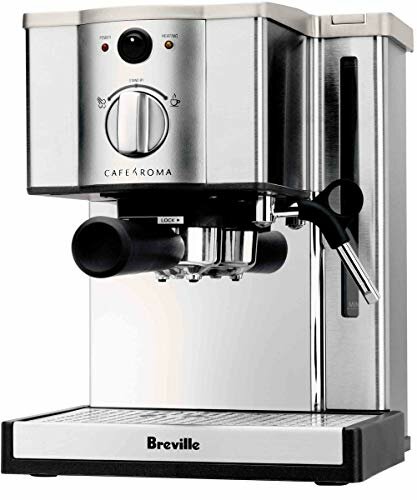
What To Expect From The Brewing System
The Cafe Roma uses a 15-bar pump and single thermoblock heater to generate the high-pressure hot water required for extraction. A thermoblock is a relatively old technology and is a significant difference between the Cafe Roma and the newer models.
Most Breville machines have been upgraded with improved thermocoil heaters, while some have the more advanced proprietary ThermoJet system. Compared to these updates, a thermoblock offers slightly poorer temperature stability, which affects the quality and consistency of your espresso shots – though an espresso novice is less likely to notice a taste difference.
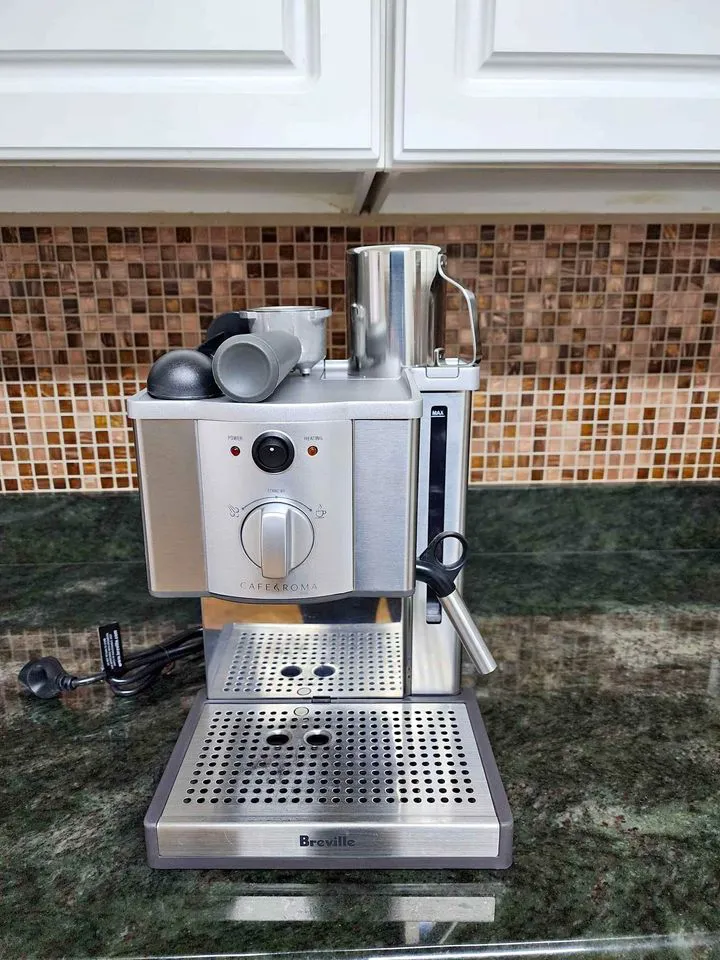
What you will notice, however, is that the thermoblock takes longer to heat up. Plan on letting it warm for at least 2 – 3 minutes before brewing (5 – 10 minutes is even better), compared to 30 seconds for a thermocoil or 5 seconds for a thermojet.
Because the same heater is used for making espresso and steaming milk, you can’t do both simultaneously. This is pretty standard for an espresso machine at this level, but the thermoblock means you’ll need to wait a little longer than average when switching between the two processes.
What size portafilter does Breville Cafe Roma use?
I was surprised to find that the Cafe Roma uses a tiny 50 mm portafilter. Most Breville espresso machines use 54 mm, while the commercial standard is 58 mm. A small filter diameter isn’t inherently bad, but it does mean you’ll need to shop around a little if you want to buy accessories like a metal tamper.
Milk Frothing With A Manual Steam Wand
The Cafe Roma comes with a manual steam wand, complete with a froth enhancer. I think this design strikes a nice balance between user-friendliness and control.
The froth enhancer guarantees a lovely pillowy milk foam even if you don’t have a practiced hand.
But you’ll still learn the basics of operating a manual wand, like how to angle the milk pitcher to get a good whirlpool or how to gauge when the milk is ready based on the temperature of the pitcher’s exterior.
The downside of the froth enhancer, which helps inject air into the milk, is that it makes it far more challenging to create the silky microfoam of a traditional latte. I wouldn’t recommend this style of wand if pouring latte art is high on your list of demands (1).
Milk System Complaints
My main complaint about the milk system is that the Cafe Roma doesn’t have a way to control the steam pressure. You can only toggle it on and off. This is another indication of this machine’s retro status. In recent years, manufacturers often include a knob to adjust the steam, even on budget machines.
I also found the steam wand a little awkward to use. It’s quite short, doesn’t have a 360-degree range of motion, and there is limited space between the wand and the drip tray. It takes a bit of practice and maneuvering to find a good position and angle for the milk jug.
How To Use The Cafe Roma
The Café Roma is very simple to use, perfect for anyone just starting out in home espresso. Other reviewers have complained that it lacks programmability or other features, but I think its simple interface is an asset – as does Breville President of Global Specialty Coffee, Phil McKnight (2).
We want to do things that are better, faster, simpler, and more engaging. Simplicity is one of the core values
It’s a semi-automatic espresso machine, which means you’re in charge of preparing the coffee puck and timing the shot.
Here’s how it works, step by step:
- Turn it on with the power switch and let it heat up. The indicator light will let you know when it’s ready.
- For a double shot, add 14 grams of finely ground coffee to the portafilter. Distribute it evenly and tamp firmly.
- Slot the portafilter into the machine, set a cup beneath the spouts, and turn the dial to the right to start the shot.
- Turn the dial back to center to stop the shot. It should take about 20 to 25 seconds for a 2-ounce double shot.
Can you use coffee pods?
The Breville Cafe Roma espresso maker comes with three interchangeable filter baskets: a pressurized single shot basket that holds 7 grams of coffee, a pressurized double shot basket that holds 14 grams, and a basket for use with ESE pods. You’ll always get better results using freshly ground coffee beans, but ESE pods are convenient for busy mornings, and I appreciate that Breville gives you the option.
Cleaning
Thanks to its simple design and stainless steel casing, the Cafe Roma is easy to clean. Like all espresso makers, it needs to be descaled on occasion to prevent mineral deposit build-up, but day-to-day maintenance is as simple as dumping the coffee grounds, wiping the stainless surfaces, emptying the drip tray, and filling the water tank.
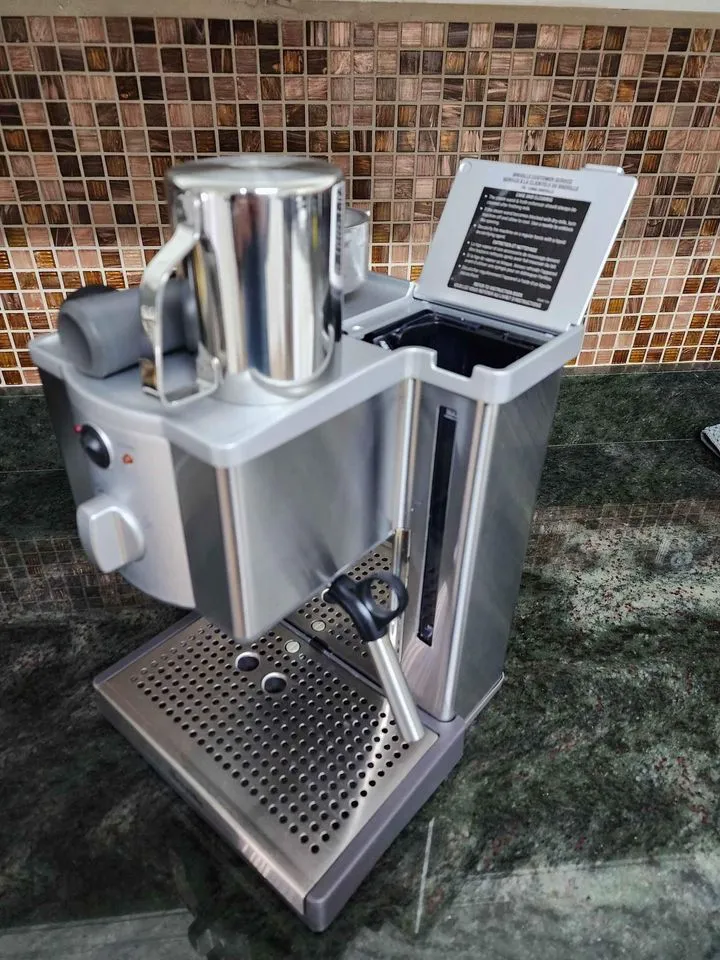
Be warned that, unlike some higher-end models, there are no lights indicating required care. You won’t be alerted when the water reservoir is running low, the drip tray is full, or a descale is required, though I like that you can see the water level in the tank from the front of the machine.
I recommend setting a reminder on your phone to descale every six months if you’re using filtered water to brew (which you should). For unfiltered water, make it three months.
How Is The Espresso Quality?
The Breville Cafe Roma pulls a very reasonable shot of espresso for its price point. While it might not match the subtle nuances in flavor and rich crema you would expect from a premium machine, this does not taste like a cheap cup of espresso – though it does suffer from the consistency issues inherent in a thermoblock heating system. Some shots were definitely better than others, even when I worked to carefully control all variables (3).
Like most cheap espresso machines, the Cafe Roma works best with medium or dark roasts, which are easier to extract by their nature. My best results were with dark roast espresso blends, which produced shots that were sweet and balanced with an appealing layer of crema. However, they lacked the complexity and vibrancy of truly cafe-quality espresso.
Pressurized Filter Baskets
This machine comes with pressurized filter baskets, which is pretty standard practice for entry-level models. A pressurized basket guarantees good flavor and a nice layer of crema on your espresso, even if you’re using pre-ground coffee or you haven’t mastered distribution and tamping. But it prevents your shot from achieving true greatness. Fortunately, there is an easy and affordable solution to this problem.
Once your skills improve (and assuming you have access to a good burr grinder), you can buy and install a non-pressurized basket for instantly better espresso. That’s what I did with mine. This easy upgrade requires no tools and costs less than $10, and the flavor improvement is obvious.
Can you make coffee with the Breville Cafe Roma?
You can’t brew coffee with this machine, but you can make an Americano, which has a similar body and intensity. Just pull a double shot, then top it off with 4 ounces of hot water. Sadly, the Cafe Roma lacks a built-in hot water tap, so you’ll need to heat water in a separate kettle.
The Stainless Steel Build Is A Standout
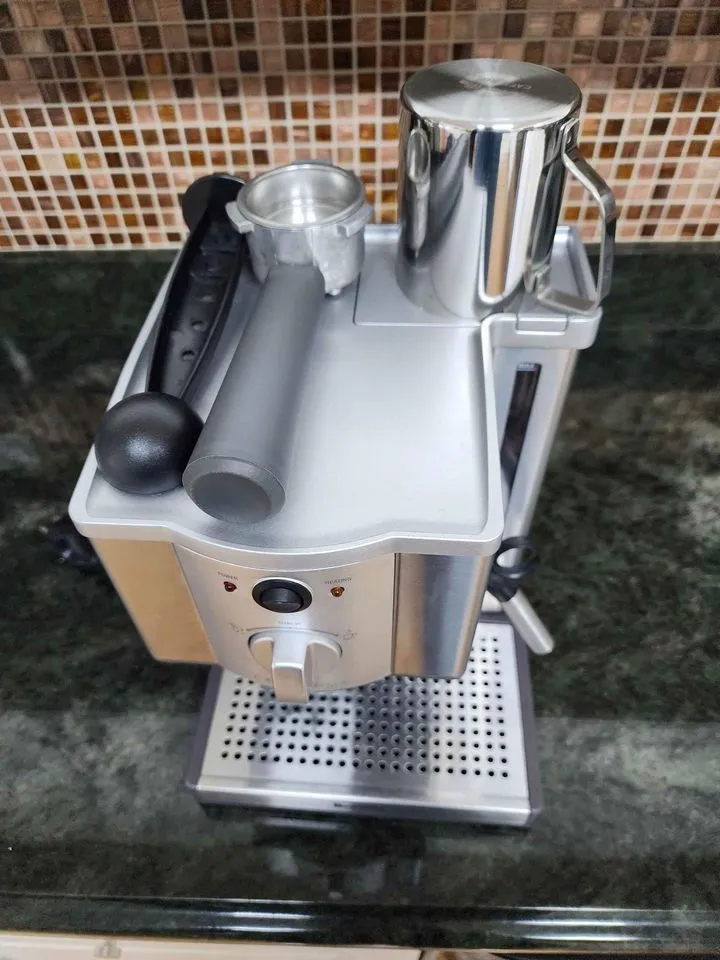
One of the Cafe Roma’s biggest selling points is its durability. It’s made primarily of stainless steel, which is corrosion-resistant, long-lasting, and easy to keep clean. I can’t think of another machine at this price that isn’t mostly plastic. And even though the aesthetics of this older model could do with a refresh, I still think the brushed stainless gives it the classiest look of any budget option.
Its simple design, with minimal extraneous features and no digital screens, also means that there is less to break or wear out.
The Cafe Roma has a relatively small footprint of just 12” x 12” x 15”. It’s not the smallest on the market, but it’s in the ballpark. Even those with tiny kitchens should be able to find a countertop location to showcase this fine piece of machinery.
A few other noteworthy features include a die-cast metal top surface that serves as a convenient six-cup warming tray and a removable 40-ounce water tank with, as previously mentioned, the water level visible from the front of the machine.
No Space For Large Mugs
My primary complaint about the design and build of this machine is that it has limited space under the spout to fit a tall mug. This is common in many budget espresso machines, but the Cafe Roma is worse than average. Plus, it has a pretty shallow drip tray, so even removing it doesn’t yield a ton of extra clearance.
If you’re planning to make a larger drink, like an Americano or a latte, be prepared to pull your shot into an espresso cup and then transfer it to the larger mug.
Is The Cafe Roma Worth Its Price?
The Cafe Barista currently retails for around $225, which I think is fair but not exceptional value. You can find cheaper machines that match the quality of espresso and user-friendly experience, but you’re paying a bit more for the stainless steel build and the Breville reputation.
That’s not necessarily a bad thing. Breville backs this coffee machine with a 1-year warranty and, in my experience, provides exceptional customer service for as long as you own it. Not every discount brand is as accommodating. The other nice thing about Breville products is it’s easy to buy replacement parts should anything go wrong, so you can usually repair minor issues without buying a whole new machine.
The Cafe Roma comes with everything you need to start your home barista journey, including a tamper that doubles as a scoop for grounds, a milk frothing pitcher, and a cleaning tool – easily $30 or $40 worth of accessories. That said, I’d still recommend upgrading the tamper to a heftier metal version as soon as possible.
Don’t Buy The Breville Cafe Roma If…
- You want something more hands-off: If you’re not interested in learning to operate a semi-automatic machine with a manual steam wand, there are plenty of more automated alternatives – though plan to spend a bit more. I love the Breville Bambino Plus, which has programmable shot volumes and an automatic steam wand. For something even more hands-off, the Mr. Coffee Cafe Barista has an automatic milk frother that makes your cappuccino at the press of a button.
- You want a built-in grinder: Many of Breville’s higher-end models feature built-in grinders, a convenient and space-saving option if you don’t already own a burr grinder. Check out the always-popular Breville Barista Express or the newer (and even better) Breville Barista Pro.
- You’re not an espresso beginner: If you’re an intermediate-to-expert espresso lover, the basic Cafe Roma will likely be a disappointment. Check out the Gaggia Classic Pro for a commercial-quality machine with a surprisingly affordable price tag. Or splurge on the premium Breville Dual Boiler to enjoy perfect espresso drinks that rival your local cafe.
- You want something cheaper: Cheap espresso machines inevitably sacrifice build quality, but I’ve been generally impressed by the bargain-priced Delonghi Stilosa. Though it has a lot more plastic than the Cafe Roma, it’s well-made, easy to use, and pulls a pretty delicious espresso shot—all for about half the price.
The Verdict
The Breville Cafe Roma Espresso Maker is an excellent choice for a first espresso machine. Its practical design, dual-wall filters, and froth-enhancing steam wand make it effortless to make great espresso and delicious cappuccinos. And its stainless steel construction means maintenance and repairs won’t slow you down.
While this retro model definitely needs a few updates, especially the thermoblock heater, I still think it deserves consideration as one of the top bargain-priced espresso machines for aspiring baristas who want to brew espresso at home.
References
- Wensma, T. (2024, January 22). Microfoam: How much should each milk-based coffee drink have? Retrieved from https://perfectdailygrind.com/2024/01/microfoam-milk-coffee-latte-art/
- Bryman, H. (2019, June 13). From Pro Scene to Home Machines: A Conversation with Breville Coffee Guru Phil McKnight. Retrieved from https://dailycoffeenews.com/2019/06/13/from-pro-scene-to-home-machines-a-conversation-with-breville-coffee-guru-phil-mcknight/
- Goodwin, R. (n.d.). Mastering the Perfect Espresso: The Crucial Role of Temperature Control. Retrieved from https://ecscoffee.com/blogs/ecs/the-importance-of-temperature-control-in-coffee-and-espresso-brewing
