
Best Jamaican Blue Mountain Coffee Of 2026 And Fakes To Avoid
Do you like smooth coffee with big flavors? Then you’re going to love Blue Mountain coffee! It has a worldwide reputation for excellence, though it comes with a price tag to match. Is it all hype, or does this mystical bean live up to its expectations?
At A Glance:
- TOP PICK: Volcanica Jamaica Blue Mountain Wallenford
- SPLURGE ON: Volcanica Jamaica Blue Mountain Peaberry Coffee
- BEST LOW-ACID BEANS: Out Of The Grey Jamaica Blue Mountain
This guide is here to answer all your Jamaican Blue Mountain coffee questions. What are the best beans to buy? How should you brew them to get your money’s worth? And we’ll help you avoid falling victim to the Blue Mountain scam that traps 80% of unsuspecting consumers.
The 6 Best Jamaican Blue Mountain Coffees Of 2026
| image | product | details | |
|---|---|---|---|
|
Volcanica Coffee JBM Wallenford |
|
|
|
Volcanica Coffee JBM Clifton Mount Estate |
|
|
|
Out Of The Grey Single Origin JBM |
|
|
|
Volcanica Coffee JBM Peaberry |
|
|
|
Dancing Moon 100% JBM K-Cups |
|
|
|
Volcanica Coffee JBM Blend |
|


Jamaica Blue Mountain (JBM) coffee is often called the “Rolls Royce of Coffee,” and I get the comparison. It’s bold, expensive, and there’s nothing subtle about it. It’s a smooth ride, but it certainly attracts attention.
Here are this year’s top picks for our Jamaican Blue Mountain coffee review roundup.
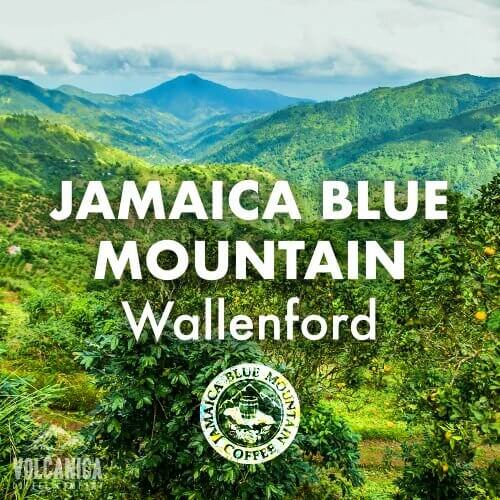
1. Volcanica Coffee JBM Wallenford
Roast: Medium
- Tasting notes: Chocolate, orange peel
- Estate: Wallenford
- Ground or whole bean: Either
Volcanica Coffee has an excellent reputation for sourcing some of the world’s best and most exclusive beans, so you can buy this Jamaica Blue Mountain coffee with complete confidence.
These beans come from the large Wallenford Estate, which spans 5,000 acres across the Blue Mountain and High Mountain regions. The beans are wash processed, and our tasters definitely noted their crisp, clean taste.
Coffee grown here is known for being brighter and more fruity than other Blue Mountain beans.
This medium-roasted coffee is versatile enough for any brewing method, but we particularly loved it as a pour over. It delivers a brew with an intense aroma, and we tasted notes of orange and some chocolatey sweetness in the cup.
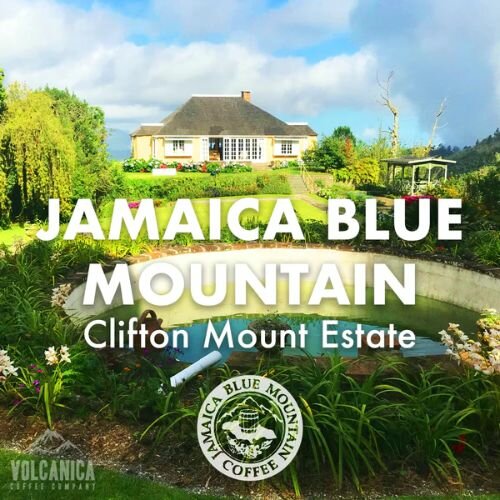
2. Volcanica Coffee JBM Clifton Mount Estate
Roast: Medium
- Tasting notes: Nuts, chocolate, rich body
- Estate: Clifton Mount
- Ground or whole bean: Either
This second excellent Jamaica Blue Mountain coffee from Volcanica could just as easily be our top pick. It just depends on the flavors you enjoy.
This single-origin coffee comes from the Clifton Mount Estate. We found it was less fruity than the Wallenford beans, leaning more heavily towards deep chocolate flavors with just a hint of bright acidity. So it’s a great choice for lovers of more traditional coffee flavors looking to expand their palate.
We thought it made a fantastic espresso, thanks to a naturally heavy body and creamy mouthfeel. It even packed enough of a flavor punch to make a fine latte.

This super-smooth quality coffee is certified by the Jamaica Agricultural Commodities Regulatory Authority (JACRA) as well as being Rainforest Alliance and Direct Trade certified. So you can trust that the money you spend is being properly directed back to the community at origin.
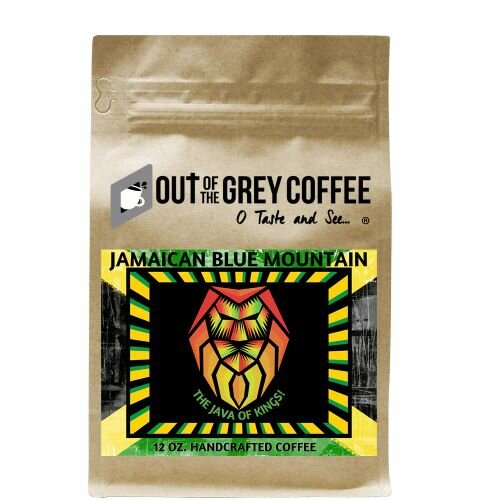
3. Out Of The Grey Single Origin JBM
Roast: Medium-Dark
- Tasting notes: Rich chocolate
- Estate: Blue Baron
- Ground or whole bean: Either
The Blue Baron Estate isn’t one of the big names for Jamaica Blue Mountain coffee, with a relatively small farm of just 67 acres. But the terrain here is perfect for growing these exclusive beans, situated between rivers at altitudes of 2000 to 3000 feet in the Buff Bay Valley.
The Minott family has been growing coffee here for almost 70 years, planting the trees amongst sections of natural rainforest and processing the harvest with natural spring water.
Along with the characteristic fruitiness, this coffee has a rich chocolate brownie flavor and full body. Several of our tasters noted that it was equally delicious black or with milk. The medium-dark roast enhances the natural sweetness of the bean while producing a lower-acid coffee that is perfect for anyone with digestive issues.
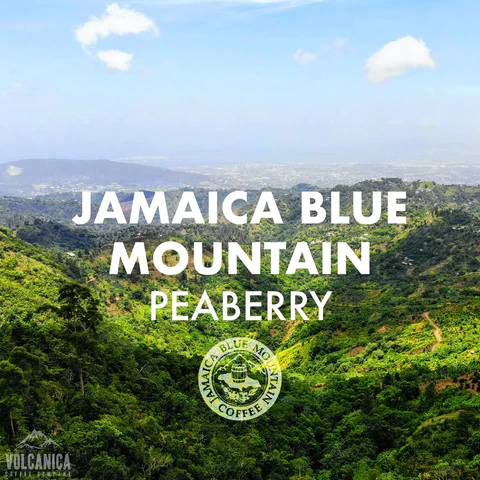
4. Volcanica Coffee JBM Peaberry
Roast: Medium
- Tasting notes: Floral, cream, smooth chocolate
- Estate: Clydesdale or Wallenford
- Ground or whole bean: Either
Jamaican Blue Mountain Peaberry coffee is widely recognized as the best coffee in the Caribbean and is often touted as the best in the world. It’s pricey, but the flavors are a notch above even standard JBM coffee.
We found this to be an incredibly smooth brew, delicately sweet without a hint of bitterness. It has a medium body and the most subtle flavors of any JBM coffee we tried. But subtlety is not a bad thing. The gentle flavors of cream, chocolate, and florals kept us coming back over and over again for “just one more taste.”
A peaberry stems from a natural genetic mutation that causes a coffee cherry to have one bean rather than two (1). That single bean doesn’t have to share its nutrients and thus develops a more intense flavor. Additionally, peaberry coffee must be meticulously hand-sorted, ensuring it is always the highest quality.
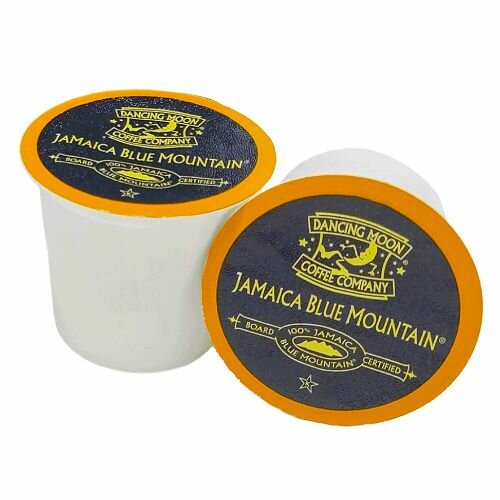
5. Dancing Moon 100% JBM K-Cups
Roast: Medium
- Tasting notes: Smooth, hazelnut, cocoa
- Estate: Unspecified single estate
- Ground or whole bean: K-Cups
In our opinion, the best way to enjoy Jamaican Blue coffee with your Keurig brewer is to invest in a refillable K-Cup filter, allowing you to brew any freshly ground or pre-ground coffee. However, if you can’t resist the convenience of a prepared K-Cup, Dancing Moon is one of few brands offering certified 100% Jamaican Blue Mountain coffee in single-serving form.
This coffee is grown on a single estate at high elevation, giving it a fairly complex flavor. We tasted primarily cocoa and hazelnut with minimal bitterness. It’s a very smooth coffee, and we were surprised by the lack of acidity from high-altitude Arabica.
Like most K-Cups, Dancing Moon pods contain a relatively small dose of just 11 g of coffee (we weighed it), so consider brewing a small serving to enjoy the full flavor intensity.
Dancing Moon donates 5% of profits to the Semper Fi & America’s Fund to benefit US Armed Forces members.
6. Volcanica Coffee JBM Blend
Roast: Medium
- Tasting notes: Chocolate, orange, lemon
- Estate: Various
- Ground or whole bean: Either
We typically advise against buying a blend of Jamaican Blue Mountain coffee beans, as they are unregulated, overpriced, and can contain less than 10% real Blue Mountain coffee. But this coffee from Volcanica is the rare exception. It’s approved by the Jamaica Agricultural Commodities Regulatory Authority. And, to be perfectly honest, our tasters loved it!
This specialty blend is crafted with 30% pure Jamaican Blue Mountain beans, with the remaining 70% made up of a supporting cast of the most elite mountain-grown coffees. The result is a wonderfully balanced brew that still has a ton of character. We tasted a vibrant fruit acidity with a rich chocolate depth and intense aroma.
The big winning factor here? They’re nearly half the price of 100% pure Jamaica coffee. This is a great way to experience the world-renowned JBM flavor profiles without breaking the bank.
How We Test and Rate Coffees
We purchased, brewed, and tasted over 15 Jamaican Blue Mountain coffees to bring you this list of the top six – an expensive and, for the most part, delicious endeavor. We prioritized single-origin coffee but included a few blends, too. If there is an affordable JBM blend that tastes as good as the pure stuff, that’s a hot tip we definitely want to pass along to our readers.
Each coffee was prepared using three brewing methods: pour over, French press, and espresso. The exception is the K-Cups, which were brewed using a Keurig K-Elite. For the pour over and French press brews, we used a standardized recipe for every coffee. For espresso, we felt it only fair to dial in each coffee to showcase it at its best. Every coffee was then blind-tasted and rated by at least three coffee drinkers.
What Is So Special About Jamaica’s Blue Mountain Coffee?
Jamaica’s Blue Mountain coffee is special thanks to the unique combination of climate, geography, and Arabica coffee variety found nowhere else on Earth. That’s why beans from the Blue Mountains are frequently called the best coffee in the world.
Why is Jamaican Blue Mountain coffee the best?
The Blue Mountain range has an ideal climate for growing Arabica coffee beans, with high elevations, ample sunshine, and plenty of humidity (2). The soil is rich and fertile. These conditions, combined with the dedication of local farmers to hand-picking and sorting their coffee beans, make Jamaican Blue Moutain coffee the best.
What Do Blue Mountain Coffee Beans Taste Like?
The smooth, clean taste of Blue Mountain coffee has given it a worldwide reputation for excellence. Along with Hawaii’s Kona beans, it is not uncommon to hear that Blue Mountain beans are on a coffee lover’s bucket list.
You can expect a mild but polished flavor, often featuring notes of chocolate and ripe fruit, with very little bitterness.
The best beans have a smooth but vibrant acidity and a sweetness that borders on creamy. The aroma is typically sweet herbs and florals with overtones of nuts, and it’s noted for its intensity.
What are the characteristics of Jamaica Blue Mountain coffee?
Jamaica Blue Mountain coffee is best known for its smooth flavors with minimal bitterness, subtle acidity, and robust aroma. This exotic coffee is crowd-pleasing, the sort of coffee you could sip all day – if you could afford it. It is notably less acidic than the best coffee from Ethiopia, where it originated.
Why Is Blue Mountain Coffee So Expensive?
Blue Mountain coffee is expensive for two main reasons: limited supply and the actions required to keep the quality high.
Supply is limited primarily by geographic area. These beans come from a small island and need to come from one of just a few different locations on the island to be certified. On top of that, they are time-consuming to grow, taking about twice as long as typical coffee (3). Roughly 80% of the crop is exported to Japan, leaving only 20% for the rest of the world.
Blue Mountain coffee trees grow in small groups on steep hillsides, making them difficult for workers to harvest. Then, every single bean is hand-inspected through a painstaking system to weed out defects and ensure that only the best coffee (most uniform beans) makes it to market.
It’s important to keep this perspective when shopping. These beans are genuinely made with diligent effort, and workers deserve their hard-earned wages.
How To Tell If the Coffee Beans Are Authentic
Blue Mountain coffee is an internationally protected brand. The Coffee Industry Regulation Act awarded it a globally protected certification mark, administered by the Jamaica Agricultural Commodities Regulatory Authority (formerly the Coffee Industry Board of Jamaica). Only coffee certified with this mark can be legally sold as “Blue Mountain.”
The development of a task force to crack down on fake Blue Mountain coffee has helped make the industry safer for consumers (4).
We are also not ruling out the possibility of ‘naming and shaming’ the establishments where the illegal practice of ‘passing off’ coffee is taking place.
There are no recognized criteria for calling something a “Blue Mountain blend.” These may contain less than 10% true JBM coffee, so always check the packaging. Blends are often crafted with other Jamaican coffee to lower the price or with something higher in acidity to round out the flavor profile.
How can you tell if Blue Mountain Jamaican coffee is real?
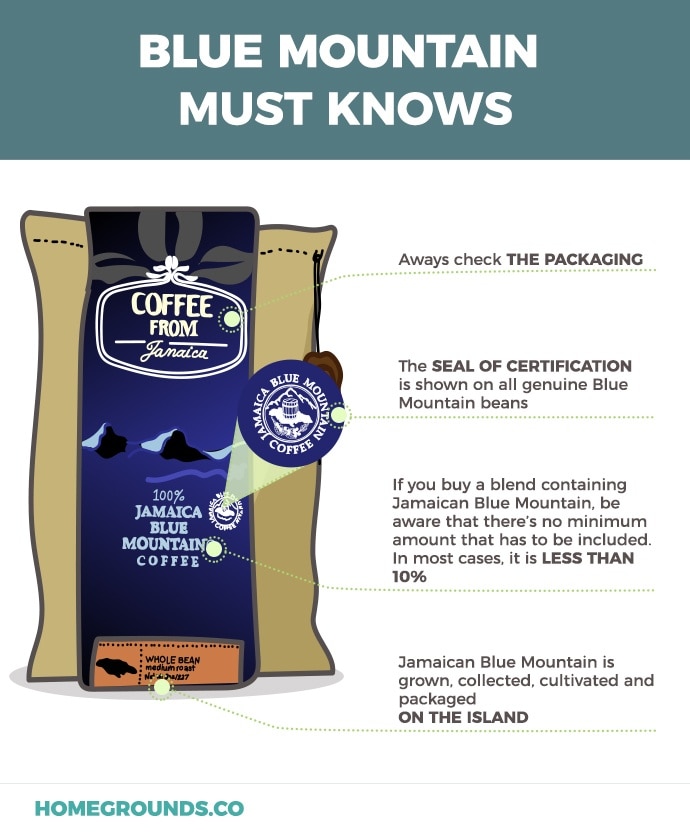
Follow these guidelines to avoid falling for any Blue Mountain coffee scams.
- Look for the seal of certification – The JCRA stamp is shown on all genuine Blue Mountain beans. It’s a blue circle; inside is an image of a mountain, an island map, a barrel and coffee beans.
- Avoid most blends – If you buy a blend, be aware that there’s no minimum amount of Blue Mountain that has to be included. Only buy a blend if you know how much Blue Mountain is within.
- Don’t be afraid to ask questions – Anyone with real Blue Mountain will be proud of that. It’s difficult to come by, so there will be a paperwork trail. Top Jamaican Blue Mountain coffee brands shouldn’t be offended if you ask to see some documentation.
Technology is playing a growing role in helping consumers find the real thing, according to Courtney Bramwell, CEO of Jamaica’s Sherwood Forest Coffee Estate (5).
Our customers need to be reassured that their JBM coffee can be traced to one of our high farms, or selected partner farms. We use blockchain technology as part of our supply chain verification process.
Traceability is increasingly valued in specialty coffee, and technological solutions benefit growers and customers.
Where To Buy Authentic Blue Mountain Coffee
You can find a bag of Blue Mountain coffee on eBay and Amazon, but we generally recommend avoiding these marketplaces. They may not be fresh roasted, and you will have difficulty verifying the certification.
The best place to buy Jamaican Blue Mountain coffee is from a renowned plantation or from a brand that deals directly with these plantations. Although there isn’t much difference in location or growing conditions, each plantation has subtle differences. Some of the best include:
- Wallenford Estate – This estate was bought in 2013 by a philanthropic businessman with the aim of reviving the company and continuing to produce some of the best Blue Mountain coffee in the world (6).
- Clifton Mount Estate – The oldest plantation still in operation in Jamaica, it sits at 5000 ft on the eastern slope of St. Catherine’s Peak.
- Flamstead Estate – Coffee is grown at 3,300 ft and is known for its incredible aroma.
- Greenwich Estate – Coffee is hand-picked, pulped, and parchment fermented to give it an incredibly rounded flavor and great mouthfeel.
Interested in visiting these coffee plantations? Here are some Blue Mountain tours to consider.
How is Blue Mountain Coffee Processed?
Almost all authentic Jamaican Blue Mountain coffee beans are wet processed (also known as washed processing). In this process, the sticky mucilage layer is removed from the coffee cherries before drying.
The coffee beans are sun-dried on large concrete slabs, which can take up to 5 days. After drying, the beans are “rested” for at least 10 weeks, a key stage for flavor development. Finally, the parchment layer is removed to yield a green bean ready to roast.
The beans are sorted and divided into four categories according to size. They are hand-inspected a final time before being sent to the JACRA for certification.
How to Brew Jamaican Blue Mountain Coffee for Optimum Flavor
Brewing a specialty coffee this prestigious demands your full attention. Here are a few general guidelines for brewing amazing Blue Mountain coffee:
- Keep your coffee fresh (store it in a vacuum container).
- Grind it as close to brewing as you can.
- Use an immersion technique to bring out the best of the flavors.
- Use good filtered water heated to 195 to 205 F.
Why Immersion?
Immersion brewing styles get every scrap of flavor out of your freshly ground coffee (7). They deliver a cup of coffee with a robust flavor and rich mouthfeel. Try a French press for a classic immersion brew, or use a Clever Dripper or Hario Switch to sample a cleaner cup. You could also experiment with cold brew.
Espresso fans, don’t despair. Our tasters loved the Jamaican Peaberry, Out Of The Grey Coffee, and Blue Mountain Blend prepared as espresso. These coffees would also be excellent using Aeropress or Moka pot coffee makers.
Roasting your own?
Since it’s so expensive, you’ll want to make sure you roast in confidence. We suggest a medium roast to bring out the complexity of the flavor. Medium roast coffee has a nice balance between the chocolate sweetness and the fruity acidity.
What is Blue Mountain Coffee?
Blue Mountain coffee is grown in the Blue Mountains of Jamaica, which sit at 7500 ft above sea level between Kingston and Port Antonio. This is the highest mountain range in the Caribbean. The high elevation and warm and humid climate are perfect for cultivating Arabica beans.
What makes a Jamaican coffee a true Blue Mountain Coffee?
True Blue Mountain coffee must come from the Portland, Saint Andrew, Saint Mary, or Saint Thomas parishes and altitudes between 3000 and 5500 ft. Authentic coffee is certified by the Jamaica Agricultural Commodities Regulatory Authority, previously called the Jamaica Coffee Industry Board.
Is Jamaican Blue Mountain Coffee the best in the world?
Many coffee experts deem Jamaica Blue Mountain coffee the best in the world. Coffee flavor is a matter of personal preference, but if you love smooth chocolate and fruit flavors, you’re likely to agree.
It’s not just the flavor. The meticulous picking, sorting, and certification process means that Jamaican Blue Mountain coffee is universally high-quality with few defects.
Which brand of Blue Mountain coffee is best?
You can trust any brand that has been certified by the JACRA, but our tasters were especially impressed with Volcanica Coffee. Volcanica has clearly developed relationships with Jamaican growers and green coffee traders. They offer a full line-up of Blue Mountain coffee, including several single-estate options, a peaberry coffee, a blend, and unroasted green coffee for home roasters.
The Verdict
Jamaican Blue Mountain coffee is expensive, but it’s worth a splurge, having earned its place among the best coffees in the world. If you want to treat yourself, we think the Volcanica Wallenford Estate beans provide a wonderful example of the famously smooth flavors. And they’re certified authentic, so you can trust you’re getting the real thing.
FAQs
Jamaica is known for Blue Mountain coffee. Though the same Arabica varietal can be grown elsewhere, only coffee beans grown in the perfect climate of Jamaica’s Blue Mountain region are certified as Jamaica Blue Mountain coffee and offer the famous flavor profile.
Yes, Jamaican Blue Mountain coffee is strong, at least in flavor. It is known for its rich taste of chocolate and fruit along with an intense aroma. However, it is no more caffeinated than other Arabica coffee beans.
No, most Jamaican Blue Mountain coffee isn’t organic. The added cost of certification might make it insurmountably expensive for most buyers. However, the ethics of the region are to use the bare minimum of fertilisers, pesticides, and fungicides.
Yes, Jamaican Blue Mountain coffee is Arabica. It is a variety of Arabica called Typica, which is one of the oldest types of coffee. Along with Bourbon, it was one of two original varieties exported from Ethiopia by coffee traders in the plant’s earliest history (8).
References
- Brown, H. (2020, March 17). What Are Peaberry Coffee Beans? The Myths & The Reality. Retrieved from https://perfectdailygrind.com/2020/03/what-are-peaberry-coffee-beans-the-myths-the-reality/
- Scott, M. (2015, June 19). Climate & Coffee. Retrieved from https://www.climate.gov/news-features/climate-and/climate-coffee
- 7 reasons why Jamaican Blue Mountain coffee is so expensive. (2019, February 06). Retrieved from https://henryshouseofcoffee.com/blogs/blog/jamaicanbluemountain
- Brown, N. (2014, December 1). Jamaica’s Coffee Board Cracking Down On Counterfeit Blue Mountain Sellers. Retrieved from https://dailycoffeenews.com/2014/12/01/jamaicas-coffee-board-cracking-down-on-counterfeit-blue-mountain-sellers/
- Wallenford sold to AIC Int’l in J$4b deal. (2013, September 15). Retrieved from https://jamaica-gleaner.com/gleaner/20130915/business/business1.html
- DEWAR, T. (n.d.). Crackdown planned on fake Blue Mountain coffee. Retrieved from https://www.jamaicaobserver.com/news/crackdown-planned-on-fake-blue-mountain-coffee/
- Jamaica Blue Mountain Coffee. (n.d.). Retrieved From https://bluemountaincoffee.com/contact/#faqs
- World Coffee Research. (n.d.). History of Arabica. Retrieved from https://varieties.worldcoffeeresearch.org/arabica-2/history-of-arabica
