
Best Kona Coffee Brands (And Scams To Avoid)
Have you ever tried coffee beans from the Kona coast? There’s a reason the region’s coffee is held in such high regard in the coffee community – assuming you’re buying the good stuff.

That’s easier said than done, as most beans sold as “Kona” don’t live up to their name. Kona blends add cheaper beans to lower costs, and roasters will do everything possible to avoid making this obvious on the package. It’s like someone is selling you a fine wine but watering it down to increase profits.
At a Glance: Top 5 Picks for Kona Coffee
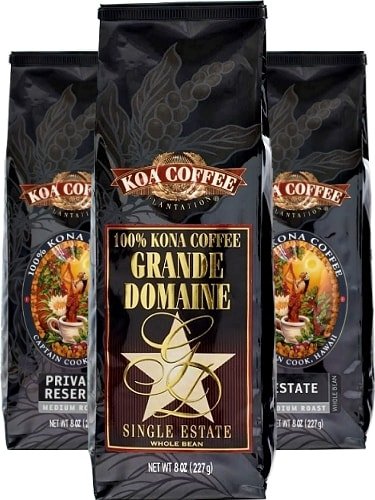
- TOP PICK: Kona Tri-pack by Koa Coffee
- WORTH A SPLURGE: Volcanica Kona Peaberry Coffee Beans
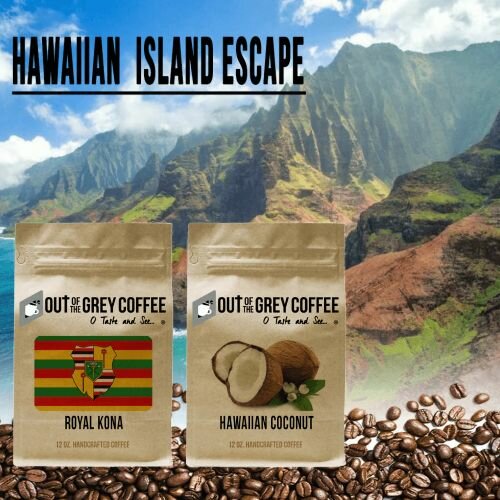
- BEST VARIETY PACK: Out Of The Grey Hawaiian Island Escape
This guide will help you avoid the scams and find the only Kona worth buying for a taste of Hawaii – the 100% real deal.
Best Kona Coffee Brands: The Top 7
| Image | Product | Details | |
|---|---|---|---|
|
Koa Coffee Kona Tri-Pack |
|
|
|
Hawaiian Lion 24K Gold Roast |
|
|
|
Koa Coffee Estate 100% Kona Coffee |
|
|

|
Volcanica Kona Peaberry Beans |
|
|
|
|
Royal Kona Private Reserve Kona Coffee |
|
|
|
Out Of The Grey Hawaiian Island Escape |
|
|
|
Blue Horse 100% Kona K-Cups |
|




To pick the best Kona coffee, you need to know how to recognize the good from the bad and the ugly:
- Avoid ‘blends’
- Go for beans grown in the right region
- Pay attention to the Kona coffee grade band
To make it even easier to find that perfect taste of Hawaii, we’ve selected the top options for you.
Lets take a look at some options to buy Kona beans online in more detail. In no particular order, the following options are the top picks (if you’re based in the USA) based on our research team, and customer feedback:
1. Koa Coffee Kona Tri-Pack
Grade: Varies
- Roast level: Medium
- Tasting notes: Varies
- Ground or whole bean: Either
Hawaii-based Koa Coffee has been in the business since 1997, and their Kona coffee has been rewarded with titles like PCCA Coffee of the Year and winner of the Gevalia Cupping Competition. We featured them as the number one Kona on our list of best coffee beans.
This stuff is wonderfully smooth and its lack of a bitter aftertaste makes you think nothing of having that second cup, or third…
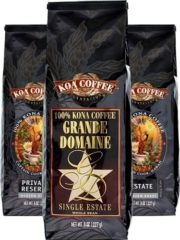
With Koa Coffee, you know you’re buying from a well-established brand with a well-deserved reputation for quality coffee. Because all their beans are so good, we recommend the Kona Coffee Tri-Pack – at least until you find your favorite. It includes three 8-ounce bags of medium roast Kona bundled at a discount price. You get the Grande Domaine, Private Reserve, and Estate beans, three different but equally wonderful flavor profiles.
The Grande Domaine is technically the most premium of the three, but it didn’t shake out that way in our taste tests. We thought it would be fun to run a blind tasting to compare the three coffees, and everyone had different favorites.
- The Grande Domaine is a slightly darker roast than the other two, and we picked up notes of dark chocolate, blackberries, and toasted nuts, with a syrupy mouthfeel.
- The Private Reserve Kona was once awarded “Best in America” by Forbes. It is super smooth with very little acidity, and we tasted hazelnut, nougat, and ripe fruit.
- The Estate is a rich and fragrant blend of the three highest-quality Kona grades. We thought it was the brightest of the three. While still low in acidity, we got more fruit-forward flavors, a floral aroma, and a creamy body.
Whether you find a favorite or want to keep buying all three, Koa Coffee rewards loyalty with special discounts for people in their coffee club and well-priced multi-buy packages.
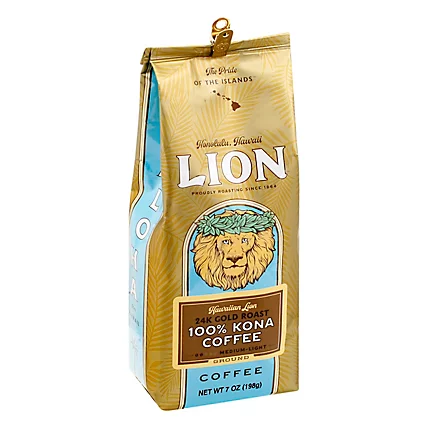
2. Hawaiian Lion 24K Gold Roast
Grade: n/a
- Roast level: Light-medium
- Tasting notes: Sweet, nutty, dried fruit
- Ground or whole bean: Either
The Hawaii Coffee Company is another well-established brand based in Hawaii. It has a long history, with its precedent Royal Kona Coffee established in 1968. They source their beans from their own plantations, like Koa Coffee.
The Hawaiian Lion 24K Gold Roast is another high-class option. It’s advertised as a medium-light roast, but we definitely thought it skewed closer to medium. However, it’s still the lightest roast on this list, showcasing a clean, bright flavor profile.
We preferred it brewed as a pour over, as the clean cup highlighted the more subtle tasting notes. While the dominant flavor profile was nuts and dried fruit, various tasters also picked out notes of honey, milk chocolate, and spice.
The Hawaiian Coffee Company offers this coffee in whole bean or “all-purpose grind.” The beans are ground only after being ordered, so they should be as fresh as possible.
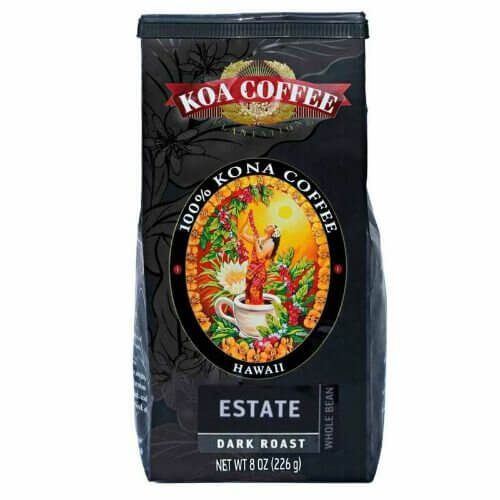
3. Koa Coffee Estate 100% Kona Coffee
Grade: n/a
- Roast level: Dark
- Tasting notes: Fruity, cocoa, smooth
- Ground or whole bean: Either
Good dark roast Kona coffees are rare. It takes a skilled roaster to achieve a darker roast without masking the unique flavor profile of the Kona beans. And there’s nothing worse than paying big bucks for something that tastes like average dark coffee. Hawaii-based Koa coffee is one of few brands we trust to push the roasting limits without surpassing them.
The Koa Coffee Estate dark roast is wonderfully sweet and toasty while still being distinctly Kona coffee.
The beans are grown at high elevations on a single estate and are never blended with coffee from another farm, which we suspect is why they can hold their character in the longer roast.
This is a very smooth coffee with little acidity. We tasted bittersweet cocoa, ripe fruit, and just a touch of coconut in the aroma. We suggest brewing with a French press or Moka pot to produce a cup of coffee with a full body to match its robust flavor.
4. Volcanica Kona Peaberry Beans
Grade: Peaberry
- Roast level: Medium
- Tasting notes: Smooth, nutty, luscious
- Ground or whole bean: Either
Volcanica specializes in Arabica coffee beans grown at high altitudes and in volcanic soil, so it’s no surprise they sell premium Kona coffee. Their Hawaiian Kona Peaberry provides an extra level of exclusivity, as these small beans only make up 5% of any given crop. Peaberry Kona beans are a rare delicacy, with demand often exceeding supply.
Peaberry is a type of coffee bean many people consider the most delicious of them all. Smaller and packing more flavor, these beans arise from a natural mutation inside the coffee cherry.
This medium roast gives you an incredibly easy-to-drink cup. More than one of our tasters remarked that it would be the perfect daily drinker, at least for anyone with a very comfortable coffee budget.
The orange blossom aroma is noteworthy and had the whole office salivating. We tasted classic chocolate and toasted almond flavors in the cup. Peaberry coffee beans are said to have a sweeter taste, which comes through here with honey notes. With a fuller body, they will satisfy those coffee lovers who like a rich flavor but also enjoy mellow brews low in acidity.
Volcanica Coffee ensures the freshness of your beans by only roasting after an order is placed. Your coffee is then shipped the same day, whenever possible.
5. Royal Kona Private Reserve Kona Coffee
Grade: 1 (Extra Fancy)
- Roast level: Medium
- Tasting notes: Smooth, nutty, tropical fruit
- Ground or whole bean: Either
It’s a bit silly to talk about a “budget” Kona coffee because these beans are still pricier than average. But if you want to enjoy a taste of the islands without totally blowing your monthly coffee budget – or settling for sub-par quality – these Private Reserve beans from Royal Kona are the way to do it.
This medium roast is crowd-pleasing. We enjoyed the natural sweetness and flavors of toasted nuts and tropical fruit, though we thought this coffee lacked a bit of complexity compared with the more expensive Volcanica medium roast.
This ultra-smooth brew with a medium body is versatile enough for any brewing method, from espresso to pour over. We even made a delightful cold brew. Note that this coffee is only available in one “all-purpose” grind size. So if you plan on making espresso or cold brew, buy the whole beans and grind them yourself.
It’s no surprise that this is Royal Kona’s most popular Kona coffee, nor that the American Academy of Taste judged it to be “superior.”
6. Out Of The Grey Hawaiian Island Escape
Grade: 1 (Extra Fancy)
- Roast level: Medium-Dark
- Tasting notes: Varies
- Ground or whole bean:
We love this creative idea from Out of the Grey for a complete Hawaiian tasting experience. This two-pack pairs classic Royal Kona Estate Extra Fancy beans, for the purists, with a Hawaiian Coconut flavored coffee. The combination provides two totally different ways to taste the islands – and you save a little money buying the bundle.
The Royal Kona beans are 100% Kona Coffee with a medium-dark roast. We preferred them brewed with a French press, which yielded a full-bodied coffee with a syrupy mouthfeel. The flavor profile was compelling and complex – so much so that of all the coffee we tasted, this one had the most diverse tasters’ notes. While everyone agreed dark chocolate and toasted almond flavors dominated, various tasters also noted watermelon, papaya, brown sugar, strawberry, vanilla, and floral lily.
The flavored Hawaiian Coconut coffee is designed as a taste of the tropics, flavored with coconut and pineapple. We aren’t generally big flavored coffee fans here, but we must admit this was a clever combination; the sweet coconut flavor is nicely balanced by slightly tart pineapple. The flavors feel natural and subtle, unlike when cheaper brands overload flavor chemicals to mask bad beans. Take a sip, close your eyes, and picture yourself on a beach somewhere.
7. Blue Horse 100% Kona K-Cups
Grade: n/a
- Roast level: Dark-Medium
- Tasting notes: Nutty, floral vanilla, velvety body
- Ground or whole bean: K-Cup
Blue Horse is a Kona-based small business selling exclusively Kona coffee, and they’re one of few brands offering 100% Kona coffee in a K-Cup. You can tell they’re rooted in Hawaii by the respect with which they grow and process their coffee beans. Blue Horse coffee is shade-grown, handpicked, and sustainably processed using the sun and rainwater.
Most “Kona K-Cups” you find online might seem like a great deal until you realize they’re blends of as little as 10% Kona beans – not even enough to really taste them. Not only does Blue Horse use 100% Kona coffee in their K-Cups, but they guarantee that their K-Cups contain the exact same coffee found in their whole bean bags.
We don’t generally advocate for K-Cup coffee at Home Brews Coffee. In fact, we had to source a Keurig machine from a team member’s parents to test this coffee. But Blue Horse solves two of our main issues with K-Cup brews. They work in small batches, so the coffee isn’t stale, and each K-cup is packed with more coffee than the cheaper brands. We checked, and there was an average of 13.4 g of ground coffee in each cup. Unfortunately, they don’t solve our third problem with K-Cups, which is their environmental impact. These pods aren’t recycleable.
The first thing we noted when tasting this coffee was a profound natural caramel sweetness. It has a creamy body, fragrant aroma, and delicate flavors of toasted almond and floral vanilla. No one felt the need to add sugar to this brew.
These K-Cups are compatible with all Keurig brewers, including the 2.0 models. But in our opinion, you can enjoy a better (if less convenient) coffee by buying Blue Horse whole coffee beans and preparing a fresh cup.
How We Rated These Coffees
Every coffee on this list – plus a few more that didn’t make the list – was brewed using two methods: a French press and a pour-over dripper. The exception was the Blue Horse K-Cups, which were brewed in a Keurig K-Elite.
We recruited at least three team members for every taste test. But we often had 5 or 6 tasters because everyone wanted to get their hands on the pricey Kona coffee. Every taster filled out a survey about their coffee preferences and experience before participating.
Tasters were given no information a coffee before trying it. They were asked to rate the coffee and make notes on flavor, body, aroma, and mouthfeel. We compared everyone’s rating and notes to compile this list of the best.
Why are Kona Coffee Beans So Expensive?
One reason Kona coffee is so expensive is that demand often exceeds the supply of this gourmet coffee. The Kona coffee belt is a small growing region, which necessarily limits production. In 2019, just 27 million pounds of coffee were produced in all of Hawaii (1). In comparison, the world’s largest producer, Brazil, grew over 4.5 billion pounds of Arabica beans.
It may only get more expensive in coming years, warns the Kona Coffee Farmers Association. Yields are forecast to drop by as much as 40% in 2023 due to the cumulative effects of pests, diseases, cost increases, and climate change (2).
Hawaiʻi coffee industry is bracing for what could be one of their worst years for production. That will likely mean higher prices for coffee drinkers as well.
Plus, Hawaii’s location in the middle of the Pacific Ocean makes it more challenging and expensive to import supplies and export coffee.
Another thing that makes Kona so expensive is that Hawaii is the only coffee-growing region in the USA. It falls under U.S. labor laws and minimum wage requirements, which are far more stringent than in most coffee-growing regions in the developing world. It simply costs more for coffee farmers to operate Kona coffee farms (3).
Is Kona Coffee Worth the Price?
Yes, provided you’re buying real, 100% Hawaiian Kona coffee. The unique flavor profile of this specialty coffee is worth experiencing at least once if you’re a coffee lover. It’s expensive for valid reasons, and you can feel good knowing you’re supporting American agriculture and higher wages in the coffee industry with your dollars.
Why Is Hawaiian Coffee & Kona Coffee Special?
Coffee grown in Hawaii, particularly Kona, is special thanks to its unique environment, which is perfectly suited for the coffee plant. The combination of tropical climate, high elevations, and rich volcanic soil is ideal for growing coffee, especially high-quality Arabica coffee trees. The result is a cup of Kona coffee with an exotic taste, rich aroma, and round body that coffee lovers adore.
Where Can I Buy Real Kona Coffee?
The best place to buy Kona coffee is directly from plantations in Kona district, like Koa and Hawaii Coffee Company, or from brands that have established relationships with growers in the region, like Volcanica.
You can find Kona coffee available through online marketplaces like Amazon, and this can be a good option for many people. But make sure you do plenty of research to ensure you’re getting the real thing and that it is roasted in small batches so that it arrives fresh.
How do you know if you’re getting real Kona coffee?
The growing popularity of Kona coffee beans over the past century has made the industry rife with scammers and those looking to take advantage of consumers. We have a few tips to help you sort the good from the bad and the ugly.
When buying Kona coffee, ensure the label reads “100% Kona Coffee” and the coffee is grown in the Kona district. Some brands take it a step further and have their beans certified by the Hawaii Department of Agriculture. This isn’t mandatory, but it can give you an extra level of security that you’re buying the real deal.
Stay Away From Kona Blends
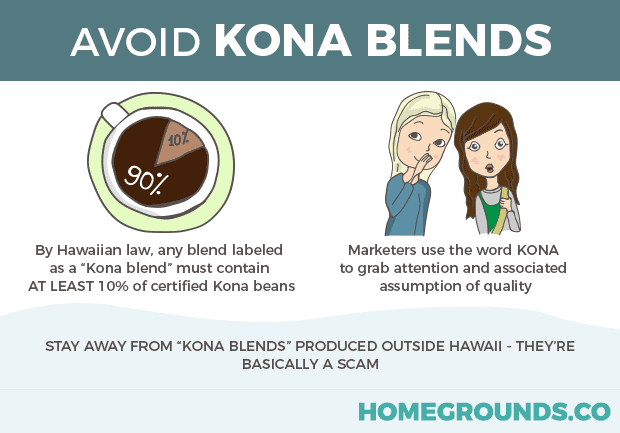
Many companies produce “Kona coffee blends” to save costs and increase supply. Stay away from these. You want pure Kona coffee beans only.
According to Hawaiian law, a “Kona blend” must contain at least 10% certified Kona beans. Companies wanting to make a buck will, naturally, use the 10% and not one bean more, leaving the remaining 90% of these blends filled with generic dark or medium roast coffee. You won’t be able to taste what makes Kona coffee special, so don’t waste your money.
Even worse, some companies outside Hawaii don’t use any Kona at all. While the Hawaiian law is strict on this, many places don’t care if companies use the Kona name merely for marketing purposes. These so-called Kona beans might contain only a tiny fraction of Kona beans or none at all. Stay away from all “Kona Blends” unless you are fully aware of what you’re buying.
Stay Away From “Kona Beans” That Are Not From The Kona Region
The Kona Belt of Hawaii is prized for its excellent micro-climate, like Champagne in France. But this doesn’t apply to all of Hawaii. In fact, most other islands of Hawaii, including Maui and Kauai, are poorly suited for coffee farming (4).
This does not mean that other coffee beans from Hawaii are terrible. But if a coffee is labeled as Kona, and you’re paying Kona prices for it, it should be grown in the correct Hawaiian coffee region. The term “Hawaiian coffee” is sometimes used on packaging to denote high quality, but this is simply misleading advertising. Don’t be fooled!
Always Check The Grade
Hawaiian Big Island coffee beans go through the most meticulous testing in the world, with each batch of Kona receiving a grade from the Hawaii Department of Agriculture (HDOA). If you want to make sure you’re getting the best of the best, pay attention to the HDOA grades of Kona coffee (5).
The grade is based on criteria including the size, shape, moisture content and possible flaws in the beans. Hawaiian coffee is divided into eight grade bands which are:
- Extra fancy (the highest quality)
- Fancy
- No.1
- Select
- Prime
- No. 3
- Natural Prime
- Mixed Natural Prime (The lowest quality)
“Extra Fancy” is the highest quality, although any of the first five categories can be considered a high-class bean. Grading is affected by qualities like bean size and rarity, which don’t necessarily influence the taste of the coffee.
Extra Fancy Kona is uniform in color and size and contains almost no defective beans, making it the most luxurious Kona you can get. You’ll definitely pay a premium for it, but it’s worth every penny for a serious coffee lover!
What Does Kona Coffee Taste Like?
The best Kona coffee has a unique, amazing flavor profile and aroma like no other coffee on Earth. There’s a reason it has an established place among the best coffee in the world.
The taste of your coffee will be affected by the roast, the brew method, and the freshness.
When prepared properly, you can expect to enjoy hints of brown sugar, milk chocolate, honey, and a bright tropical fruit.
In general, it is described as bright, crisp, and clean. Expect a pleasant, lingering aftertaste with hints of nuts and citrus on your pallet. The aroma is unforgettable, a sweet mix that’s reminiscent of caramel, butter, cocoa, or fruit.
It’s not so much the Kona coffee taste, aroma, or aftertaste alone but the combination of all three that makes this premium coffee so addictive and beautiful.
Why are Kona beans famous?
Authentic Kona coffee beans are famous due to their unique flavor profile, making them a must-try for coffee lovers worldwide. But that’s only part of the story; the history of Kona coffee also plays a role.
Kona coffee has been famous for a long time, first drawing attention by winning an award of excellence at the 1873 World’s Fair in Vienna. Then, demand for coffee from the Big Island of Hawaii increased during both world wars and when a freak frost destroyed most of the Brazilian crop. Finally, Kona brands certainly benefit from marketing hype, highlighting their exotic rarity and the fact that Kona is the only “Made in the USA” coffee.
If you want to find out more, you can read our article – what is kona coffee.
What’s the best roast for Hawaiian and Kona Coffee?
The best Kona roast is generally agreed to be a medium or medium-dark roast. These roasts caramelize the beans enough to highlight their naturally sweet flavors – like chocolate, nuts, brown sugar, and honey – while keeping the bright tropical fruit flavors intact. Kona Peaberry coffee, which has a creamier body and is naturally lower in acidity, tends to be roasted no darker than medium.
The best roast for coffee from Hawaii is far more variable as Hawaiian coffee varies considerably in flavor profiles. Hawaii has fantastic light, medium, and dark roast beans.
The Verdict
All of the Kona brands on this list are worth their premium price, or we wouldn’t recommend them. But the Koa Coffee Tri-Pack stands out from the crowd, offering amazing value for three bags of top-class Kona. If you’ve never tried Kona before and want to see what all the fuss is about, the Tri-Pack lets you sample three different Kona coffee types and flavor profiles. It’s a delicious way to educate yourself about coffee that comes from the Kona region.
FAQs
No, Starbucks doesn’t sell Kona coffee – at least not right now. It was featured as one of their limited-release offerings in 2012, so it is entirely possible that it will make its way onto the menu (6). Keep checking back!
No, Hawaiian coffee isn’t strong. Hawaiian coffees are known for their smooth and mild character. They are easy-drinking brews without overpowering acidity or bitterness. For a stronger-flavored cup, try using a metal-filtered brewing method and increasing your coffee-to-water ratio.
No, Kona coffee isn’t high in caffeine. It has the same caffeine content as any Arabica coffee, which is about 100 mg of caffeine per 8-ounce brewed cup. If you want a more caffeinated brew, the best option is to use a higher coffee-to-water ratio in your coffee maker.
Yes, Kona coffee has less acid than many other specialty coffees, which is why it is often described as “smooth.” If you have a sensitive stomach, you may find Kona coffee more tolerable than others. Look for darker roasted Kona coffees, which are even less acidic than lighter roasts.
References
- State of Hawaii Department of Agriculture. (2020, May). Coffee Acreage, Yield, Production, Price and Value State of Hawaii, 2020. Retrieved from https://hdoa.hawaii.gov/add/files/2021/12/Coffee-Stats-2020_SOH_R_12.02.21.pdf
- Comunicaffe. (2022, November 4). Kona coffee farmers face big challenges. Retrieved from https://www.comunicaffe.com/kona-coffee-growers-are-facing-big-challenges/
- Royal Kona Coffee Company. (2015, August 28). Kona Coffee – Why So Expensive? Retrieved from: https://www.royalkonacoffee.com/kona-coffee-expensive/
- J. Deenik and A.T. McClellan. (2007, September). Soils of Hawaii. Retrieved from https://www.ctahr.hawaii.edu/oc/freepubs/pdf/SCM-20.pdf
- State of Hawaii Department of Agriculture. (2014, May 24). STANDARDS FOR COFFEE. Retrieved from https://hdoa.hawaii.gov/qad/files/2012/12/Summary-of-Chapter-4-143-7.14.pdf
- Starbucks Coffee. (2012, February 29). Limited Release of Starbucks Reserve 100% Kona Coffee at Select Retail Locations. Retrieved from https://stories.starbucks.com/stories/2012/limited-release-of-starbucks-reserve-100-kona-coffee-at-select-retail-locat/
