
THE 8 BEST ITALIAN ESPRESSO MACHINES OF 2024: MOLTO BENE!
If you want to enjoy authentic Italian espresso at home, start with one of these excellent Italian espresso machines.

When you think espresso, you think of Italy. As the homeland of espresso, it’s where many of the best espresso machines are still manufactured. But how do you know which offer true Italian craftsmanship and which are just trading on their heritage to sell a product? Let me help you.
I’ve done the research, run the tests, and drank far too many espresso shots in the quest to find the best Italian espresso machines. Here are my top 8 – chosen to satisfy every type of espresso lover at every budget.
At A Glance on Amazon: Best Espresso Machine Made in Italy
-
OUR TOP PICK:
Rancilio Silvia Pro X -
IMPECCABLE QUALITY:
Rocket Appartamento -
BEST AUTOMATIC MACHINE:
Nuova Simonelli Oscar II
The 8 Best Italian Espresso Machines Of 2026
Italy is the homeland of espresso, so it’s no surprise that there are a lot of excellent Italian espresso machines in the market (1). In fact, the majority of high-end commercial espresso machines are still made in Italy, but I stuck to home espresso machines for this list.
I chose the eight models below to represent a diversity of espresso experiences and budgets. So you’ll find a suitable machine for you, whether you want a super-automatic that does it all or a semi-automatic that lets you be in charge.
| Image | Product | Details | |
|---|---|---|---|

|
Rancilio Silvia Pro X |
|
|
 |
Gaggia Classic Evo Pro |
|
|

|
Nuova Simonelli Oscar II |
|
|
 |
Delonghi Magnifica Start |
|
|

|
La Pavoni Professional |
|
|
|
Rocket Appartamento |
|
|
|
La Marzocco Linea Mini |
|
|
 |
Delonghi Stilosa |
|



1. Rancilio Silvia Pro X
-
Type: Semi-automatic
- Heating system: Double boiler
- Pump: Vibration
- Water tank: 68 oz
The original single-boiler Rancilio Silvia was released in 1997, and fans immediately began clamoring for a double-boiler version. It took Rancilio 23 years, but the dual boiler Rancilio Silvia Pro was worth the wait. This machine far exceeded my expectations, easily sliding into the top spot on this list.
I expected it to be the Silvia with a second boiler, but Rancilio actually added a ton of unexpected upgrades.
Along with a 1-liter steam boiler and 0.3-liter brew boiler, it includes a PID temperature controller, adjustable soft pre-infusion, programmable turn-on time, and shot timer.
The Rancilio Silvia Pro X maintains the incredible durability that is Rancilio’s hallmark but improves on the brand’s reputation for bland aesthetics. The Silvia Pro X is sleek and attractive – available in stainless steel, black, white, or pink – and features a more professional stainless steel portafilter.
Yes, the Pro X is more than twice the price of the Silvia, but it’s much more than twice the machine. That said, if you only need a single boiler, the Rancilio Silvia remains a fantastic option.
2. Gaggia Classic Evo Pro
-
Type: Semi-automatic
- Heating system: Single boiler
- Pump: Vibration
- Water tank: 72 oz
The Gaggia Classic has, in my opinion, been the best entry-level prosumer espresso machine for decades. The latest edition, the Pro Evo, is the best yet. It maintains the simple operation, high-quality build, and low price that characterize the line while adding some noteworthy updates.
As with any semi-automatic espresso machine, it takes a bit of practice to dial in the perfect grind, dose, and shot timing. But if you’re new to home espresso, that’s part of the fun. And it’s that degree of user control that allows you to make the best espresso.
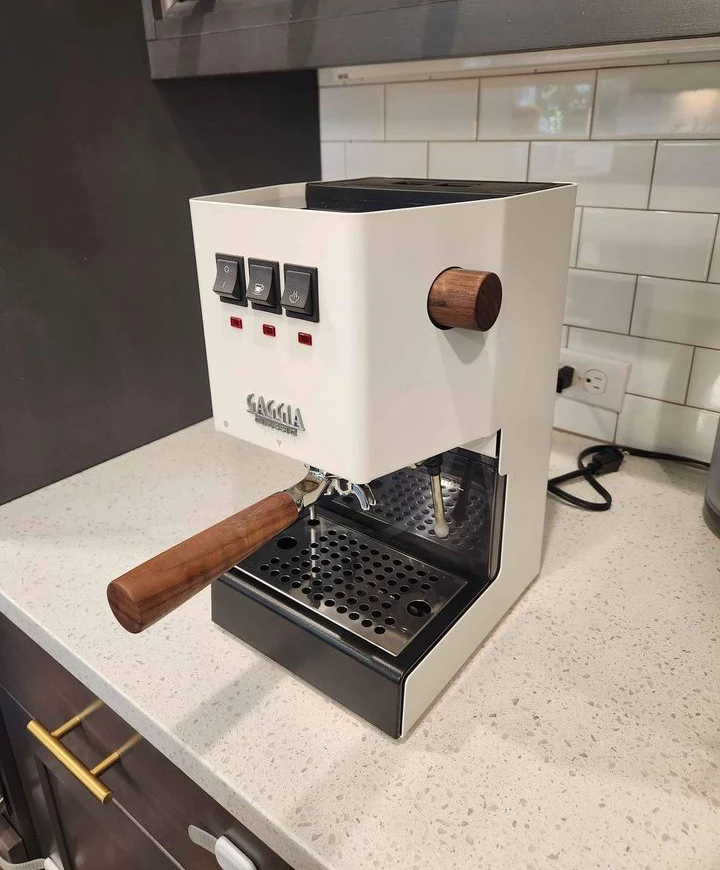
Two huge changes in recent years have taken this machine from good to excellent. With the Pro model, the Pannarello wand was replaced with a proper professional-style steam wand, making this a machine I could finally recommend to fans of milk-based drinks. And the Evo upgrade added a 9-bar OPV. If they’d only add a pressure gauge, I’d have no complaints left.
The Gaggia Classic Pro Evo is compact and attractive, with a durable stainless steel build and commercial parts that put it firmly in the prosumer category.
3. Nuova Simonelli Oscar II
-
Type: Automatic
- Heating system: Heat exchange boiler
- Pump: VIbration
- Water tank: 34 oz (or direct plumb)
The Nuova Simonelli Oscar II is a high-end Italian espresso machine that doubles as a piece of modern art. Its shiny chrome exterior and futuristic style make it as much a conversation piece as a coffee maker.
The Oscar II is the updated version of the best-selling original Oscar. Like its predecessor, it features a copper heat-exchange boiler so you can pull a shot and steam milk simultaneously. But the new model is more durable, lighter, and faster to heat.
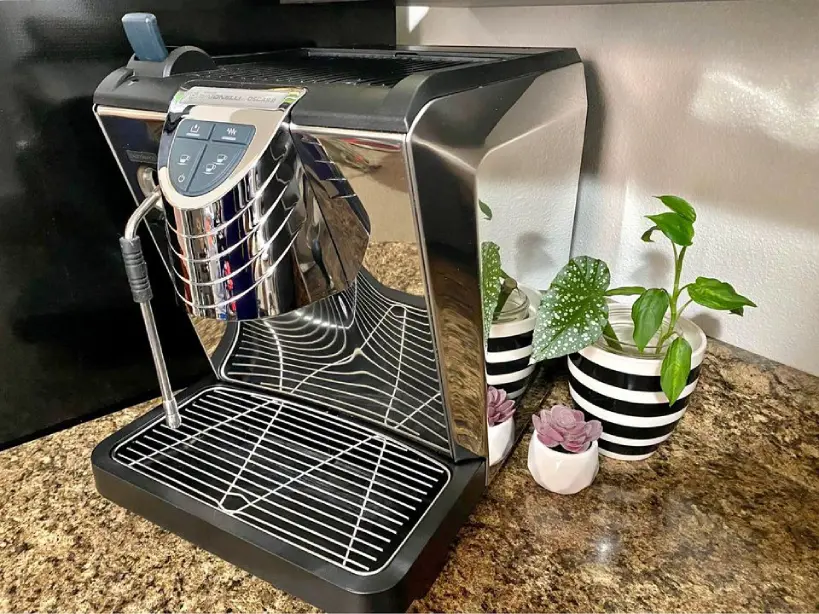
It’s an automatic espresso machine that uses a programmable timer for dosing. I generally prefer volumetric dosing, but timing is just as effective (and less expensive) once you have your puck prep dialed in.
The extra-long articulated steam wand is very easy to use, especially for novice home baristas. It excels even if you’re frothing small or large volumes of milk – something shorter wands can’t manage. The pressure is controlled by a manual lever.
A quirk of this machine is that it is available in two versions, either with a water reservoir or designed for direct plumbing. So you must decide which set-up you want before you buy. I’d recommend the tank as more practical for most home users, even though it’s smaller than I’d prefer.
4. Delonghi Magnifica Start
-
Type: Super-automatic
- Heating system: Thermoblock
- Pump: 15-bar vibration
- Water tank: 61 oz
Before I start, I should clarify that Delonghi is an Italian company; its machines are designed and engineered in Italy, but most are now manufactured elsewhere. This model is produced in nearby Romania. But Italian manufacturers of super-autos are few and far between, so let’s roll with it.
Delonghi’s Magnifica line is substantial, with many variations on the same theme, but the new Start edition is my current favorite. The updated LatteCrema automatic milk frothing carafe is better with non-dairy milk than older editions, a clear indication that Delonghi is taking note of changing customer preferences.
The Magnifica Start claims to have five preset drink options, but one of them is hot water. Regardless, it covers the basics well. You can enjoy an espresso, cappuccino, latte macchiato, or black coffee at the touch of a button, and each is customizable to your taste.
I like the sleek, all-black aesthetic and intuitive touchscreen display. I like the plastic casing a lot less, but I wouldn’t expect otherwise at this price point. It’s impressively compact compared to other super-autos, given that it contains a grinder and 1.8-liter water tank. At only 14 inches tall, it fits nicely under my upper cupboards, even leaving room to store cups on top.
Check out the Gaggia Brera for a truly made-in-Italy super-automatic machine. In my opinion, it surpasses the build quality of the Magnifica but offers a less enjoyable user experience.
5. La Pavoni Professional
-
Type: Manual lever
- Heating system: Single boiler
- Pump: n/a
- Water tank: 38 oz
La Pavoni is an Italian espresso icon. Indeed, the company founder was involved with the development of the very first espresso machines, so you can trust their manufacturing expertise (2).
Pavoni bought Bezerra’s patents in 1903 and improved many aspects of the design. Notably, he invented the first pressure release valve.
La Pavoni lever machines don’t have a pump. Extraction pressure is generated by the barista pulling a lever attached to a piston. The natural pressure profile achieved by a lever machine is coveted by espresso fanatics everywhere (3). I find it produces softer, sweeter, and smoother shots.
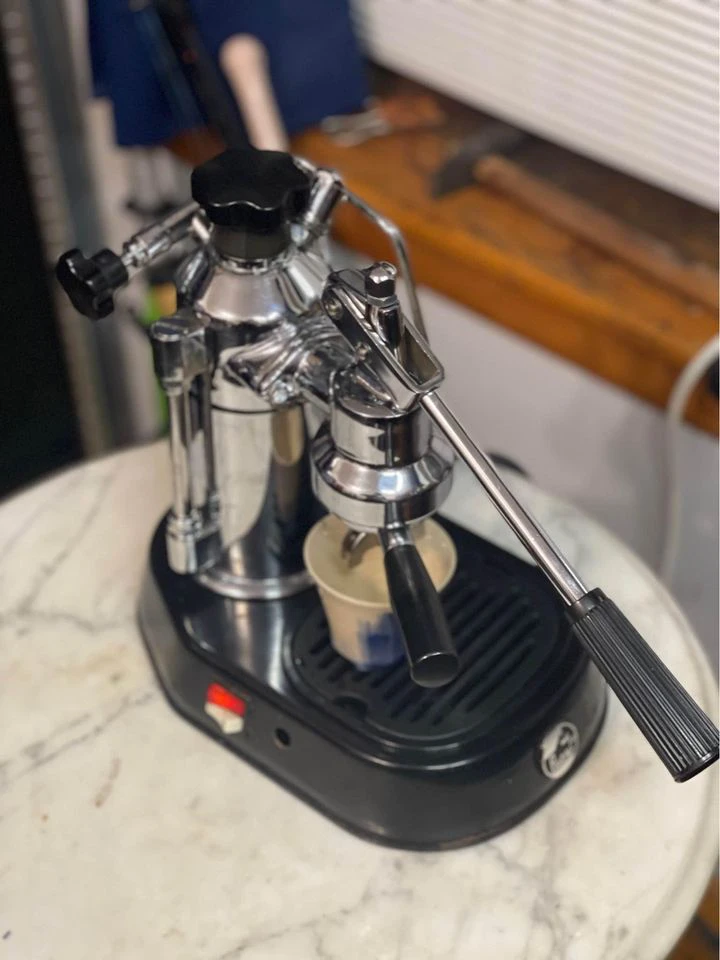
Despite its retro appearance, the La Pavoni Professional is surprisingly easy to use. If you’ve always been intimidated to experiment with lever espresso, I encourage you to reconsider. It even includes an automatic milk frother that you can swap in for the steam wand.
Note that if you only pull a few shots a day, you’ll be better served by the La Pavoni Europiccola, a similar model with a smaller capacity and lower price tag.
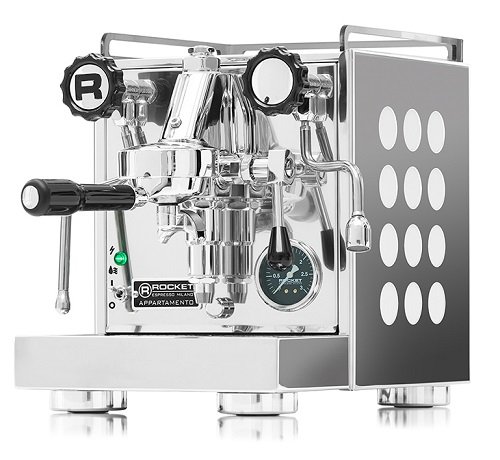
6. Rocket Appartamento
-
Type: Semi-automatic
- Heating system: Heat exchange boiler
- Pump: Vibration
- Water tank: 78 oz
The Appartamento is actually Rocket’s cheapest model, but it matches the craftsmanship of the higher-end machines and, in my opinion, offers plenty of performance for the average home user.
Its standout feature, as indicated by the name, is its compact footprint. At less than 9 inches wide, the Appartmento was designed to fit small apartment kitchens. Its small frame still packs prosumer-grade perks like a 1.8-liter heat-exchange boiler, E61 grouphead, professional-style steam wand and separate hot water tap, and a pressure gauge.
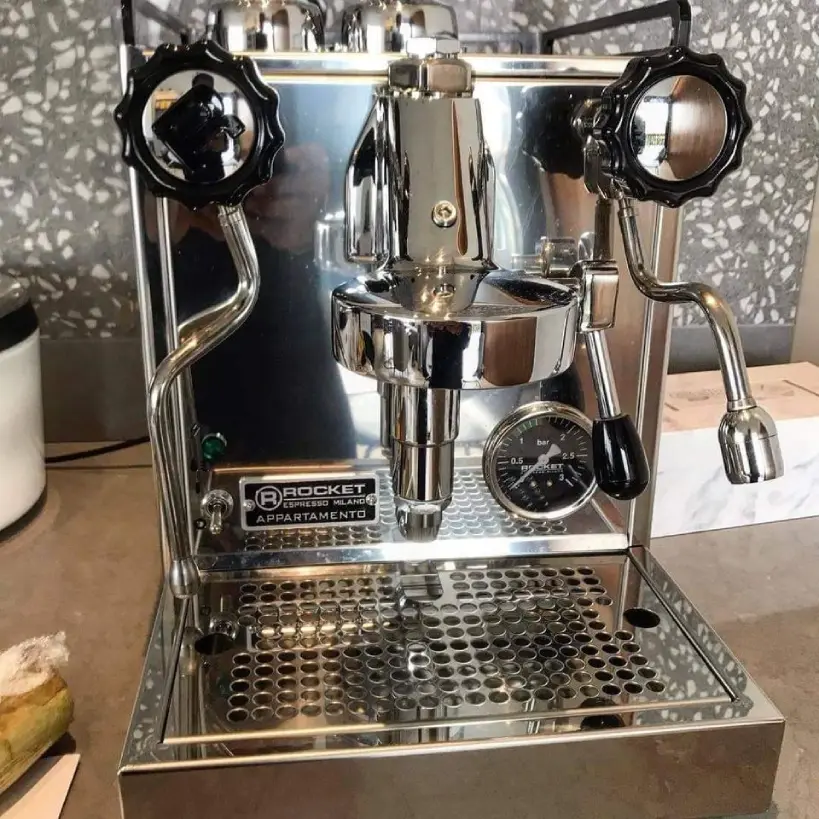
It has the chops to produce true cafe-quality specialty drinks. I was particularly pleased with the steam power, something often lacking in smaller machines. You can crank out a perfect silky latte or frothy cappuccino in seconds.
The Rocket Appartamento is also impressively quiet. Rocket engineered the interior to dampen pump vibrations – presumably another way to appeal to apartment dwellers whose kitchens and bedrooms are often adjoining. It works so well that if you told me it had a rotary pump, I’d believe you.
7. La Marzocco Linea Mini
-
Type: Semi-automatic
- Heating system: Double boiler
- Pump: Rotary
- Water tank: 85 oz
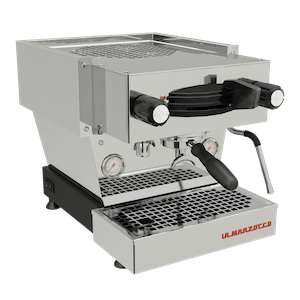
The La Marzocco Linea Mini probably won’t be in the budget for the average espresso fan. But it didn’t seem right to put together a round-up of Italian espresso machines without including the famed brand, especially now that they’ve finally entered the home market.
The Linea Mini is a scaled-down version of the famous Linea designed for high-end home users or small businesses, and it maintains many of the commercial-grade components of its big brother.
It’s a double boiler machine with individual PID temperature control at each boiler. That it makes fantastic espresso goes without saying, but the milk steaming is even more impressive. Thanks to a massive 3-liter steam boiler and professional stainless steel wand, it’s as powerful and efficient as most commercial machines I’ve used.
I love the Linea Mini’s unique style, which strays from the prevailing chrome-box look of most prosumer machines. It keeps the jaunty angles of the original Linea and adds a series of color options, from basic black to vibrant yellow.
8. Delonghi Stilosa
-
Type: Semi-automatic
- Heating system: Single boiler
- Pump: 15-bar vibration
- Water tank: 34 oz
As with the Magnifica, the Delonghi Stilosa is designed but not manufactured in Italy. You simply can’t find a made-in-Italy espresso machine for under $100. But I think the brand’s longstanding Italian expertise is at work here because the Stilosa consistently outperforms other inexpensive machines. It’s one of few machines at this price point I’d even recommend.
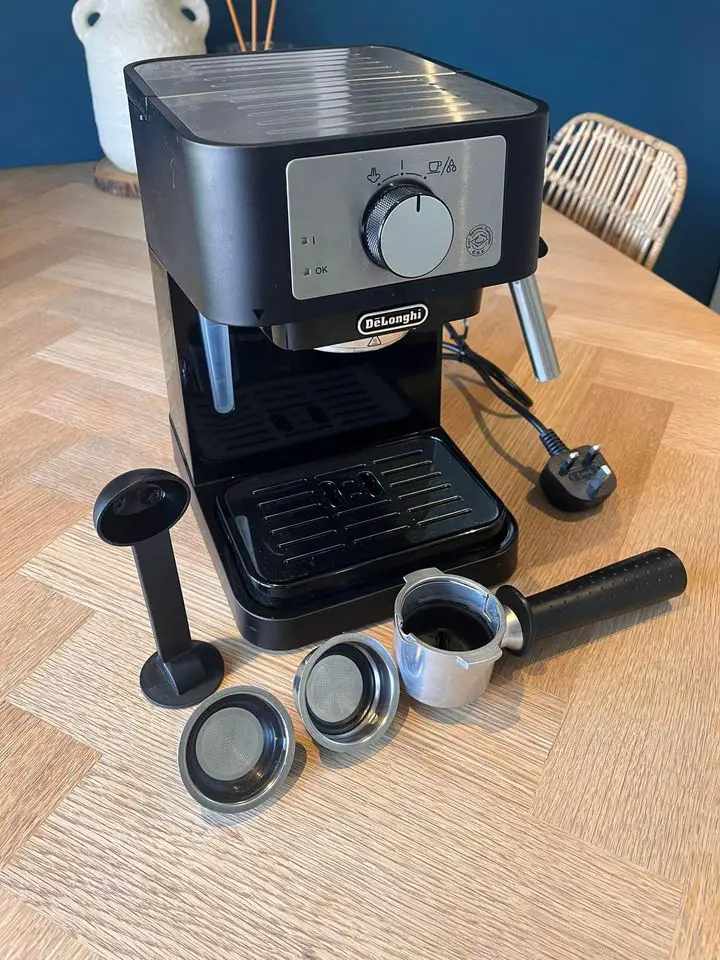
The biggest surprise of the Stilosa is its little stainless steel boiler. I definitely expected a thermoblock at this price. While that means it takes a little longer to heat than most home machines (5 to 10 minutes), it provides a more stable brewing temperature and better extraction.
The fatal flaw of most cheap machines is underheated brew water, and the Stilosa excels in that regard.
Naturally, the Stilosa can’t match the other machines on this list in performance or build quality. It’s mostly plastic, the froth enhancer on the short steam wand is unwieldy, and the pressurized filter baskets put a cap on espresso quality. But even with those complaints in mind, I still think the value for money is incredible for anyone buying their first espresso machine.
How To Choose The Right Italian Espresso Machine
Given that Italy is the birthplace of espresso, it should come as no surprise that Italian brands make some of the world’s best espresso machines. They have high standards to uphold (4).
I think Italy is such a special place. I am so respectful of the Italian coffee heritage and the Italian culture
So what’s the best way to bring that Italian coffee culture into your home? This buyer’s guide is here to walk you through it.
The Balance Between Control, Consistency, and Convenience
This is the most important consideration when buying any espresso machine, Italian or otherwise. How much work do you want to put in, and how much do you want the machine to do for you?
More control in your hands means more potential for incredible espresso but also more hands-on effort and room for error. A machine that makes your latte at the push of a button is convenient, but its drink quality is fixed. No amount of barista practice will net you a better latte.
Let’s quickly break down the four styles of espresso machines on this list:
- Manual lever espresso machines take the most skill and allow the most user control. They’re the only type of machine without a pump, so along with being responsible for puck prep and shot timing, you also manage the extraction pressure.
- Semi-automatic espresso machines add an electronic pump, but you still need to grind the beans, fill and tamp the portafilter, and time the extraction.
- Automatic espresso machines remove the need for shot timing. Instead, a timer or flowmeter is used to stop the shot automatically at a programmed time or volume.
- Super-automatic espresso makers are basically robot baristas. All you need to do is keep the bean hopper and water reservoir full, and you can have an espresso at the touch of a button. Many also have automatic milk frothing.
As a general rule, the price scales up with the amount of automation. All other things being equal, a super-automatic machine is more expensive than a semi-automatic. However, factors like build quality and brand name can skew that trend.
Heating Systems: Boiler Or Thermoblock?
An espresso machine uses one of two ways to heat water to the required brew temperature: a boiler or a thermoblock. I’m not going to go deep into the operational details here.
Most inexpensive home espresso machines use thermoblocks; they’re cheaper, faster, and more compact. However, they lack the temperature accuracy or stability of a boiler.
Commercial and prosumer machines use boilers. While they take a little longer to heat up, they guarantee a more stable brew temperature, more even extraction, and better steam pressure.
Single boiler machines use the same boiler for heating brew water and steam, which means you can’t pull a shot and froth milk simultaneously. For that, you’ll need either a double boiler, which uses a separate boiler for each process, or a heat exchanger, which uses a single boiler with a separate region for lower-temperature brew water. These systems are more expensive but worthwhile for lovers of milk-based cafe drinks.
Do You Have A Grinder?
I always recommend grinding your coffee beans right before you brew to guarantee the freshest and most flavorful cup. To do this, you can either buy an espresso machine with a built-in grinder or buy a separate burr grinder to pair with your espresso machine (5).
The former’s advantage is that it saves counter space, makes your espresso preparation more efficient, and can save you some money. The advantage of the latter is that you’ll have more flexibility. You can use the separate grinder to prepare other coffee styles, and you can opt for a brand specializing in grinders.
ESE Pods
ESE (easy-serve espresso) pods are Italian in origin, so they are compatible with many espresso machines made in Italy. Conceived by famed Italian coffee brand Illy, the pods are designed to make espresso as convenient and consistent as possible, and they succeed on that front.
They don’t match freshly ground beans in terms of flavor, but they are undeniably convenient. And they don’t come with the negative environmental consequences of K Cups or similar single-serve products (6).
Does Size Matter?
Bigger isn’t necessarily better when it comes to espresso machines. A larger espresso machine tends to have more fancy bells and whistles, some of which are pretty handy. For example, dual boiler machines are larger than single boilers, allowing you to steam milk and pull espresso at the same time.
But the size of an espresso machine is unrelated to the quality of espresso it makes. If you don’t have a lot of room in your kitchen, don’t feel like you’re doing yourself a disservice by buying a compact espresso machine.
What’s Your Budget?
Wouldn’t it be wonderful to shop for an espresso machine with no fixed budget? Sadly, that’s not realistic for most of us.
The machines on this list range from under $100 to over $5000, with most falling between $500 and $2000. Checking your bank account and setting your budget is a good way to narrow down your options.
Don’t forget to consider more than just the purchase price. Think about how long the machine will last. Does it have expensive maintenance needs? Do you need to buy extra accessories, like a grinder? Choosing a machine that appears cheap upfront might cost you more in the long run.
The Verdict
Italians love espresso, so Italian brands know how to build a great espresso machine. Every espresso maker on this list is well-deserving of a place in your kitchen; which one to buy just depends on your specific demands.
My overall top pick is the new and improved Rancilio Silvia Pro X, a real crowd-pleaser. This made-in-Italy dual boiler semi-automatic espresso machine has everything you need to get your morning off to the right start, whether that means pulling a perfect shot or serving up a velvety latte.
FAQs
What are the best beans for Italian espresso?
The best espresso beans are the ones that taste the best to you. Personally, I love a flavorful and full-bodied medium roast with chocolate and nut flavors, like a Colombian or Costa Rican single origin. For a more authentic Italian experience, consider an espresso blend from an Italian brand like Illy or Lavazza. I’d steer clear of “Italian roasts,” though; these have a habit of tasting like char.
Is an expensive espresso machine worth it?
Expensive espresso machines usually have better-quality components. It is often worth shelling out the extra bucks upfront to avoid maintenance headaches in the long run. Plus, more expensive machines have more precise controls, which allows them to make consistently better espresso. However, there’s always a point with diminishing returns, depending on your level of expertise.
What grinder should I pair with my espresso machine?
You should pair a burr grinder with your espresso machine, ideally one with good grind uniformity in the fine grind range and small steps between grind sizes. There are many options that fit the bill at a wide range of prices. The Baratza Encore ESP is a fantastic entry-level option, and I love the Eureka Mignon Specialita as a premium alternative.
References
- Bizzarri, C. (2017, May 29). The curious story of how transatlantic exchange shaped Italy’s illustrious coffee culture. Retrieved from https://qz.com/992879/the-curious-tale-of-how-italy-became-the-world-capital-of-coffee
- Stamp, J. (2012, June 19). The Long History of the Espresso Machine. Retrieved from https://www.smithsonianmag.com/arts-culture/the-long-history-of-the-espresso-machine-126012814/
- Nosowitz, D. (2012, June 12). FYI: What is Espresso? Retrieved from https://www.popsci.com/technology/article/2012-06/fyi-what-espresso/
- Barry, C. (2017, February 28). Starbucks ready to give Italy a shot, CEO Howard Schultz says. Retrieved from https://www.pressherald.com/2017/02/28/starbucks-ready-to-give-italy-a-shot-ceo-howard-schultz-says/
- By the way, what are ESE pods? (2016, November 14). Cafe Liegeois. Retrieved from https://en.cafeliegeois.ca/blogs/actualite-nouvelles-cafe-liegeois/by-the-way-what-are-ese-pods
- Rossi, R. (2017, December 15). A Brewer’s Guide to Choosing a (Good) Grinder. Retrieved from https://perfectdailygrind.com/2017/12/a-brewers-guide-to-choosing-a-good-coffee-grinder/
