
10 BEST COFFEE GRINDERS OF 2026: TOP PICKS BY EXPERTS
Having a good burr coffee bean grinder is a must if you want a good-tasting cup of coffee.

Photo: Home Brews Coffee
In this post, I’ll guide you to the best burr coffee grinders according to your preferred brew styles.It didn’t take me long working in the coffee industry to learn that the secret to a perfect cup lies not only in the beans, but that the grind quality matters a lot too. Don’t waste your specialty coffee beans by using the wrong grinder for the brew you prefer.
At A Glance:
- TOP PICK: Baratza Encore ESP
- For Pour-Over Coffee: Fellow Ode Gen II
- Premium Option: Turin DF83
Whether you’re an espresso aficionado or a French press lover, choosing the best home coffee grinder is crucial to optimize flavor.
But the dilemma prevails: What is the best burr coffee grinder for home use? And this is where our expertise comes in handy. For me, it’s the grinder that delivers a consistent, even grind, aligns with my preferred brewing methods, and is built to high standards with quality materials. I have tested dozens in pursuit of those criteria, and here are my top ten.
The 10 Best Burr Coffee Bean Grinders in 2026
| image | product | details | |
|---|---|---|---|
| No products found. | Baratza Encore ESP |
|
|

|
Turin DF64 V5 |
|
|

|
Fellow Ode Gen II |
|
|
| No products found. | Baratza Virtuoso Plus |
|
|

|
Fellow Opus |
|
|
| No products found. | Breville Smart Grinder Pro |
|
|
| No products found. | 1Zpresso JX Pro |
|
|

|
Turin DF83 V2 |
|
|

|
Eureka Mignon Silenzio |
|
|
| No products found. | Capresso Infinity |
|



Based on my experience, these are the top coffee grinders that promise to unlock the full potential of your coffee beans. From precision grinders with premium features to budget-friendly options that don’t compromise on quality, this list has something for everyone.
I made sure to include best burr grinders for beginners, those that cater specifically to espresso and filter coffee lovers, and models renowned for their quiet efficiency. Each grinder listed here has unique features designed to meet your specific coffee needs.
1. Baratza Encore ESP
Hopper capacity: 8 ounces
- Burrs: 40 mm conical steel
- Grind settings: 40
- Dosing: On/Off
The Baratza Encore ESP is the home grinder we’ve all been waiting for. I like that Baratza took the perennially popular Encore and made it capable of grinding for espresso. What I love about it the most is that they did it without dramatically increasing the price.
This one is my top pick, not because it’s the best grinder money can buy but because it’s the perfect grinder for most home users, and it’s priced so they can afford it.
Baratza used a simple and elegant trick to turn the original Encore filter coffee grinder into an espresso-capable model.
They shortened the distance between the finest 20 grind adjustment settings, turning them into micro adjustments suitable for dialing in espresso. To compensate, the 20 coarser settings were widened slightly. While I noticed the loss of precision in the coarser settings in my tests, it was a sacrifice I was happy to make after tasting the quality of espresso from the finer settings.


The original M3 burr from the Encore was replaced with the more advanced M2 set in the pricier Virtuoso+ to sweeten the deal. The Encore ESP also adds a dosing cup compatible with 58 mm and 54 mm portafilters.
Read my full Encore ESP review for more details. Or, if you’re not an espresso fan, the Baratza Encore remains a top partner for a drip coffee maker.
Pros:
- Works for all brew methods
- Upgraded M2 conical burrs
- Excellent value for money
Cons:
- Lost sensitivity in coarser settings
- No timer function
2. Turin DF64 V5
Hopper capacity: 50 grams
- Burrs: 64 mm flat steel
- Grind settings: Infinite
- Dosing: Single-dosing with auto-stop

The original Turin DF64 was a low-budget electric burr grinder obviously released to compete with the raging success of the Niche Zero. It had some perks, but it also had a lot of flaws. The expanding market has forced the DF64 to evolve to compete, and my testing shows that the fifth iteration isn’t just a budget Niche knock-off. In my experience, it’s an incredible grinder in its own right, while still offered at a very reasonable price.
The DF64 is the best espresso grinder, though you can use it for pour-over brewing. I picked it as my top choice for espresso due to the high-quality burr, stepless grind adjustment, and low retention. In my experience, the grinds it produced resulted in a nice shot of espresso with a good crema.


Its angled design and included bellows gave it the second-lowest retention of any machine I tested, consistently under 0.5 grams (surpassed only by the Turin DF83). That dosing consistency pays off when dialing in espresso shots (1).
The excellent stainless steel burrs from ItalMill are suitable for most users. But if you aspire to espresso super-geekdom, it’s designed to be easy to swap in higher-end burrs. I only tested the stock burrs, I took them in and out to make sure the switching process was as easy as claimed. Options include ItalMill titanium burrs, SSP multipurpose burrs, and SSP high uniformity burrs, but be prepared to up your budget.
Learn more about this grinder in my full Turin DF64 review.
Pros:
- Very low retention
- Stepless grind adjustment
- Excellent burrs for the price
Cons:
- Plastic dosing cup
- Can be messy
3. Fellow Ode Gen II
Hopper capacity: 100 grams
- Burrs: 64 mm flat steel
- Grind settings: 31
- Dosing: Single-dosing with auto-stop
The Fellow Ode was the first time the brand branched out from coffee accessories to more serious coffee gear. While the Ode was a commercial success, serious coffee geeks were quick to point out its flaws, particularly the quality of the burrs. Fellow paid attention, and the Ode 2 is a substantial upgrade that we’re happy to recommend (2).
The Ode Gen 2 is designed for pour over brewing. The 64 mm burr set is optimized to grind beans in the medium to coarse end of the spectrum, and with only 31 settings, it is clearly unsuited to dialing in espresso. For this reason, I didn’t test it for espresso nor dock it any points; it works precisely as intended. I found that the new-and-improved Gen 2 burrs deliver exceptional grind uniformity throughout the intended grind range. It was by far my favorite electric grinder for drip coffee.


The Gen 2 is a single-dose grinder with an auto-stop function. It keeps grinding until the hopper is empty – an efficient workflow that I especially loved. It sports a larger hopper than the original, suitable for batch brewing up to 10 cups at a time. The combination of vertically mounted burrs, static-reduction tech, and knocker also made it one of the lowest-retention grinders I have ever tried, always under 1 gram.
I have so much more to say about this grinder; you can find it all in my complete Fellow Ode coffee grinder review.
Pros:
- Great burrs designed specifically for filter coffee
- Easy-to-use auto-stop function
- Anti-static limits grind retention and mess
Cons:
- Pricey for a brew-only grinder
4. Baratza Virtuoso Plus
Hopper capacity: 8 ounces
- Burrs: 40 mm conical steel
- Grind settings: 40
- Dosing: Digital timer
The Baratza Virtuoso Plus is the updated version of the Baratza Virtuoso, one of the industry’s favorite electric coffee grinders for the past two decades. It features the same burr set and basic form as the Encore ESP but adds a digital timer instead of the manual on/off and a premium chrome finish.
The Virtuoso+ is specifically a drip coffee grinder. Its 40 grind adjustment settings span a wide range of sizes. During my tests, it produced good uniformity throughout the range. And that’s a big plus. But I didn’t like that the adjustment steps are too wide to dial in an espresso unless you use a pressurized portafilter.
The digital timer, programmable to 1/10th of a second, is what really sells this one as a batch brewing option – and what justifies its price increase from the Encore. Using the Encore to grind 100+ grams of coffee while you stand there waiting to turn it off is a hassle. With the Virtuoso+, just press a button and go about your morning.
The Virtuoso is consistently on our list of the best Baratza coffee grinders. For more details, read our Baratza Virtuoso review.


Pros:
- Easy-to-use digital timer
- Good grind consistency at all settings
- Compact design with LED-lit grounds bin
Cons:
- Not suitable for espresso
- Noisy
5. Fellow Opus
Hopper capacity: 110 grams
- Burrs: 40 mm steel conical
- Grind settings: 41+ (120)
- Dosing: Timer
This award was a toss-up between the Fellow Opus and the Encore ESP. Both grinders were released around the same time, at the same price, to address the same need: a grinder that can do drip and espresso without costing a fortune. Both succeeded in their own way.
I found the Opus to be a great drip grinder that also does espresso; the Encore is a great espresso grinder that also does drip coffee. The right choice for you depends on your most frequent brewing method.


The Fellow solution to the problem of macro and micro steps is to have two adjustment rings. An outer ring has 41 macro settings. A second micro-adjustment ring is located under the hopper. It adds six positions between each step, producing fine enough steps to dial in espresso. While I thought it was a bit inconvenient to remove the hopper to make adjustments, I liked the trade-off of not losing sensitivity in the coarser settings like the Encore ESP.
Overall, this is a really nice grinder for the price. I think Fellow has done some really cool stuff here, and to use it daily is a joy.
The Opus is also blessed with Fellow’s always impeccable design sensibility, with a compact footprint and spare, industrial aesthetic. It’s a single-dosing grinder, but I found that the 110-gram hopper held enough coffee to make up to 10 cups.
If you’re interested in this grinder, be sure to read my Fellow Opus review.
Pros:
- Suitable for all brew methods
- Great value for money
- Attractive, compact design
Cons:
- Have to remove the hopper to make micro-adjustments
- Plastic casing
6. Breville Smart Grinder Pro
Hopper capacity: 18 ounces
- Burrs: 40 mm conical steel
- Grind settings: 60
- Dosing: Digital timer
Breville is a brand that knows its market and serves it well. Its innovative coffee gear is consistently better than average without straying too far into the premium price bracket (3). It’s for people who care about good coffee but aren’t ready to devote their lives to it.
The Breville Smart Grinder Pro fits this mold. With a 40 mm conical burr and 60 grinder settings, it’s quite versatile.
I generally prefer a stepless grinder for dialing in espresso, but when I tested the Smart Grinder, I found that its 60 steps provided enough precision to dial in a shot, especially when I used more forgiving darker roasts. And unlike many other multi-purpose grinders, Breville’s user-friendly digital display made it painless for me to switch between grind settings.


The LCD display is what sets this grinder apart from the crowd, making it an easy choice for Most User Friendly. The more novice testers on our team all loved the feel of this grinder! You can select grind settings and program timed doses for batch brewing, pour over, or espresso shots. It comes with a portafilter holder and a grounds-catch bin to meet the needs of all users.
To discover the other “smart” features of this grinder, read my full Breville Smart Grinder Pro review.
Pros:
- Many features and programmability
- Easy-to-use LCD display
- Has enough settings to manage espresso
Cons:
- Performance drops at the coarsest grind
- Lots of plastic in the build
7. 1Zpresso JX Pro
Hopper capacity: 35 grams
- Burrs: 48 mm conical steel
- Grind settings: 40 clicks per rotation
- Dosing: Manual
1Zpresso is one of the top names in the game for manual grinders right now, consistently delivering products that far exceed their price point. I actually prefer the feel and user experience of this grinder to the more expensive Comandante and Kinu options.
1Zpresso has a huge line-up of hand grinders, and I tried a number of them, but the JX Pro stood out as the most balanced option. It hits the sweet spot of quality, utility, and affordability.


The JX Pro has a stainless steel 48 mm conical burr that delivers uniform grinds at all sizes. Compared to the JX, it halves the distance between each grind setting click to 12.5 microns, making it a true all-around grinder. I used it successfully for French press, pour over, and espresso.
Compared to electric grinders, the feel of a hand grinder is a more important factor. This one feels good and sturdy. I found it is quite easier and smoother to crank compared to the many hand coffee grinders I tried. At 780 grams, it’s neither too heavy nor too light. The 2.24” diameter is comfortable for all hand sizes. It’s made of high-quality materials – stainless steel inside, aluminum alloy body, hardwood knob – and includes a silicone sleeve for grip.
Pros:
- Fantastic burr set for the price
- Durable build with quality materials
- Suitable for drip and espresso brewing
Cons:
- Small hopper doesn’t hold much coffee
- Cranking by hand gets tiring, especially with lighter roasts
8. Turin DF83 V2
Hopper capacity: 50 grams (225 grams optional)
- Burrs: 83 mm flat steel
- Grind settings: Infinite
- Dosing: Single-dosing
Honestly, few people making coffee at home need an 83 mm burr set. This grinder will be overkill for most. But if you have the coffee knowledge and budget to be considering prosumer coffee grinders, the Turn DF83 may well be the best value on the market right now. It’s about $1000 cheaper than I would have guessed after reading the specs.
The DF83 is a single dosing grinder with included bellows, and it had the lowest retention of any grinder I tested at less than 0.3 grams. It ships with an optional 8-ounce hopper, a nice addition to expand its user base. And even without the bellows, retention still hovered at a very impressive 0.5 grams.


This is designed as an espresso grinder, but I also enjoyed it for pour-over brews. Like the DF64, you can easily upgrade the burr to titanium or SSP burrs as you fall further down the espresso rabbit hole.
This is kind of perfect for that, for people who love traditional coffees and want to really push that creamy body. The stock burrs are perfect for you.
A few other touches make the DF83 a more premium option than the DF64, including a super-powerful 550-watt motor and painted aluminum body.
Pros:
- Huge high-end 83 mm burrs
- Powerful 550-watt motor
- Stepless grind adjustment for espresso or coffee
Cons:
- Expensive
- Probably overkill for most people
9. Eureka Mignon Silenzio
Hopper capacity: 10.6 ounces
- Burrs: 50 mm flat steel
- Grind settings: Infinite
- Dosing: Basic timer
The Eureka Mignon Silenzio’s most exciting feature is right there in the name – at least if you speak Italian. Silenzio means silence, and this is one of the quietest grinders on the market.
I always assumed more powerful meant more noise, but this grinder proved me wrong. Eureka outfitted it with anti-vibration technology and an improved sound-insulating case. The result? It never exceeded 75 dB in our tests, even with dense light-roast beans. And that’s not because it lacks juice; a 260-watt motor spins the burrs at 1350 rpm.


The Silenzio is espresso-focused but can be used for drip or pour over coffee. It is difficult to switch back and forth between settings, however, so I’d advise using it primarily for one or the other. It includes the patented stepless micrometric adjustment and anti-static system common to many Eureka coffee grinders. The basic timer isn’t as convenient as digital options, but it keeps the price of this grinder very reasonable, given its quality.
Pros:
- Powerful but quiet
- High-quality 50 mm steel burrs
- Durable design with metal casing
Cons:
- Inconvenient to change back and forth between grind settings
- No digital timer
10. Capresso Infinity
Hopper capacity: 8.8 ounces
- Burrs: 40 mm conical steel
- Grind settings: 16
- Dosing: Basic timer

The Capresso Infinity was the first grinder I bought when I grasped the importance of burr grinding (4). And it’s the grinder I continue to recommend to friends and family just getting into coffee. It’s the best budget burr grinder, and if you’ve been using a blade grinder, it’ll change your life.
The Infinity is an entry-level conical burr grinder. It only has 16 grinder settings, but they span a nice range from French press coffee through espresso. And our tests showed pretty impressive uniformity throughout that range. It’s ill-equipped for dialing in an espresso shot, but I can vouch from experience that it’ll work with a pressurized portafilter.


It’s very easy to use, perfect for coffee newbies. Turn the hopper to set the grind size, and turn the timer to start the grind. The timer runs from 5 to 60 seconds. That, coupled with the large hopper and surprisingly fast 3 g/s output, makes this an excellent grinder for batch brewing.
Read our full review of the Capresso Infinity coffee grinder for more information.
The Oxo Brew Conical Burr Coffee Grinder is another great option in this category, but we voted it out due to its unpleasant sound.
Pros:
- Very affordable
- Good consistency at a wide range of grind sizes
- Quiet and compact
Cons:
- Only 16 grind settings limits precision
- Cheap plastic exterior
How We Tested The Grinders
Why should you trust these recommendations? Our team has extensive experience brewing coffee and testing coffee gear. We know what to look for. Every grinder on this top-ten list has been through numerous qualitative and quantitative assessments, as described here.
Grind Uniformity
The consistency of the grind was evaluated using the Kruve sifter system, the easiest way to analyze grind distribution short of a microscope and a team of interns.
We ground 10 grams of coffee with each grinder at coarse, medium, and fine grind levels. The sifters were used to sort out the largest particles (boulders) and the smallest (fines). They were then weighed separately to determine their percentage in the overall yield.
Some distribution is inevitable, but the best grinders had the fewest boulders and fines (5). An overly coarse grind will under-extract, leading to weak or sour-tasting coffee. Fines will over-extract, resulting in a bitter brew – and likely a clogged filter.


Grind Retention & Dose Consistency
Grind retention is the coffee left behind trapped in the grinder after grinding. High grind retention interferes with dose consistency and flavor (6).
To test grind retention, we put a 10-gram dose of coffee in each grinder and weighed the output. We didn’t try to shake or knock the grinder, but if it came with a knocker or bellows, we used it. We recognized that this test is more relevant for single-dosing grinders.
Dose consistency is a more valuable metric for grinders with a bean hopper. For these, we filled the hopper and ground using the same timer setting three times. We then weighed and compared the three outputs.
Noisiness
Each grinder was monitored with a decibel meter while grinding the same medium-roast coffee. The team also listened to each qualitatively because the pitch of a sound can contribute to its relative unpleasantness as much as the volume.
Build Quality and Design
My proposal to drop every grinder off the counter to see which ones survived was rejected by the higher-ups. So, we resorted to more qualitative assessments of quality. The materials used and the quality of assembly were considered. We also accounted for how easily the burr chamber could be accessed for cleaning or repairs.
Aesthetics are a matter of personal taste and didn’t factor in our rankings. However, the functional design was evaluated qualitatively. The grinders were all used by beginners and experts to note any convenient or frustrating design points.
Taste Test
We brewed the same type of coffee using at least two brewing methods (French press and pour over) with grounds from every grinder. A shot of espresso was added for any grinder that claims to be suitable for espresso. In every case, we ensured the grind size setting was optimized.
Coffee was blind-tasted by every member of the team. While coffee can be a matter of personal taste, it was quite clear which grinders offered consistently more delicious coffee.

Are High-End Coffee Grinders Worth It?
Coffee experts know that grinding your own coffee beans is the number one way to improve your coffee at home – and that a conical burr coffee grinder is infinitely better than a blade grinder. So yes, high-end grinders are absolutely worth it. I own one. But depending on your preferences, you don’t necessarily need the biggest or most expensive grinder.
First, determine your needs (and budget). Then buy the best grinder that meets all your criteria without exceeding them.
If you only brew drip or pour over coffee, you don’t need a stepless adjustment designed for dialing in an espresso machine. If you only drink one cup daily, you don’t need a commercial-quality grinder built to grind ultra-fast and withstand heavy use. If you’re not a specialty coffee nerd, you likely won’t taste the difference between a 64 or 83-mm burr set.
Should I Get A Manual Grinder?
A manual grinder is a wonderful option for any coffee drinker limited by space or budget. Because you’re not paying for electronics, a manual grinder can offer a far superior burr set compared with an electric coffee grinder at the same price. The best hand grinders are also more compact, much quieter, great for travel, and have fewer breakable parts.
The biggest downside is their small capacity; they aren’t practical for grinding a large amount of coffee for batch brewing. Plus, you have to crank the grinding arm by hand, which can be challenging for anyone with hand or wrist weakness. But you can do what I did: I bought one for the travels, and I have an electric one at home.
How To Choose The Best Coffee Grinder 2026
A coffee grinder is a complex piece of equipment. You can easily get lost learning about burr sizes and shapes, motor speed and torque, and micro and macro adjustments. For gear nerds like us, getting into the nitty-gritty of grinder design is kind of fun. But in case you don’t feel the same way, we put together this easy-to-follow buyer’s guide to choosing the right grinder for you.

Grinding For Drip, Espresso, Or Both
The kind of coffee you make is the number one factor when choosing a coffee grinder. Don’t be fooled by cheap grinders advertising, “It can do everything from Turkish coffee to cold brew.” It probably can’t.
Quality grinder manufacturers design their products specifically for coffee, espresso, or both. You should buy for what you brew.
Not sure what you need? Check out our coffee grind chart.
Grinding For Espresso
Grind size and distribution are essential when dialing in an espresso shot. It’s a common misconception that a grinder just needs to grind fine enough. Most grinders can do that. It needs to grind finely, uniformly, and have small steps between grind adjustment settings. Ideally, an espresso-specific grinder should have a stepless adjustment, allowing infinite settings. For these reasons, espresso grinders are generally more expensive, making a hand grinder a great option for espresso lovers on a budget.
All-Around Grinders
Grinders that work for drip and espresso are an appealing choice for coffee lovers who enjoy variety in their coffee routine. But they are difficult for manufacturers. So the good ones are expensive, and the cheap ones are not very good. The clever tricks used with the Encore ESP and Fellow Opus make them exciting exceptions to this rule.
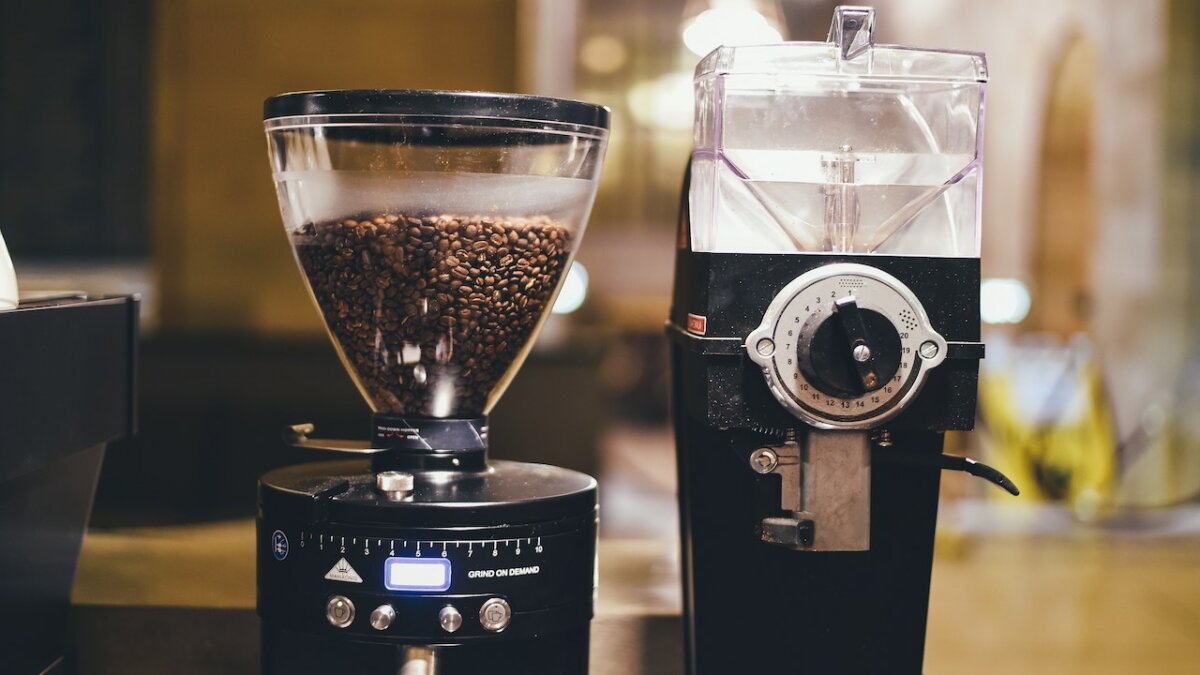
Most all-around grinders come with the caveat of being better for one brew method than the other, which we’ve pointed out in our reviews. If you plan to change brew methods frequently, consider how easy it is to go back and forth between settings. It might make sense to own two grinders. Additionally, if you need help in choosing the right grinders, check the posts below for our expert recommendations and detailed comparisons.


What Is A Conical, Flat, Or Blade Grinder?
Whatever you do, don’t buy a blade grinder. I know it’s temptingly cheap, but blade grinders chop your coffee into uneven pieces. There is no way to enjoy properly extracted coffee from a blade grinder.
Burr grinders crush the coffee beans to a uniform size. The two main burr shapes are flat and conical (7).
- Flat burrs produce a more uniform grind distribution, typically yielding a cleaner-tasting cup with a lighter body. They are more common in grinders for coffee than espresso, but you can find both. Flat burrs generally have higher grind retention than conical, though this can be alleviated with good engineering.
- Conical burrs produce more fines, making them popular for espresso grinders because the fines contribute to the heavier body of an espresso. However, they can muddy the flavors of a crisp single-origin pour over.
Read our full flat vs conical burr grinder article for more detail on this topic.
Single-Dosing Versus A Bean Hopper
Single-dose burr grinders don’t have a hopper. Instead, you weigh and add the coffee beans you need for a cup or two of coffee, and grind until they’re all ground. This method has become more popular in recent years for a few reasons. You don’t risk beans going stale in the hopper, it’s easy to switch coffees, and grinding by weight is more accurate than dosing with a timer – assuming grind retention is minimal.
A bean hopper comes with its own perks. It simplifies your morning workflow by avoiding the need for a scale. And it is more practical for batch brewing, as single-dose grinders usually don’t hold enough coffee for a full carafe.
The Verdict
Each of the grinders on this list has qualities that make it the best for certain users, whether that’s espresso-level precision, an easy-to-use design, or quiet operation.
My overall top pick is the new Baratza Encore ESP. I chose it using a series of quantitative tests plus a general assessment of the needs and budget of the average home coffee brewer. The Encore ESP is well-built by a trusted brand, it grinds coffee beans nicely, works for all brew methods, and delivers performance well above its price tag.
FAQs
Maintaining a coffee grinder is all about keeping it clean. To clean your coffee grinder, wipe up visible coffee grounds or stains daily, clean out the hopper and grind chamber monthly, and give it a serious clean once or twice a year – depending on use. More involved maintenance should be done by a professional.
Yes, oily beans will clog a coffee grinder. If you are a fan of darker roasts, which tend to be oilier, consider patting them with a paper towel or absorbent cloth to remove some surface oil before grinding. You should also plan on cleaning your grinder more frequently than you would for lighter roasts.
To reduce static in a coffee grinder, use the Ross Droplet Technique (RDT). It sounds fancy, but it’s as simple as giving your coffee beans a light spritz of water before grinding (8). It dramatically reduces static, leading to less mess and less grind retention.
Coffee shops use grinders that can handle much higher usage than home grinders. They have larger capacities, higher-quality components, and better engineering. They often have safety certifications like NSF. As a result, the top commercial coffee grinders are much more expensive than typical home coffee grinders.
You should buy a coffee machine with a built-in grinder if you have limited counter space or value the convenience. However, a separate coffee grinder provides more flexibility and usually offers more grind settings. Both Breville and Gaggia coffee makers are known for having good-quality integrated grinders.
References
- Miller, D. (2017, July 31). Effects of Grind Precision on Beverage Quality. Retrieved from https://coffeetechniciansguild.org/blog/2017/7/31/effects-of-grind-precision-on-beverage-quality
- Bryman, H. (2023, February 7). Fellow Follows Ode Gen 2 with the Opus Conical Burr Grinder. Retrieved from https://dailycoffeenews.com/2023/02/07/fellow-follows-ode-gen-2-with-the-opus-conical-burr-grinder/
- The Breville Story: A timeline of innovations. (2016, June 4). Breville. https://www.breville.com.ph/blog/242-the-breville-story-a-timeline-of-innovation
- Friedrick, J. (2020, August 5). Capresso marks 25th years of coffee and beverage innovation. Home Furnishings News. https://www.hfndigital.com/housewares/capresso-marks-25th-years-of-coffee-and-beverage-innovation/
- Scott Rao. (2018, October 30). Using Extraction Levels To Rate Grinders. Retrieved from https://www.scottrao.com/blog/2018/10/4/using-extraction-levels-to-rate-grinders
- Valerio, Y. (2023, July 27). Grind Retention: Why Is It Important? Retrieved from https://www.baristamagazine.com/grind-retention-why-is-it-important/
- Petrich, I. L. (2021, February 23). Conical vs Flat Burr Grinders: Whats The Difference? Retrieved from https://perfectdailygrind.com/2020/05/conical-vs-flat-burr-coffee-grinders-difference/
- Florin Coffee. (2023, March 23). Ross Droplet Technique; a Complicated Name for a Simple Hack. Retrieved from https://www.florincoffee.com/blogs/news/ross-droplet-technique-a-complicated-name-for-a-simple-hack
