
FLAT VS CONICAL BURR GRINDER: WHAT YOU SHOULD KNOW
We all have our obsessions. Mine is specialty coffee, and if you’re here, I’m guessing that’s something we share. For us exceptional coffee enthusiasts, there is no consideration too small, including how the design of the burrs in our coffee grinder impacts our precious morning cup.
So today, I’m exploring flat vs conical burr grinders. What’s the difference between them? Is one burr type better than the other? And how do you decide which grinder to buy? Find the answers below.
What are the two types of burr grinders?
One way to classify burr grinders is by the geometry of their burr set: conical and flat burrs. In both cases, a burr set consists of two burrs, and the grind size is defined by the distance between them.
Conical burrs have a cone-shaped inner burr sitting inside a ring-shaped outer burr. Beans are funneled in through the top and are crushed between the burrs on their way down. Because gravity assists with this process, conical burr grinders operate with less power and at lower speeds, which is why almost all the best manual grinders have conical burrs.
In a flat burr grinder, two flat ring-shaped burrs sit one atop the other, and the coffee beans are crushed between them. They may be vertically or horizontally aligned within the grinder.
For a quick rundown on the difference between flat and conical burr grinders, check out this geeky but informative video:
Which is better, a flat or conical burr grinder?
Coffee lovers aren’t always great at separating opinion from fact. We’ve all been known to regard our taste as a tool of impartial scientific discovery. I’ll try and avoid falling into that trap as we address the great burr debate.
Instead, I’ll offer factual comparisons between the two types of grinders in various categories so that you can make an informed buying decision based on your priorities.
Grind Consistency
Delivering a uniform particle size is arguably the most important task of any coffee grinder – and why you should definitely choose a burr grinder over a blade grinder (1).
To the naked eye, the difference between the grounds from flat burrs and conical burrs is imperceivable. Yet, subject those grounds to the scrutiny of a microscope and another story begins to unfold (2).
No grinder produces a perfectly uniform grind size; it’s impossible. However, more consistent grinders yield a smaller distribution of grind sizes.
The general consensus for many years was that conical burr grinders yielded a bimodal grind distribution, with higher proportions of small and large particles (3). In contrast, flat burrs were said to produce a unimodal distribution, with more particles at the desired grind size.

I haven’t found a lot of scientific research to back that specific claim regarding distributions, but it does seem clear that – all other things being equal – flat burrs produce more consistent grounds. This is at least partly because they are easier to align.
A consistent grind size means that every particle extracts at the same rate when coffee brewing. So your extraction will be more even, and the flavor profile of your brew will be clean and balanced. That’s a good thing – and a good reason to consider flat burrs.
Which burr is best for espresso?
Espresso fans may feel differently. Conical burrs create more very small particles (known as fines), which can actually benefit an espresso shot. Just ask David Schomer, espresso expert and co-founder of Seattle’s famous Espresso Vivace (4).
“I favor conical burrs because they produce micro-particles (fines) that add flavor and body to the shot compared to flat burrs.”
Ultimately, it’s a matter of personal preference, and you’ll find high-end commercial espresso machines paired with conical or flat burr coffee grinders.
Grind Retention
Grind retention is the ground coffee left behind in the grinder after grinding. It is particularly relevant in single-dose grinders. If you put 20 grams of whole beans in the hopper, in a perfect world, you would get 20 grams of ground coffee out.
Grind retention is undesirable because it leads to dosing inconsistency and can contaminate your fresh grinds with stale coffee grounds.
Conical burr sets naturally have lower retention than flat burrs. The vertical geometry of the conical burrs means that gravity helps the grounds fall straight into the exit chute. Flat burrs use a higher RPM to force the grounds out sideways, leading to a greater risk of them being trapped in the grind chamber.
Good engineering can mitigate the problem to a large extent. Single-dosing flat burr grinders often have an angled geometry and special features like a knocker or bellows to dislodge trapped grounds.
Heat And Noise
As I already mentioned, flat burrs spin faster, thus requiring more power. Naturally, this means they are louder and generate more heat. But the discussion, particularly regarding heat generation, is somewhat nuanced.
I see a lot of talk about heat generation in grinders. As the story goes, excessive heat during grinding causes the volatile aromatics in the ground coffee to evaporate and changes the solubility of the grounds, influencing the flavor profile and extraction rate of your brew. That is 100% true.
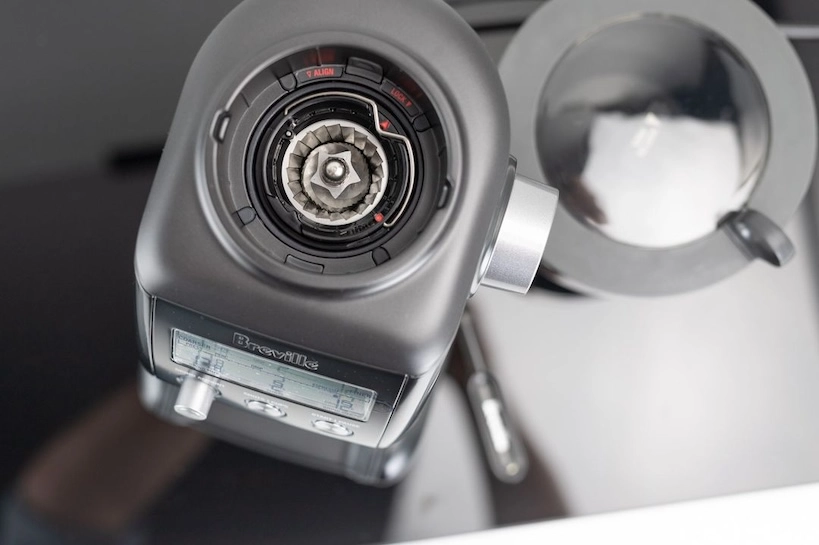
However, I think it’s important to differentiate between grinding at home and in a commercial setting. In a busy cafe, minimizing heat generation is critical. Grinders are running constantly, preparing fresh grounds for coffee and espresso. Some cafes even grind pounds at a time to sell in bulk. That’s why most commercial and top prosumer coffee grinders are engineered with fans or other cooling systems.
At home, my grinder is in use for an average of 8 seconds a day – the time it takes to grind 18 grams for a double shot. Even in a busy household, you probably don’t grind coffee for more than a few minutes daily. The difference in heat between a flat and conical burr grinder in this scenario is minute.
It’s also important to note that both heat and noise can be reduced through better engineering of the coffee equipment – ventilation, cooling fans, rubber dampening, sound-proof casing, etc. So a well-made flat burr grinder can easily outperform a cheap conical burr grinder in this category.
Price
Grinders with flat burrs are more expensive than conical burrs for all the reasons you’ve probably noted while reading this article. A good flat burr grinder requires a more powerful motor and better engineering. That’s why you don’t see many budget grinders with flat burrs.
If you’re looking for an entry-level grinder, you’re pretty much confined to a conical grinder or hand grinder, something like the Baratza Encore or Virtuoso. Once your budget hits about $300 and above, you’ll find excellent coffee grinders with both burr geometries.
Does burr shape affect coffee flavor?
This is a hotly debated topic in the coffee community, and there is no clear answer beyond what we’ve already discussed regarding particle distribution.
Some coffee lovers insist that one burr shape is better for certain roast levels, origins, or flavor notes.
I’ve heard experts insist that conical burrs are better for brighter coffees, while flat burrs highlight deeper chocolate notes. And I’ve heard others claim the opposite. In this case, I think the differences in our taste buds might matter more than the differences in the burrs. I’ll let you decide for yourself.
Final Thoughts
What kind of grinder is right for you? My not-so-satisfying answer is that it depends on your priorities and budget.
Consider a flat burr grinder if you drink primarily filter coffee and value the crisp flavors afforded by a more uniform grind distribution – provided you have the budget. Otherwise, a conical burr grinder is a generally more affordable alternative that produces a rich, full-bodied cup.
Espresso lovers can go either way. Flat burrs offer shots with greater clarity and complexity, while conical burrs result in a heavy body and richer mouthfeel.
My very final thought is to take all this with a grain of salt. Only the keenest coffee drinkers can even taste the subtle differences in burr design discussed in this article.
FAQs
A burr grinder, whether flat or conical, produces a much more uniform grind distribution than a blade grinder – so much so that even a coffee newbie can taste the difference. A burr grinder crushes the coffee beans between two burrs, and the distance between the burrs dictates the grind size. Blade grinders grind coffee beans with steel blades that chop them into gradually smaller pieces over time.
Yes, bigger burrs are better for a coffee grinder, all other things being equal. But this is another factor that is substantially more important for a professional barista in a setting where the grinder gets heavy use. Bigger grinder burrs grind faster, which is more efficient and generates less heat.
You should consider replacing the burrs in a consumer coffee grinder after about 500 pounds of coffee if they are stainless steel or 700 pounds if they are ceramic. Specialty burrs with titanium alloy coatings can last much longer, up to 10,000 pounds.
References
- Blue Bottle Coffee. (2016, November 9). Blue Bottle Explains: Coffee Grinding. Retrieved from https://blog.bluebottlecoffee.com/posts/coffee-grinding
- Lee, J. (2018, February 28). Why Grind Coffee Fresh Every Time? Burr or Blade? Retrieved from https://perfectdailygrind.com/2015/01/why-grind-coffee-fresh-every-time-burr-or-blade/
- Butterworth, M. (2016, March 21). Grinding for a Purpose. Retrieved from https://freshcup.com/grinding-for-a-purpose/
- Schomer, D. (2019, August 30). A Call to Action on Espresso Grinders, by David Schomer. Retrieved from https://dailycoffeenews.com/2019/08/30/a-call-to-action-on-espresso-grinders-by-david-schomer/
