
BARATZA VARIO REVIEW: HOW GOOD IS THIS BURR GRINDER?
This is my updated Baratza Vario review.
Have you ever wondered if you could brew cafe-quality coffee at home if you had the same equipment as your local coffee shop? Welcome to the slippery slope of buying prosumer coffee equipment. I hope your wallet is ready.
I reviewed the original Baratza Vario about five years ago, but the 2022 release of the new Vario+ and Vario W+ means it’s time to reevaluate this professional-grade grinder.
Is it the right choice for your home or cafe? Let’s find out.
Things I liked:
- Consistent grind from high-quality 54-mm flat burrs
- Excellent versatility for all brew methods
- Easy-to-use stepped grind adjustment with 220 settings
- Fast grind output
Things I didn’t like:
- Cheap-looking plastic exterior
- Not as consistent at the coarsest settings
The Full Baratza Vario Coffee Grinder Review
The Vario+ and W+ are the top-of-the-line Baratza grinders – the only models suitable for home and commercial use. That also makes them the brand’s most expensive offerings, which means it’s all the more important to get a complete picture before you buy. Read on for my thoughts.
How We Rated It
-
Design
-
Durability
-
Ease Of Use
-
Grinding Capability
-
Value For Money
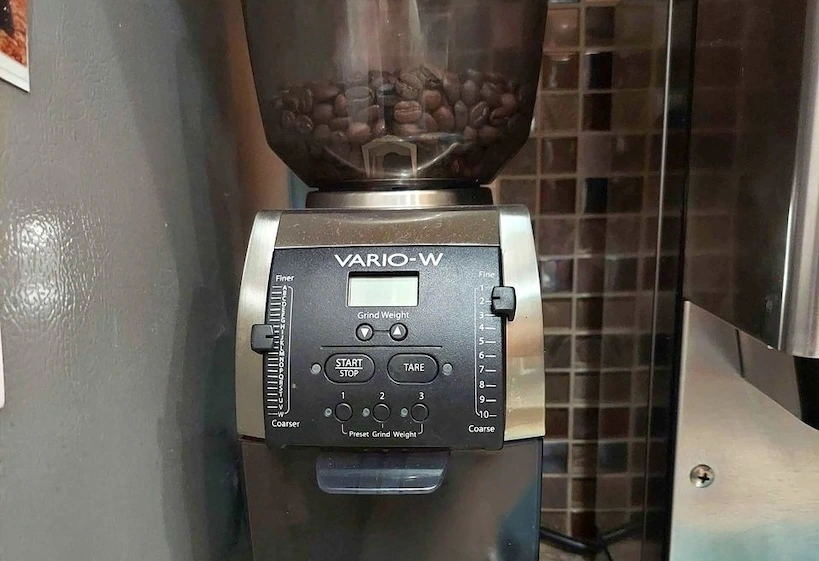
What is the difference between Vario and Vario W?
Baratza currently makes two models of the Vario, the Vario Plus and Vario W Plus, both of which are upgrades from the original Vario.
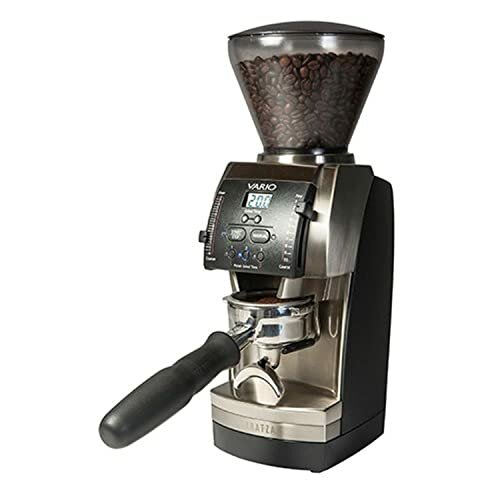
The Vario+ is an all-around grinder with a ceramic burr set and time-based dosing. Because it is designed for drip and espresso, it includes a grounds bin and a portafilter holder.
The pricier Baratza Vario W Plus uses weight-based dosing, hence the W. It is positioned more for filter coffee, with a steel burr set best suited to medium grinds and only a grounds bin.
This review focuses on my hands-on experience with the Vario+, but many of the details apply to both models, and I will clarify where that is not the case.
Grinding Capability And Quality
The Baratza Vario+ has 54-mm flat ceramic burrs (1). The stepped grind adjustment has 10 macro and 22 micro settings, yielding 220 possible grind size settings. In my experience, the grind consistency is excellent throughout most of the grind range, making the Baratza Vario+ one of the most versatile options on the home grinder market.
My only minor complaint was a few more fines than I’d like at the coarser grind settings. My French press coffee was quite thick, and I wouldn’t recommend it for cold brew.
The W+ has the same grind adjustment but uses 54-mm flat steel burrs. It arrives calibrated for Moka pot through French press, though you can adjust it to make espresso. It is less versatile than the Vario+ but better suited to filter coffee methods.
The Vario+ and W+ are equipped with the same 130-watt high-torque DC motor to spin the burrs at a steady 1350 RPM. Though fast, it’s not as loud as you’d expect, even compared to slower conical burr grinders. If you’ve ever used the Baratza Sette, you’ll be happy to hear (no pun intended) that the Vario is significantly quieter.
My Baratza Vario grinder is one of the fastest home grinders I’ve used, outputting up to 2.5 grams per second at the coarser drip coffee settings. It takes me about 10 seconds to grind 18 grams for a double espresso shot and closer to 6 seconds to grind 15 grams for a V60 pour over.
Is the Vario good for espresso?
The Baratza Vario+ is a fantastic espresso grinder, in my opinion. I would describe it as an espresso grinder that also happens to do drip coffee very well. In contrast, I consider the Vario W+ to be a great brew grinder that can be recalibrated to be capable of grinding fine enough for espresso in a pinch.
I usually recommend a stepless grinder for espresso, but the micro settings on the Vario+ are fine enough to dial in a shot – while the stepped adjustment keeps this grinder much more practical for other brew methods.
The ceramic burrs deliver excellent grind quality at the finer end of the spectrum, with none of the clumping that seemed to plague the original Vario.
The shots I pulled were consistently clean and sweet with a rich body, and I was able to dial in dark, medium, and light roast coffee beans with no issues.
Dosing By Time Vs Weight
The Baratza Vario+ doses by time with a precision of 0.1 seconds. The Vario W+ doses by weight, precise to 0.1 g. Which is better? That depends on your needs (2).
Time-based dosing is far more common for home grinders, largely because integrating a timer is much less expensive than integrating a scale. The grind time dictates the amount of coffee ground.
“The main difference between gravimetric and timed grinders is that with the former, you directly select the desired amount of coffee.”
So weight-based dosing is more accurate because it is unaffected by the grind size or how many beans are in the hopper. It is also more efficient and less wasteful because there is no need to recalibrate the timing. These are key factors for baristas in a commercial environment but substantially less crucial at home.
Consider a weight-based grinder if you take your home coffee as seriously as a professional barista – and are willing to pay the cost. Personally, I’m content to save a little money and use a timer.
What is the retention of the Vario?
The grind retention of the Baratza Vario+ is impressively low for a flat burr grinder. I measured an average of around 0.5 grams. If you are interested in single-dosing, you can swap in a single dose hopper (sold separately) which reduces retention even more.
Related: The differences between flat and conical burr grinders.
How To Use The Baratza Vario+ or W+
Using the Vario Plus is very simple, and the procedure is nearly identical for the W+.
- Load the hopper with beans.
- Set the grind size using the sliders on opposite sides of the grinder.
- Use the arrow buttons in the middle of the face to set the grind time (or weight for the W+).
- Press Start.
Simplify things further by taking advantage of the three programmable dose buttons, which can be set to the grind times. Likewise, you can program three different weights on the W+. Both grinders also have a manual grind button.
The presets still require you to adjust the grind size manually, but I’m a big fan of the Vario’s easy-to-use grand adjustment mechanism.
The macro settings run from 1 to 10 on the right side of the machine, while the micros are from A to V on the left. While a bit unsightly, this makes the current setting obvious—unlike the more subtle adjustment collars hidden at the base of the hopper.
Need some setting suggestions to get you started? Here’s what I’ve been using with my Vario+:
- Espresso: 1J – 2S
- Moka pot: 2D – 4V
- Hario V60: 3A – 6A
- Drip coffee machine: 3A – 8L
- French press: 6A – 10V
Every Vario includes a calibration tool for serious coffee geeks. I didn’t recalibrate my Vario+ because the factory settings are ideal for all-around grinding, but it’s a great option if you plan to focus on a single brew method.
Cleaning The Vario
Keeping your Vario clean is easy and helps prolong its life. I deep clean mine every few months, but you may need to do it more often if you’re a heavy user or you favor oily, dark roast coffee.
The hopper twists off to reveal the top burr, which can be removed with the included tool to access the grind chamber. This is no big deal unless you lose the tool, in which case you’ll wonder why Baratza didn’t choose something more universal.
Use a paintbrush or air blower to remove any ground coffee from the grinding chamber and exit chute. If there is a lot of coffee residue, I recommend buying grinder-cleaning pellets. I know it’s tempting to save money and just use rice, but be warned that this voids your Baratza warranty.
Aesthetics, Design, And Build Quality
Beauty is in the eye of the beholder, but I admit that don’t particularly love the look of the Vario. The front panel looks busy and cluttered, like it’s going to be more complicated to use than it is. Though I am fond of the new white color option to go along with the classic black.
The Vario has a compact design, measuring 5.1 x 7.1 x 14.2 inches and weighing under 10 pounds. It’s a commercial-quality grinder that fits comfortably in a home setting. The hopper holds 10 ounces of beans, and the grounds bin has a 4-ounce capacity.
The Vario+ portafilter holder is adjustable to accommodate commercial-standard 58-mm portafilters and the 54mm portafilters common on home espresso machines.
How Long Does The Vario Last?
The internals of the Vario Plus and W Plus are commercial quality; you see these grinders in cafes. So with proper care and maintenance, I expect at least 5 to 10 years from my Vario+. However, the plastic exterior feels out of place in a machine with a burr set and price tag in the prosumer range. It lacks the premium feel of its competition.
Baratza’s customer support is incredibly reliable, so you will be well taken care of should anything go wrong with parts of the grinder. The Vario has a 1-year warranty, which is on par with others on the market.
What is the duty cycle of Baratza Vario?
The duty cycle of a coffee grinder is the workload it can endure, taking into account mechanical load, torque, and heat dissipation (3). The duty cycle of the Vario+ motor is 25%, and a thermal overload protector will shut the motor down automatically after 90 seconds.
Should You Buy The Baratza Vario Plus?
I think the Vario+ grinder is among the best all-around options for anyone serious about espresso but still enjoying other brewing methods. It’s also a perfect light-duty commercial grinder, such as for an espresso cart, catering business, or as a secondary grinder in a coffee shop for decaf or a rare single origin.
Its price (around $500-600) is similar to other entry-level prosumer grinders, but its versatility and user-friendliness are unique. While the plastic exterior makes this grinder feel lower-end than the competition, it’s durable and well-engineered where it counts.
What about the Vario W+? In my opinion, the value is harder to justify for home use. It’s more expensive and lacks the versatility of the Vario+. That’s not to say it isn’t a top-notch coffee grinder for pour-over. It is! But for my money, I’d be more inclined to buy the Vario+ and put my savings toward a good coffee scale.
Don’t Buy The Baratza Vario+ If…
- You want a dedicated espresso grinder: I love the versatility of the Vario, but if you don’t need it, you’ll get better value for money by specializing. My favorite espresso grinder is the Eureka Mignon Specialita, with 55-mm flat steel burrs, incredible build quality, and a stepless grind adjustment.
- You want a dedicated filter coffee grinder: The same logic applies here. Filter coffee lovers should check out the gorgeous Fellow Ode 2. It comes with an impressive 64-mm flat steel burr set, but you could even upgrade to SSP burrs for less than the price of the Baratza Vario-W.
- You’re a coffee beginner: If you’re still new to the coffee world, you don’t need to jump right into the expensive deep end. The entry-level Baratza Encore, is everyone’s favorite first burr grinder. Or if you like to dabble in espresso, the new Encore ESP adds finer control to the Encore to help you dial in those perfect shots. Both are well under half the price of the Vario+.
The Verdict
Baratza is a top name in the home coffee grinder market for a good reason, and the Vario is the brand’s most impressive (and expensive) model. While it doesn’t come cheap, I think the Vario+ is one of the best options for anyone who wants one grinder for making coffee and espresso. With a commercial-grade build, ease-to-use macro and micro sliders for 220 grind settings, and great grind quality at all sizes, this is a stellar all-around grinder.
References
- Lemos, C. (2018, July 17). Espresso Grinder Burrs: What’s the Difference?. Retrieved from https://coffeetechniciansguild.org/blog/2018/7/17/espresso-grinder-burrs-whats-the-difference
- Stanley-Foreman, Z. (2022, December 15). Should you grind coffee by weight rather than time? Retrieved from https://perfectdailygrind.com/2022/12/should-you-grind-coffee-by-weight/
- Bush, C. (2019, February 28). Know Your Grinder. Retrieved from https://pillarcoffee.com.au/journal/know-your-grinder
