
FELLOW ODE COFFEE GRINDER REVIEW: HOW THE ODE GEN 2 NAILS IT
Does the next generation of the Fellow Ode address the problems of the first? I put the new release through its paces to find out.
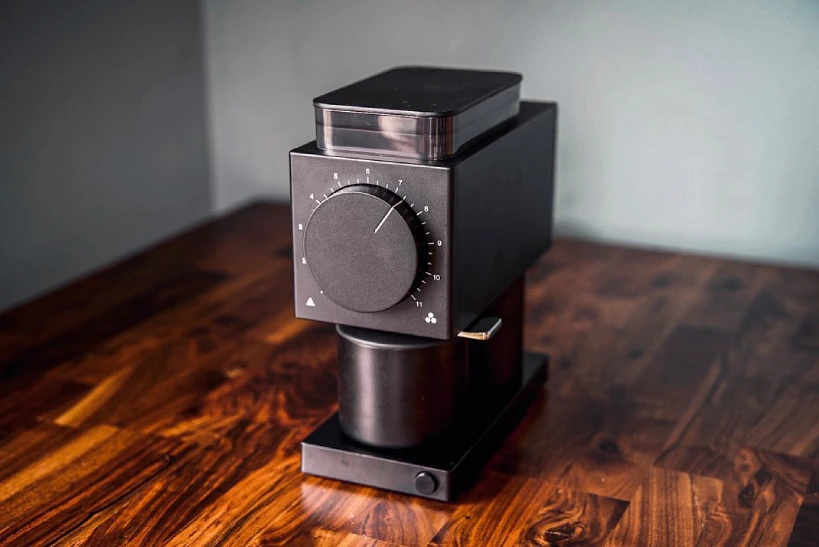
The original Ode was one of the most hyped coffee gear releases of the last decade, and unfortunately, it didn’t quite meet expectations. The new Ode Gen 2 model, however, is a whole other story. Fellow addressed all the complaints about the original and came out with something I truly believe is one of the best filter grinders on the market.
In this Fellow Ode review, I’ll discuss my experience with the new second-generation Ode, including how it differs from its predecessor and why I think it’s a substantially better buy.
What I Liked:
- New Gen 2 burrs deliver spectacular grind quality
- Easy to use with an auto-stop feature
- Relatively large 100-gram single-dose hopper
- Beautiful industrial aesthetic
What I Didn’t Like:
- Hard to get all the grounds out of the catch cup
- Power cord is weirdly stiff
The Full Fellow Ode Brew Review
I reviewed the Ode flat burr grinder when it was first released in 2020, and while I was generally impressed with the grinder, it wasn’t perfect. The workflow and design were fantastic, but the burr set left something to be desired.
I wasn’t alone in this opinion. Coffee experts around the world expressed frustration that this grinder didn’t quite meet expectations, particularly given its relatively high price tag. Fellow took note, and out came the new-and-improved Fellow Ode Gen 2 in late 2022. That’s the version I’ll be reviewing today, and I can say right up front that it’s a big step up from its predecessor.
I’ll start by explaining what’s different between the old and new models before getting into the details of using the Gen 2.
How I Rated It
-
Grinding Capability
-
Ease Of Use
-
Design
-
Durability
-
Value For Money
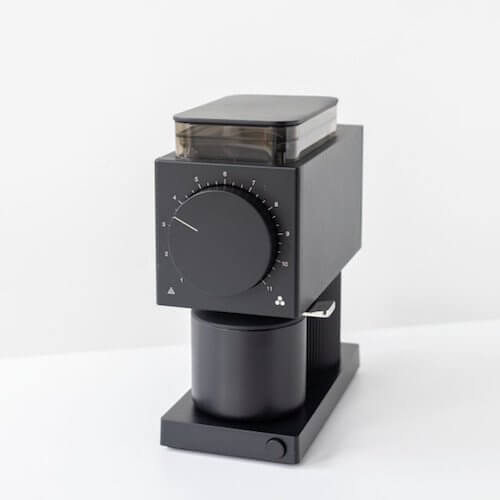
The Fellow Ode Gen 1 vs Gen 2
I assumed when Fellow released the Gen 2 in 2022 that the first generation was soon destined for retirement, but so far, they’re still selling both models. So here’s a quick rundown of key differences.
The new Gen 2 brew burrs were developed to address user complaints. They grind finer and more uniformly than the older version. While I found the Gen 1 burrs bottomed out around 600 microns, you can grind as fine as 300 microns with the Gen 2. To me, the difference was especially noticeable when brewing light roast pour overs. Beans that tasted borderline too sour with the older grinder had a much more balanced sweetness when I brewed coffee with the Gen 2.
Other notable differences include a much-improved anti-static system on the Gen 2 and an increase in hopper size from 80 to 100 grams. The larger hopper is nice if you brew with a drip coffee machine because now you can grind a full 10 cups worth of grounds in one go.
Other than that, there are a few minor aesthetic changes, and the Gen 2 comes with a 2-year warranty compared to just a year for the Gen 1 – which, to me, suggests retirement is probably still coming.
If you’re shopping for a new coffee grinder, I wouldn’t recommend buying the Gen 1. Its only advantage is a marginally lower price, but it actually gets more expensive than the Gen 2 once you upgrade the burr set. That said, if you already own the original model, I wouldn’t buy the Gen 2. Instead, I’d suggest simply upgrading to SSP burrs; the other updates are more minor.
With that out of the way, let’s talk about the Gen 2. Or you can watch Steven from Home Brews Coffee review it in this video:
What The Ode Offers: The Basics
Fellow launched the Ode on Kickstarter in 2019, which I suspect was done more to build hype than to finance production. In either case, the crowdfunding strategy was successful; they met their $200,000 goal in just 94 minutes.
The first thing you should know about this grinder is that it is for pour-over or filter coffee, not espresso. This was a deliberate design decision – and one that I definitely respect. As much as I appreciate an all-around grinder, a huge population of specialty coffee drinkers simply never need to grind fine enough espresso. They deserve a premium grinder all their own.
Too many grinders try to do both and end up doing neither well.
This Fellow grinder does an excellent job at what it is designed to do. The money that would have gone into making it espresso-capable has instead been funneled into making it the best possible brew grinder.
Electric burr coffee grinders live and die by their motor and burrs. The Ode 2’s innovative feedback-controlled PID motor and newly redeveloped 64 mm flat burr set yield incredible grind quality, among the best I’ve encountered at this price point (1).
It has 31 grind settings, and while the original Ode definitely skewed too coarse, the new model has a nice distribution. I’ve used it’s finest setting for my Moka pot and the coarsest for cold brewing. But it really excels between medium-fine and coarse, ideal for brew methods like Aeropress, V60 pour over, automatic drip coffee makers, and French press (2).
Grind Speed And Volume
The Gen 2 is impressively speedy, one of the nice perks of its relatively large burrs. It takes me less than 20 seconds to grind 30 grams of coffee to medium for a pour over brew. For comparison, the similarly priced Wilfa Uniform single-dosing grinder takes nearly a minute to do the same thing.
It’s also surprisingly quiet for such a powerful little grinder. I measured it at 82 dB with a medium roast, which is lower than most. And the sound itself is reasonably low-pitched and not unpleasant.
How fine can the Ode grind?
Can the Ode grind for espresso? I get this question quite often, and the answer is no. In my test, this grinder wasn’t able to grind fine grounds for espresso.
Even though the Gen 2 can grind substantially finer than the original, it’s still strictly a filter or brewed coffee grinder.
It can grind coffee beans to about 300 microns, which is technically suitable for espresso, but the issue is the large gap between settings. With only 31 grind size options, there is simply no way to dial in the particle size with the required precision. That said, if your espresso machine has a pressurized portafilter, you can get away with it.
How To Use The Ode Grinder
Ease of use was clearly a design priority for this grinder. Adjust the grind setting, if necessary, using the large stepped knob on the front, which feels pleasantly smooth and well-made. Weigh your beans, fill the hopper, and press start. The auto-stop feature shuts it down automatically when the bean hopper is empty.
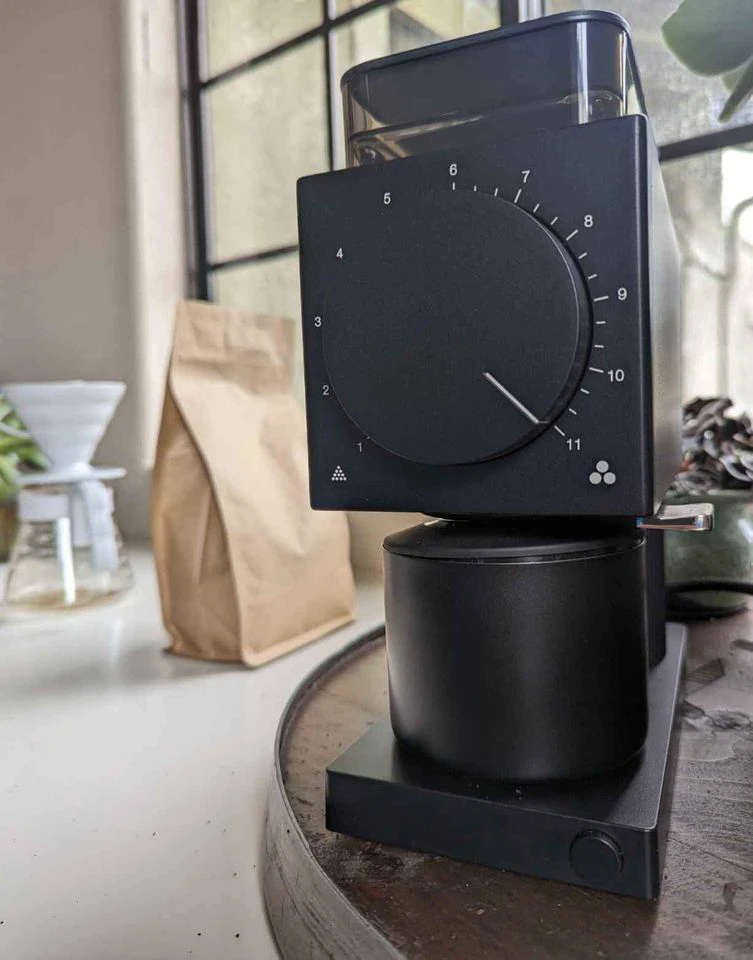
I love how the magnetized grounds’ catch cup snaps satisfyingly onto the base. I’m not as big a fan of the fins built into the cup’s interior. In theory, they funnel the grounds into a nice stream as you pour, but in practice, they tend to trap a few coffee grinds at the end.
Less Mess
I have to say that the new anti-static system in the Fellow Ode 2 is a massive improvement from the first model, which I previously considered one of the messier grinders on the market. The Gen 2 turns that completely around; it’s one of the cleanest grinders I’ve worked with. You can limit static further using the Ross Droplet Technique, but I wouldn’t say it’s mandatory the way it was with the Gen 1 (3).
The anti-static technology doesn’t get all the credit for this. I’m happy to see the knocker remains in the Gen 2. It’s a simple device that literally knocks any remaining grounds out of the chute to minimize grind retention. Most commercial grinders I’ve used have had something along these lines, and I’m happy to see Fellow add it to a home grinder.
How often should I clean my Ode?
As with most coffee gear, the frequency of cleaning depends on use. Fellow recommends cleaning this grinder every 60 cycles if you mostly grind light or medium roasts, which equates to roughly once every month or two. If you’re a fan of oily dark roasts, plan on cleaning more often.
Beautiful And Durable
The Fellow is known for aesthetically pleasing products, and the Ode brew grinder is no exception. I love its spare, industrial design and matte black or matte white finish. It manages to scream “classy” and “functional” in equal measure.
It’s a wonderfully compact grinder with a small footprint, which I think is a big part of its appeal. Single-dose grinders, in general, are smaller because they don’t need a hopper. But this grinder, in particular, has a minimalist design and clever features that mean it’s absolutely no larger than it has to be – measuring just 9.4″x 4.1″x 9.8″. That’s particularly impressive given that it has one of the largest sets of burrs among domestic brew grinders.
The Ode has only been around for a few years, so it remains to be seen how the motor holds up in the long run. But I haven’t encountered (or heard of) any serious issues with the electronics. And previous Fellow products, like the wildly popular Stagg Kettle, certainly indicate high-quality design, engineering, and fabrication. This Fellow grinder has an aluminum body and grinds cup – a key upgrade from the pastic casing of cheaper grinders – along with stainless steel burrs and plastic hopper.
The Gen 2 Ode comes with a 2-year warranty (extendable to 3 years), which is longer than the industry average of 1 year in this market segment.
Where is Ode manufactured?
Fellow is headquartered in San Francisco, CA, and the Ode is manufactured at the brand’s factory in China.
Is The Ode 2 Grinder Worth It?
The Ode 2 retails for about $300, which I think is fantastic value if you’re a pour-over coffee lover.
Now that the burr set has been improved, I can’t think of another grinder at this price that delivers this level of grind consistency and quality.
The fact that it’s beautiful, well made, and comes from a reliable (and, let’s be honest, trendy) brand is just the cherry on top.
If you want more detail on what you’re paying for you can watch Steven from Home Brews Coffee compare this grinder to a much cheaper and much more expensive grinder in this fun video. But take it with a small grain of salt because he was testing the older model at the time:
Don’t Buy The Fellow Ode If…
- You want to grind for espresso: Fellow doesn’t make a dedicated espresso grinder, but the Fellow Opus is a good all-rounder with much more fine grind size precision than the Ode.
Alternatively, spend a little more for a prosumer coffee grinder like the Niche Zero or DF64. Both are multipurpose grinders that excel in the espresso range. The former is a conical burr grinder, while the latter has flat burrs.
- You’re on a tight budget: My top pick for a filter coffee grinder on a budget has always been and continues to be the Baratza Encore. It’s a long-time favorite among coffee experts because it punches well above its price point in terms of grind quality. The trade-off is it doesn’t have a dosing mechanism; you have to stop and start the grind manually.
- You’re not interested in single-dosing: If you prefer to pour a bag of beans in a hopper rather than pulling out the coffee scale each morning, check out the Eureka Mignon Filtro, which boasts spectacular build quality and a spare aesthetic. Another option is the Baratza Vario, a good all-around grinder from a consistent brand. You can even buy a model with a built-in scale to simplify things further!
The Verdict
Thanks to an impressive array of upgrades, I am inclined to recommend the Fellow Ode Brew Grinder as my favorite home grinder for filter coffee. It delivers impeccable grind quality and consistency throughout the medium-fine to coarse grind range – all from a compact and stylish package. Though not the cheapest grinder by any means, the current pricing of this grinder is remarkably good value for any pour-over enthusiast.
References
- Avery, P. (2016, February 5). Introduction to PID Control. Retrieved from https://www.machinedesign.com/home/whitepaper/21830779/introduction-to-pid-control-pdf-download
- Koh, S. (2017, December 1). A Guide to Coffee Grind Size, Consistency, & Flavor. Retrieved from https://perfectdailygrind.com/2017/12/a-guide-to-coffee-grind-size-consistency-flavor/
- Clive Coffee. (n.d.). Reducing Static in your Grinder. Retrieved from https://clivecoffee.com/blogs/learn/reducing-static-in-your-grinder
