
Dominican Republic Coffee: Guide + The Best Brands to Try
Coffee from the Dominican Republic doesn’t get a lot of recognition on the global scene. But that’s not because it doesn’t exist or because it isn’t delicious. It’s because Dominicans like it so much that they drink most of it before the rest of the world gets a chance.
Luckily, a fraction of the country’s exceptional coffee makes it to market. So we’ve tracked down the top six. Try any of these coffee brands, and you’ll understand why Dominicans don’t want to share!
At A Glance:
- OUR TOP PICK: Volcanica Dominican Red Honey Coffee
- BEST LIGHT ROAST: Cafe Kreyol Ramirez Estate Microlot
- BUDGET PICK: Induban Gourmet Whole Roasted Coffee
The 6 Best Dominican Republic Coffees In 2026
| image | product | details | |
|---|---|---|---|
|
Volcanica Dominican Red Honey Coffee |
|
|

|
Santo Domingo |
|
|
| No products found. | Fresh Roasted Coffee Organic |
|
|
| No products found. | Cafe Kreyol Ramirez Estate Microlot |
|
|
| No products found. | Monte Perelló Whole Bean Coffee |
|
|
| No products found. | Induban Gourmet Whole Roasted Coffee |
|


Coffee from the Dominican Republic tends to be smooth, well-balanced, and easy to drink. You’ll find it with a variety of roast levels and flavor profiles. That’s great news, because no matter your taste, there’s a perfect option for you!
1. Volcanica Dominican Red Honey Coffee
Medium roast
- Strawberry, stone fruit notes
- Organic, Kosher certification
- Ground and whole bean
You can always count on Volcanica to offer high-quality coffee. They source 100% Arabica coffee from only the world’s premier growing regions, typically the slopes of volcanoes, and they always roast fresh to order. For our favorite Dominican Republic this year, check out their organic Dominican Red Honey.
The coffee beans are grown high in the hills of the northern Jarabacoa region on the famed Ramirez Estate. The beans are naturally bright flavored, and the red honey processing enhances this. Honey processing adds a sweet and fruity character (1). Volcanica expertly roasts them to medium for a smooth brew with flavors of strawberry and stone fruit and a nice hit of acidity.
With its bright but balanced flavors, this is a perfect pick-me-up coffee to start the morning. It’s very versatile, so go ahead and try it as a pour over, drip coffee, AeroPress, or even a cold brew on a summer’s day.
2. Santo Domingo
Medium roast
- Caramel, hazelnut, vanilla notes
- Kosher certification
- Ground bean
Café Santo Domingo is the child company of Industrias Banilejas S.A.S., or Induban, the biggest coffee producer in the Dominican Republic since 1945. This medium roast is infused with rich Dominican culture, which we are fortunate enough to enjoy around the world today.
This Kosher-certified coffee is ground to a medium grind. Regarding the brewing methods, it’s compatible with Drip, French press, Moka, and Pour over. We recommend refrigerating it after opening and using a ratio of 1 tbsp of coffee grounds to 1 cup of water.
With a full-bodied, nutty brew balancing inherent sweetness undertones, this blend is perfect for those who love a slight bitterness and a subtle acidity. You’ll be reminded of malt and walnut flavors along with the more prominent and heavenly-tasting notes of caramel, hazelnut, and vanilla.
3. Fresh Roasted Coffee Organic
Medium roast
- Baked apple, grapes, vanilla, spice notes
- Organic, Direct Trade, Kosher certification
- Ground and whole bean
For a classic medium roast with just a bit of quirky character, take a look at this organic and direct trade option from Fresh Roasted Coffee, consistently rated among the best coffee on Amazon. It has a mild flavor and pleasant smooth body that’s perfect for easing into your day.
The coffee beans are of the Red Caturra varietal, grown at high elevation in the Cibao region of the Dominican Republic. This is single origin coffee taken to the extreme. The beans are produced on a single-family-run farm in the area. And you can feel good knowing that the family is known locally for putting their profits back to work in their community. Additionally, it’s roasted in the U.S. using an energy-efficient Loring roaster to minimize carbon footprint.
Once brewed, the Fresh Roasted coffee is low in acidity but with a bright, fruity sweetness that distinguishes it from many medium roasts. You’ll enjoy balanced flavors of baked apple, grapes, vanilla, and spice. It’s vaguely apple cobbler but in coffee form. Perfect for sipping on a cool fall morning.
4. Cafe Kreyol Ramirez Estate Microlot
Light roast
- Stone fruit, sweet, balanced notes
- Organic, direct trade certifications
- Whole bean
Light roast coffee is known for having complex and subtle flavors. You’re tasting more of the bean itself and the characteristics of the origin, as opposed to the caramelization effects of the roasting process. With a light roast, bad coffee has nowhere to hide.
Luckily, this single-origin micro-lot Dominican coffee from Cafe Kreyol starts with exceptional beans. The beans are grown on a specific farm, the well-known Ramirez Estate in the high-elevation Jarabacoa region of the Dominican Republic. They’re certified organic, shade-grown, and red honey processed.
The result is a brightly acidic coffee with just a touch of added sweetness from the honey process.
It’s a well-balanced brew featuring flavors of stone fruit and florals and a surprisingly punchy aroma of strawberry.
Light roast Dominican Republic coffee is best showcased in a brewing method using a paper filter, which gives a clean cup that lets the coffee’s subtleties come through. Try brewing this coffee with a Chemex, Kalita Wave, Hario V60, Aeropress, or drip coffee machine.
5. Monte Perelló Whole Bean Coffee
Medium roast
- Honey, vanilla, caramel
- Kosher certification
- Whole bean
Check out Monte Perelló medium-roast coffee for a sweet, rich, and bright espresso. Monte Perelló is a premium sub-brand of the well-known Cafe Santo Domingo. This is the biggest coffee brand in the Dominican Republic, which is why it’s beloved by Dominicans and coffee lovers everywhere. Yet it’s shipped worldwide.
The Monte Perelló coffee is a carefully crafted blend from two of the company’s plantations. It combines Arabica coffee from the center of the country with Conilon coffee from the west. The result is a beautifully balanced brew with a round body and gentle acidity.
Any brewing method will work with this coffee. We especially loved it ground extra fine and prepared as an espresso or Americano. It’s pleasantly sweet with flavor notes of honey, caramel, and floral vanilla. The thick crema layer enhances the naturally creamy mouthfeel. It’s a modern-style espresso, far less bitter than traditional dark roast Italian blends (3).
6. Induban Gourmet Whole Roasted Coffee
Medium roast
- Almond, chocolate, caramel notes
- Kosher, Strictly High Grown certifications
- Whole bean
This is a versatile medium roast coffee. It features crowd-pleasing flavors of chocolate, almonds, and caramel, perfectly balanced with a hint of fruity acidity. It does well in every brewing method, from espresso to Chemex, and tastes as delicious black as it does with milk.
These 100% Arabica beans are certified Strictly High Grown, a designation that guarantees all were cultivated at elevations above 1000 meters. These conditions slow growth, ensuring denser and more flavorful coffee beans.
We love that these beans are so reasonably priced, making them an affordable way to sample Dominican Republic coffee. Heavy coffee drinkers can save even more by buying two or three pounds at a time. But if you’re going this route, invest in a good coffee canister and try not to buy more than you will consume in a month.
How to Choose the Best Dominican Republic Coffee
Coffee is grown throughout the Dominican Republic, which means you’ll have lots of flavor profiles to choose from because each region has a unique environment. You’ll also want to consider roast level, certifications, and whether or not you wish to grind your coffee.
Sound confusing? Don’t worry. This buyer’s guide is here to walk you through it.
Coffee Growing Regions and Flavor Profiles
The Dominican Republic occupies the eastern half of the island of Hispaniola, which it shares with Haiti. Both countries share a beautiful landscape, rich farmland, and an often underappreciated coffee production industry.
Though it’s a small country, the Dominican Republic produces a surprisingly diverse selection of coffee. It has six central coffee-growing regions spread across four mountain ranges. They’re scattered throughout the country, each with a specific altitude, soil, and microclimate contributing distinct flavors.
The government recognizes the officially delegated regions of the Cibao Valley, Bani, Azua, San Jose de Ocoa, Barahona, and Juncalito. However, small farms exist in many less prominent areas as well.
Most Dominican Republic coffee farms are small, at less than 3 hectares each, and family-run. The plants are typically shade-grown, thriving under a canopy of macadamia and guava trees. The main varietals of Arabica coffee you’ll encounter are Typica, Caturra, Catuaí, Bourbon, and Mundo Novo. Robusta beans are also grown, but they’re relatively rare and never exported (4).
Most coffee beans grown in the Dominican Republic are wet-processed (also known as washed processed), which means that they remove coffee cherry fruit before drying. Washed coffees tend to be cleaner tasting and are more consistent in their flavors than dry-processed coffee.
Honey processing is also popular in the country. In this case, some of the coffee fruit remains during the drying process. It’s more difficult to control than wet processing.
When done well, honey processing contributes a sweet character to the final coffee.
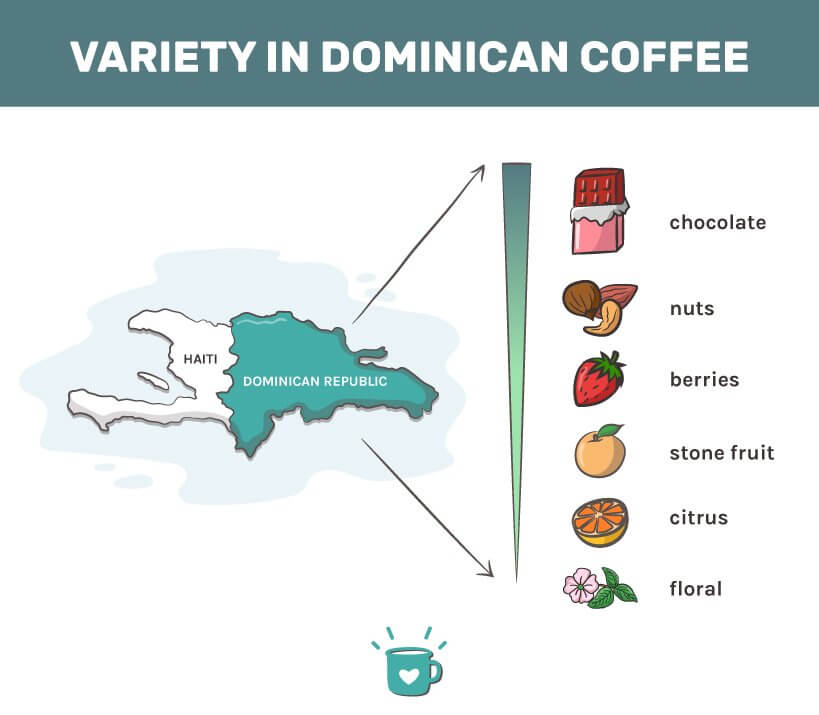
Because the Dominican Republic has such a diversity of growing conditions, it’s hard to assign a specific flavor to coffee from the country.
The Dominican Republic’s variable weather and coffee varietals make for an equally variable finished cup, depending on where the beans were grown and how they were roasted.
You’ll find earthy, nutty, sweet, and full-bodied coffees that make excellent espresso in some regions. In others, you’ll find bright, fruity, and acidic coffees that are fantastic brewed as a pour over.
Your Favorite Roast is the Right Roast.
Dominican Republic coffee tends to be well-balanced and clean in flavor, similar to Central American origins like Mexico, Nicaragua, and Guatemala, so it takes well to pretty much any roast level. On top of that, the diversity of coffee growing regions means that different coffee beans from within the country may be best highlighted with a particular roast.
As a consumer, this is great news!
You don’t have to adapt your tastes to enjoy the best Dominican Republic coffee. Whether you prefer a fruity light roast or a chocolatey dark roast, there’s already a brand to meet your needs.
Coffee Certifications Matter But Not Too Much.
If you’re a conscious consumer, there’s a good chance you’re checking your bag of coffee beans for labels like Organic or Fair Trade. Good for you! It’s important to care about the environmental and socioeconomic conditions at coffee’s origin.
These certifications can indeed be a reliable way of knowing how your Dominican Republic coffee was grown and marketed. That said, they aren’t a substitute for doing a bit of research into the brand you plan to support.
For example, many different organizations can award a Fair Trade type of certification, each with their criteria. A direct trade model is a better system for both consumers and producers in many cases.
In direct trade, for which there is no certification, producers, and importers negotiate directly, cutting out the certifying middle man. This promotes better prices for farmers and better quality beans for Dominican coffee lovers (5).
A number of importers and exporters in the coffee business are saying we can get more money into the pockets of farmers through direct trade than if we use the Fairtrade Labelling Organizations model.
While the definition of Organic is a bit more precise than that of Fair Trade, it also falls out of favor as a priority for specialty coffee companies. Often small farmers are sustainably growing coffee beans and simply lack the resources to obtain official certification.
Grind Your Own Beans When Possible.
The best way to ensure your coffee is as fresh and flavorful as possible is to grind it yourself right before brewing. So where possible, we always advise that you buy whole coffee beans. This is particularly important with lighter roasts, which tend to have milder flavors quickly lost as the coffee goes stale.
However, not everyone has the time or money for grinding at home, and buying ground Dominican Republic coffee isn’t the worst thing in the world, especially for bold and powerful darker roasts. Look for brands that turn over their stock quickly or, better yet, grind fresh to order. Try to buy in smaller quantities, and store your coffee in a proper coffee canister in a cool place to keep it tasting fresh.
The Verdict
The Dominican Republic doesn’t get a lot of press on the world stage as a coffee-producing nation. But as it turns out, that’s not because they don’t grow great coffee; it’s because they drink most of it themselves!
With a diversity of growing regions, microclimates, and varietals, there is a Dominican coffee that will suit any coffee lover, whether you’re in search of a chocolatey espresso or a fruity pour over brew.
FAQs
Dominicans drink coffee in a variety of ways. They don’t have any specific national beverage. It is common to see coffee consumed black with sugar at home, often brewed in a Moka pot. At the cafe, cafe con Leche and Americano are popular orders.
In 2013, nearly half a million bags of coffee beans were grown in the Dominican Republic or around 66 million pounds. However, only about 20% is destined for export, which means the Dominican Republic makes up less than 1% of the global coffee market.
Coffee from Haiti is excellent. Despite the country’s economic woes, it produces some exceptional coffee beans. That said, quality can vary widely, so it is crucial to find a reliable brand. At its best, Haitian coffee is rich, well-rounded, and full-bodied.
References
- Kilbride, D. (2017, February 23). Honey Processed Coffee: What’s the Difference Between Yellow, Red, & Black? Retrieved from https://perfectdailygrind.com/2017/02/yellow-red-black-honey-processed-coffees-whats-the-difference/
- Berry, J. (2019, September 18). What are nootropics (smart drugs)? Retrieved from https://www.medicalnewstoday.com/articles/326379
- Poggioli, S. (2017, July 14). Italy’s Coffee Culture Brims With Rituals and Mysterious Rules. Retrieved from https://www.npr.org/sections/thesalt/2017/07/14/535638587/italys-coffee-culture-brims-with-rituals-and-mysterious-rules
- Fedenia, L. (2017, March 30). Diving into Domonican Coffee Production. Retrieved from https://freshcup.com/diving-into-dominican-coffee-production/
- Haight, C. (2011). The Problem With Fair Trade Coffee. Retrieved from https://ssir.org/articles/entry/the_problem_with_fair_trade_coffee
