
BEST CAPPUCCINO MAKERS OF 2026: 6 TOP PICKS FOR HOME USE
Your search for the best cappuccino maker will end here. I picked the best machines from Breville and Philips to Rancilio companies. Buckle up.

If you’re a cappuccino fan and want a decent machine, you have probably searched dozens of options. Googling gives you well over 2 million cappuccino maker reviews – a mountain of needless research and information. That’s why I’ve done the heavy lifting for you.
At A Glance:
- Top pick: Breville Barista Express
- Best super-automatic: Philips 4300 with LatteGo
- Great bargain: De’Longhi EC155
Our team has tested dozens of the best coffee, espresso, and cappuccino machines over the years – and the worst. So we know exactly what to look for and what to avoid.
This list of the best cappuccino machine for home results from our combined expertise, and it’s sure to have the right cappuccino maker for you.
The 6 Best Cappuccino Makers On The Market In 2026
| IMAGE | PRODUCTS | DETAILS | |
|---|---|---|---|
| No products found. | Breville Barista Express |
|
|
| No products found. | De’Longhi EC155 Espresso and Cappuccino Maker |
|
|

|
Rancilio Silvia M |
|
|
| No products found. | Breville Bambino Plus |
|
|

|
Philips 4300 |
|
|
| No products found. | Mr. Coffee Cafe Barista |
|


First off, let’s clarify that this is a review of cappuccino makers, not espresso machines – even if there is some overlap between the two. Some espresso machines come without a way to froth milk, which is useless to the serious cappuccino fan.
Our focus here is to help you find the best cappuccino maker. If you’re more interested in the best espresso, check out this round-up of the best home espresso machines.
1. Breville Barista Express
Machine type: Automatic
- Milk system: Manual steam wand
- Water tank: 67.6 ounces
- Built-in grinder: Yes
The Breville BES870XL Barista Express is an incredible mid-range option that has topped “Best Of” lists for years. Its balance of quality, ease of use, and low price is unique on the market and make it an easy choice for my favorite cappuccino maker of the year.
I chose this model for its combination of automation and user control. Unlike fully automated machines, you can’t get a cappuccino at the press of a button. But the trade-off is the potential for superior cappuccinos.
It was satisfying watching the quality of my drinks improve as my skills developed. And don’t worry, the learning curve is short!
The Barista Express has a manually operated steam wand. It’s very intuitive to use, and I appreciated that its 360-degree swivel made it easy to find a comfortable angle for steaming. It isn’t the fastest, taking over a minute to froth 6 ounces of milk in our tests, but this relatively slow rate makes it more approachable for beginners. It only took me a few attempts to master the perfect airy cappuccino froth.
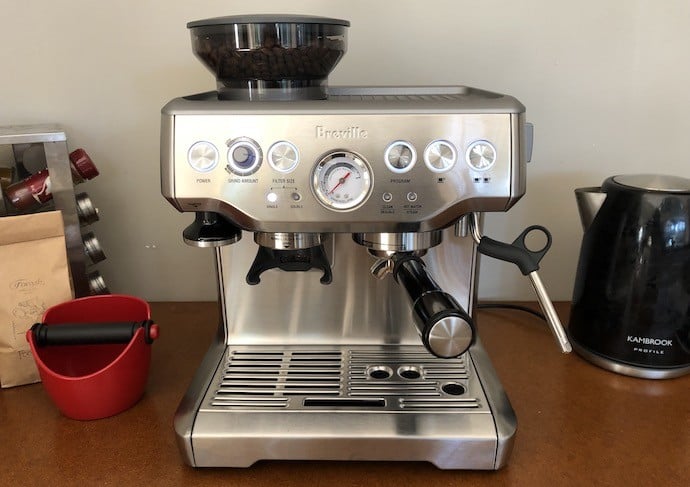
This machine is truly quality-made, especially at this price range. I love that it includes a built-in grinder, a metal tamper, and a stainless milk frothing pitcher. So even if you’re new to making cappuccinos at home, you have all the necessary accessories to get started.
This unit is particularly tall because of the grinder hopper, standing at nearly 16 inches. Make sure you measure your space before you buy.
Related: We compared two of the most popular espresso machine manufacturers in this Breville vs Delonghi article.
Pros:
- Gives you more control over the process
- High quality at a reasonable price
- 360-degree swivel-action steam wand is perfect for cappuccinos
Cons:
- Short learning curve to operate
2. De’Longhi EC155 Espresso and Cappuccino Maker
Machine type: Semi-automatic
- Milk system: Manual steam wand with frothing aid
- Water tank: 33.8 ounces
- Built-in grinder: No
The second cappuccino maker on our list comes from De’Longhi, a reputable company in the coffee space. I always advise sticking to well-known brands when buying cheaper machines. They benefit from the company’s experience and usually have better customer service and warranty policies should something go wrong.
The EC155 Espresso and Cappuccino Maker is an excellent semi-automatic machine for any budding coffee enthusiast who wants a quality cappuccino at an affordable price. It has the features you need to craft a quality drink with no cost-increasing extras – a good pump, a reliable heater, and a manual steam wand.
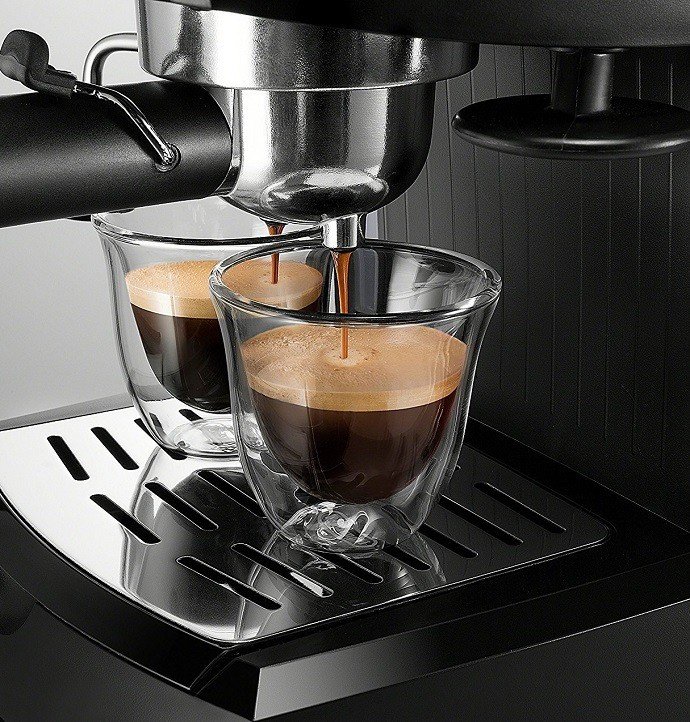
Speaking of the heater, this espresso machine delivered remarkably stable brew water temperature in our tests, averaging 198 F and fluctuating only a few degrees. This surprised me coming from a budget machine, and it’s a big part of what landed it on the list. Stable brew temperature means better extraction and more flavorful espresso.
The EC155 steam wand is equipped with a frothing aid. I’m usually not a frothing aid fan, but it makes sense in this case. Frothing aids help beginners incorporate air into the milk while steaming and are especially useful in relatively low–steam-power machines like this. While they make it difficult to achieve creamy microfoam for a latte, they ensure lovely foamy cappuccino froth.
And did we mention it’s small? Because it is. Very small. Under a foot in every direction, the EC155 is the perfect size to fit snuggled up on your counter. Just keep in mind it’s hard to brew into anything larger than an espresso cup.
Pros:
- Frothing aid makes it easy to make cappuccino foam
- Affordable price
- Compact size
Cons:
- Doesn’t fit larger mugs
- Cheap plastic exterior
3. Rancilio Silvia M
Machine type: Semi-automatic
- Milk system: Commercial-style steam wand
- Water tank:
- Built-in grinder: No


This is the first machine on our list that begins to move you out of the realm of the beginner into the more nuanced stages of your espresso journey. Its build quality, including many commercial-grade components, puts it in the league of prosumer espresso machines. I definitely suggest pairing it with a good burr grinder to maximize its potential to make great espresso.
The Rancilio Silvia is a semi-automatic espresso maker that comes backed by the quality of an iconic Italian brand (1). It gives you complete control over the cappuccino-making process as you learn puck prep, pulling an espresso shot, and milk frothing. True, it has the largest learning curve of any machine on this list, but it also makes the best cappuccinos. It was the hands-down winner in our taste tests.


The Silvia also took the win in our milk steaming tests. Compared with the thermoblock machines on this list, the Silvia’s boiler delivers far more steam power and drier steam, making it faster and easier to prepare perfect milk foam. It was more than twice as fast as the Barista Express when steaming 6 ounces of milk.
The Silvia is known for its durability, with many of the same high-quality stainless steel components found in Rancilio’s commercial machines. I often describe it as “built like a tank,” so expect many years of service from a relatively modest investment. Unfortunately, its aesthetics are also rather tank-like.
By the way, if you really want to make cafe-quality cappuccinos, consider spending a bit more for the Rancilio Silvia Pro, a double boiler version of the Silvia which can brew espresso and steam simultaneously.
Pros:
- Makes cafe-quality latte or cappuccino
- Comes with a commercial-style steam wand
- Iconic brand in the coffee community
Cons:
- Takes time to learn to use
- Not the best looking
4. Breville Bambino Plus
Machine type: Automatic
- Milk system: Automatic steam wand
- Water tank: 64.2 ounces
- Built-in grinder: No
The Breville Bambino Plus is already one of my favorite espresso machines thanks to the impressive features it offers at an affordable price, including programmable pre-infusion and PID temperature control. In fact, I also recommend it as the best espresso machine for beginners. But let’s talk about the functions for cappuccino lovers in particular.
The Bambino Plus cappuccino and latte maker is what I have at home and use daily. I bought it mainly because of the high praise of its automatic steam wand from James Hoffmann, former World Barista Champion (2). He knows what he’s talking about; the quality of milk froth I get at the press of a button is a huge step up from most automatic frothers.


You can customize the milk by choosing between three milk textures – from airy cappuccino foam to creamy microfoam for a latte – and three temperatures. In my tests, the three temperatures were exactly as advertised at 130 F, 140 F, and 150 F, facilitated by a temperature sensor built into the drip tray. The steam wand automatically purges after every use to keep things hygienic.
The Bambino Plus includes Breville’s brand-new ThermoJet heating system, an upgrade from the older Barista Express ThermoBlock. It heats up in just 3 seconds. This is handy for getting my morning off to a speedy start, but the hidden perk is that there is virtually no wait time between brewing and steaming. It’s the next best thing to a dual boiler.
All this is packed into a slim and attractive machine available in a series of colors to suit any decor – and for less than $500!
Pros:
- Simple to use the machine
- Can control milk texture and temperature
- Compact and attractive design
Cons:
- Mostly plastic exterior
5. Philips 4300
Machine type: Super-automatic
- Milk system: LatteGo frothing carafe
- Water tank: 60 ounces
- Built-in grinder: Yes
Philips makes a series of super-automatic espresso machines, with the 4300 at the top of the line. I chose it as the best fully automatic cappuccino maker because it allows a reasonable amount of control over the cappuccino while still offering the convenience of a one-touch brew.
At first glance, I thought the number of options on the 4300 might be overkill, making it harder to use than necessary. But the 2” full-color display and menu navigation were intuitive. I could easily access the eight pre-programmed drinks (espresso, black coffee, Americano, cappuccino, latte macchiato, café au lait, caffé crema, and ristretto) and customize them to my heart’s content.
The built-in burr grinder has 12 grind settings – not quite as many as the Barista Express’s 16 but enough to dial in an espresso. I could choose between five coffee strengths, from mild to robust, and set the brew temperature at one of three settings between 90 and 98 °C – the ideal range as recommended by the Specialty Coffee Association (3). My tests showed the brew temperatures to be reasonably accurate, and tasters confirmed they noticed the differences in temperature at the three settings.
What about the milk frothing? The patented LatteGo Milk System produces creamy frothed or steamed milk at the press of a button. I wish there was an option to adjust milk temperature, but at least it prepares it just right – within 5 degrees of 140 F in my tests.
More importantly, the LatteGo system is super easy to clean, a rarity among super automatic machines. There are no pipes or tubes to collect stale milk; instead, the entire frothing system pops into two dishwasher-safe pieces. Plus, the milk carafe can be stored in the fridge between uses to avoid waste.
Pros:
- Built-in grinder
- Customizable brew strength and temperature
- Easy-to-clean milk system
Cons:
- Plastic build
- Can’t set milk temperature
6. Mr. Coffee Cafe Barista
Machine type: Super-automatic
- Milk system: Automatic frothing carafe
- Water tank: 40 ounces
- Built-in grinder: No
This last unit screams affordability and convenience, making it a great way to kick off your journey as a home barista. As a fully automatic espresso machine, the Cafe Barista does almost everything for you, while still teaching you the components and process of cappuccino-making.
Once the portafilter is set, the rest of the process is as simple as a push of the cappuccino button. Because this machine uses a pressurized portafilter, you can get away with using pre-ground coffee if you haven’t yet invested in a quality burr grinder – though I suggest you do that ASAP. The machine automatically brews the coffee and froths the milk for you, providing the drink quickly and with minimal hassle.
The Cafe Barista makes a delicious but not outstanding cappuccino, certainly an improvement over a Nespresso pod. In our taste tests, tasters described the espresso as “bold” and “rich” but lacking in complexity. I’d stick to medium and dark roasts for the best results. Likewise, I found the milk was sweet and frothy but lacked the traditional cappuccino layers of steamed milk and foam.
This is an entry-level machine, as reflected in its price and quality, which is why I recommend it for beginners. It likely won’t last more than three years, but you’ll learn so much in that time you’ll be ready to take your cappuccinos to the next level by then anyway!
Read our Mr. Coffee Cafe Barista review for more details on its performance.
Pros:
- Affordable and easy to use
- Has a removable milk reservoir that can be stored in the fridge
- Comes with a recipe book
Cons:
- A low-end option with few features
- Less durable for long-term or heavy use
How I Tested These Cappuccino Machines
A good cappuccino has two components, perfectly frothed milk and a delicious rich shot of espresso. It’s important not to overlook either when buying a cappuccino maker.
Espresso Quality Testing
When considering espresso, we used a thermocouple to test brew water temperature and stability – the two most important factors in delivering consistently high-quality shots. We also noted additional features that can enhance espresso quality, including flow control/adjustable brew pressure, automatic or programmable preinfusion, and (where applicable) the quality of the built-in grinder.
Blind taste tests were then conducted using three team members. The same medium-dark roast coffee beans were used in every case. The fully automatic machines were used in their default settings, while the hands-on machines were properly dialed in before tasting.
Milk Froth Quality Testing
We timed how long it took to froth 6 ounces of dairy milk with every machine. For super-automatic machines, we also tested the final milk temperature and froth quality. For machines with a steam wand, those factors are in the hands of the user, but we considered how easy it was to achieve ideal milk temperature and texture for beginners and experienced users.
We also tested every machine with oat milk, as non-dairy alternatives are becoming increasingly popular.
The results of the froth tests were combined with espresso to conduct cappuccino taste tests, which were again done by a minimum of three team members. We did all our taste tests with whole milk.
Other Factors
We also considered additional factors like which machines were easier to use, heat-up time, time lag when switching between brewing and steaming, and noise level. Finally, we researched build quality, brand reputation, customer service, and included warranty. Because a machine that makes great cappuccino but dies in a year or causes constant frustration isn’t the best choice in our book.
Why Buy A Cappuccino Maker?
The best reason to buy a cappuccino maker for your home is because you love cappuccinos and aspire to master the craft. You’ll have fun experimenting with different espresso profiles and milk textures and exploring other espresso-based drinks like the mocha or flat white.
Cappuccinos also tend to be one of the most expensive coffee shop drinks. So buying a cappuccino maker, even if it seems pricey initially, may save you a lot of money in the long run.
Can You Make A Cappuccino Without A Machine?
You can make something reasonably close to a cappuccino without a machine, but it won’t live up to the real deal.
To make cappuccinos at home without a machine, start with 2 ounces of strong coffee prepared with a French press, Aeropress, Moka pot coffee maker, or a pod machine like Nespresso. It won’t have the same full body or thick crema as true espresso, but it will deliver the rich flavor you need. Then, froth milk using an automatic or handheld milk frother, a French press, or even a mason jar.
How To Choose Your Home Cappuccino Maker
Choosing a home cappuccino maker isn’t as easy as just looking for the outright best; it’s about finding the model that meets your needs, budget, and skills. Here are some things to consider before you buy.
Know Your Skill Level
This is an easy factor to overlook while you’re shopping, but it’s an important one. Don’t bite off more than you can chew (or maybe we should say… don’t drink more than you can swallow).
Find a machine that fits your current skill level or challenges you reasonably. Buying an overly complicated machine if you’re new to making espresso might just leave you feeling discouraged and full of sub-par cappuccinos. I suggest beginners choose machines for home use that adapt as they learn. Look for automatic machines with manual espresso machine options, for example.
On the other hand, if you’re an old pro, consider a machine that will give you more control to take advantage of your skills and experience.
Cost: The Almighty Dollar
Money is a factor for most of us. Establish a budget before you start shopping. No cappuccino maker is worth sacrificing rent money, and there are wonderful options at every price range.
If you’re just starting out, don’t drop big bucks on a fancy machine that you won’t be able to capitalize on, unless you really want to commit to learning the craft. If you’ve used a skimpy machine for years, see if you can set a budget big enough for a machine that will take your skills to the next level.
Remember that the upfront price doesn’t always tell the whole story. Cost usually reflects build quality and longevity; expensive machines last longer and cause fewer frustrations. And don’t forget to factor in the cost savings of skipping the regular Starbucks visit!
What Are The Different Types Of Espresso Machines?
The different types of espresso machines are manual, semi-automatic, automatic, and super-automatic. Understanding the differences and determining which style you want is important because each can meet different needs.
While we love a classic lever or manual machine, they are generally not the best idea for making a cappuccino. They take time and experience and often don’t include a milk frothing option. This list will focus on the various automatic options, as they come equipped with the tools you’ll need to whip up a delicious cappuccino from start to finish.
- A semi-automatic espresso machine gives you the most control. You prepare the portafilter, start and stop pulling the espresso shot, and steam the milk for your cappuccino. They are usually the most affordable option, but semi-automatic cappuccino machines require time to learn how to use.
- An automatic espresso machine is similar to a semi-automatic, but it takes shot timing out of your hands. Instead, you pre-program the desired shot volume and press a button to get your espresso. You’ll still need to prepare the portafilter and froth milk. They offer a nice balance between price and ease of use.
- A super automatic espresso machine (aka fully automatic machine) does it all, often including grinding the coffee beans and prepping the espresso puck. Many allow you to get an entire cappuccino prepared at a press of a button. They also tend to be the most expensive. And because the user isn’t involved, you’ll have no chance to improve your coffee drink by practicing your techniques.
What’s The Deal With Built-In Grinders?
Grinding your coffee with a good burr grinder is crucial if you want to make the perfect cappuccino. If you don’t already own a coffee grinder, plan to budget for a cappuccino machine and a grinder or buy a machine with an integrated burr grinder.
A separate grinder generally gives you more flexibility. It isn’t confined to your cappuccino maker; you can also use it for your coffee machine. It also gives you the freedom to explore different brands, styles, and price ranges to find what you want.
A built-in grinder is convenient if you only need to grind for your cappuccinos. With many super-automatic cappuccino machines, a built-in grinder means just adding beans and pressing a button to prepare your drink. They can also be space-saving and usually cost less than buying a separate electric grinder.
How Many Bars Of Pressure Should A Cappuccino Machine Have?
Tradition states that it requires about 9 bars of pressure at the group head to pull a proper espresso shot, though modern baristas are experimenting more and more (4).
To achieve an espresso shot that is neither weak nor bitter, nine bars is typically seen as the rule-of-thumb.
But you don’t need to worry too much about this when shopping. Most machines go above and beyond, advertising 15 or 19-bar pumps. It all works out the same when the water hits the ground coffee.
Avoid machines that use steam pressure rather than a pump unless you’re really on a tight budget. They usually max out around 4 bars, enough for a nice strong cup of coffee, but not an espresso.
What’s The Difference Between A Cappuccino And An Espresso Machine?
A cappuccino machine can be thought of as a subset of espresso machines. Automatic cappuccino machines need to be able to make espresso, certainly, but they also need to produce the airy froth that defines a cappuccino.
Do Espresso Machines Make Cappuccinos?
Many espresso machines can be used to make a good cappuccino, but not all of them.
To make a cappuccino, the espresso machine must have a means of frothing milk – either a steam wand or an automated milk frother.
If you have an espresso machine without a milk system, you don’t need to buy a separate cappuccino maker unless you really want a one-touch drink. You can just buy a milk frother to pair with your espresso maker for your cappuccino fix.
What Is A Cappuccino?
You’re looking for a cappuccino maker, so you likely have a pretty good idea of the drink. But just to be clear, a traditional Italian cappuccino is one part espresso, one part steamed milk, and one part milk foam (5). It’s usually a 6-ounce drink and is served in a wide cappuccino cup.
Want more detail and a recipe? Read our complete cappuccino recipe.
What’s The Difference Between An Espresso, Cappuccino, And Latte?
Confused by the many Italian espresso drinks? I don’t blame you, especially given how they’ve evolved. Every coffee shop seems to have its own version.
Here’s a quick rundown:
- A single espresso is a 1-ounce shot of coffee extracted at high pressure. It doesn’t include milk.
- A cappuccino is a drink with a 1:1:1 ratio between espresso, steamed milk, and milk foam.
- A latte is a drink with a 1:2 ratio between espresso and steamed milk, capped with just a thin layer of milk foam.
Once you’ve mastered those basics, learn the difference between flat white vs cappuccino.
The Verdict
Each of the models on this list of the best home cappuccino machines is excellent in its own way and could easily be best suited for you. Our choice for the overall top cappuccino maker is the Breville BES870XL Barista Express Espresso Machine, which we think will appeal to most cappuccino lovers.
This machine answers the needs of beginners and experts alike, combining high-quality espresso, a premium build, and easy-to-use features. It allows enough control to keep you a part of the process and improve your barista skills while including user-friendly options like volumetric dosing and a built-in grinder.
FAQs
No, you can’t make coffee with an espresso machine, other than rare exceptions like the Decent Espresso Machine. However, cappuccino and espresso machines can make drinks like a long black or an Americano – espresso diluted with hot water – that are very similar to brewed coffee.
Cheap espresso machines are worth it when you buy them from reputable brands like Breville or De’Longhi. Even the cheapest models benefit from the brands’ expertise in these cases. They know where to cut corners without sacrificing user experience. But stay away from cheap Amazon knock-offs. They’ll only cause you grief, and you’ll spend more replacing them.
You can use any kind of espresso you enjoy for a cappuccino. It’s traditional to use darker roasts, often blended with Robusta beans, because the bolder coffee flavor is better paired with the large quantity of frothed milk (6). But it’s by no means mandatory.
References
- Stamp, J. (2012, June 19). The Long History of the Espresso Machine. Retrieved from https://www.smithsonianmag.com/arts-culture/the-long-history-of-the-espresso-machine-126012814/
- James Hoffman. (2020, September 18). The Best Espresso Machine Under £500 [Video]. YouTube. Retrieved from https://www.youtube.com/watch?v=7HIGdYy5of4
- Specialty Coffee Association. (n.d.). Protocols & Best Practices. Retrieved from https://sca.coffee/research/protocols-best-practices
- Lapierre, F. (2022, October 13). Feeling the pressure: Why baristas are ditching the 9-bar standard for espresso. Retrieved from https://newgroundmag.com/2022/10/baristas-ditching-9-bar-standard-espresso/
- McNamee, G.L. (2022, October 29). Cappuccino. Retrieved from https://www.britannica.com/topic/cappuccino
- Lavazza Team. (n.d.). Italian Style Coffee: From Espresso to Cappuccino. Retrieved from https://www.lavazzausa.com/en/recipes-and-coffee-hacks/italian-style-coffee-history-types-culture
